


A fire that burns evenly for an hour
Flame-grilled salmon needs a tall, steady flame for a long time. Here's how to build the fire, choose wood and keep it going without it collapsing.
Read about lighting a fireA side of salmon, a plank and a fire that heats from the side
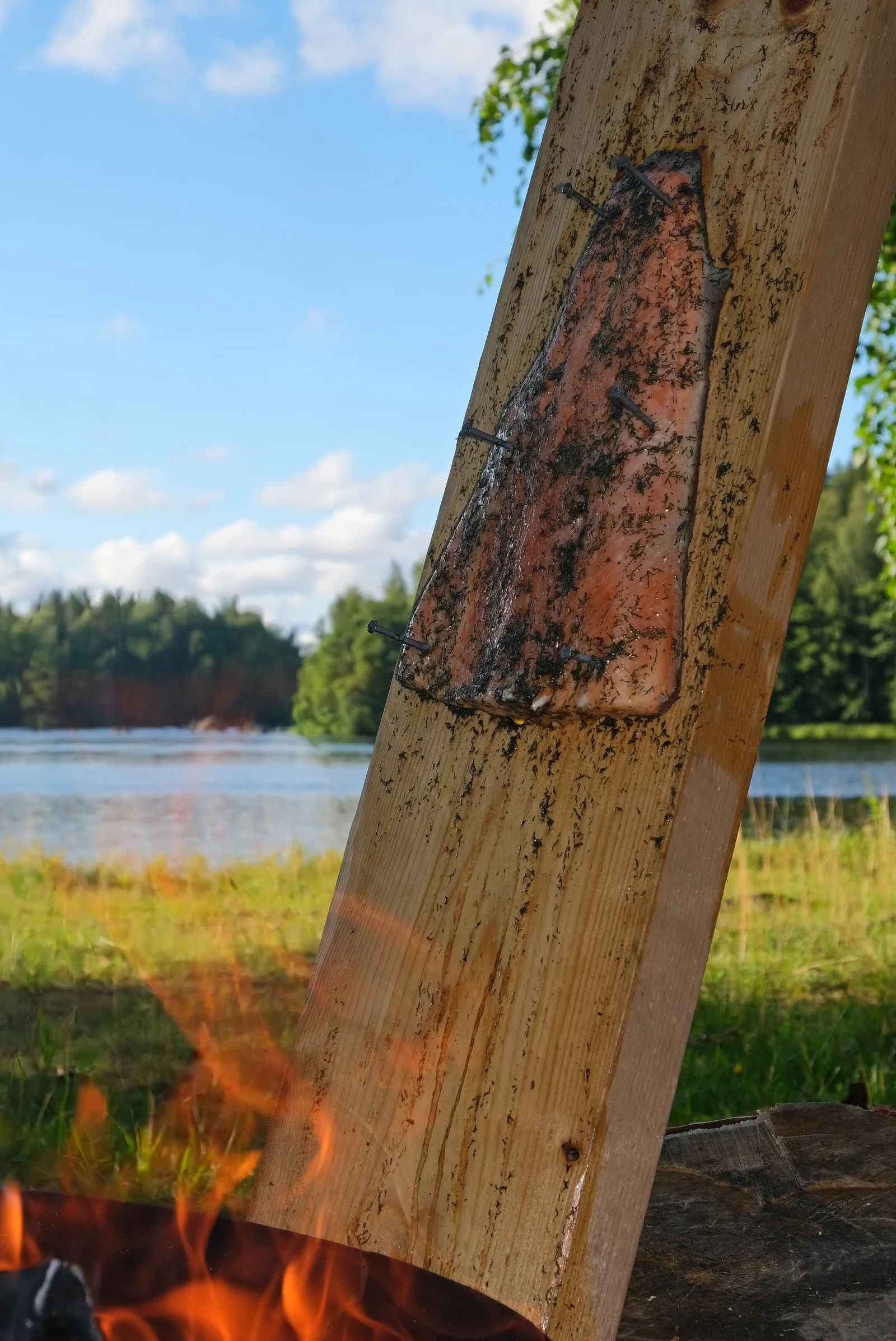
The fire is tall and wide, and you can feel the heat two metres away. At the edge, a pale plank leans against a couple of stones, with a whole side of salmon fixed to it with small wooden pegs. No pan, no grill. Just fish, wood and a wall of flames that slowly turns the salmon glossy and golden at the edges.
This is Finnish loimulohi, flame-grilled salmon. The fish never sits over the fire – it stands beside it and is cooked by the radiant heat, a bit like in front of an open fireplace. It needs a bigger fire and more patience than a pan, but it's one of the simplest ways to cook a whole fish for a crowd. It all comes down to three things: the right plank, the right distance, and moving the plank rather than the fire.
Have you made this recipe? Rate it
0.0 out of 5 · 0 votes
out of 5
vote
votes
Be the first to rate this recipe.
Thanks for your vote!
Your vote could not be saved right now. Please try again later.
 🔥 Over fire
 🔥 Over fire
 🔥 Over fire
 🔥 Over fire
The plank. It must be untreated: no pressure-treated, painted, varnished, oiled or glued wood, and never offcuts from a building site where you don't know what has happened to them. Wood preservatives and paint give off substances that shouldn't get into food when the wood heats up. Alder is often considered the best, and birch, aspen and beech work well too. But an ordinary planed board of spruce or pine is also widely used in Finland, and you can buy ready-made spruce loimu planks. Choose a piece without large knots or resin pockets. A planed surface makes it easier to free the fish afterwards.
Put the plank in water an hour beforehand – in a lake, a stream or a bath at home. A wet plank doesn't char as easily at the edges. The same plank can be used several times if it's scrubbed and dried properly in between.
The pegs. Wooden pegs are the traditional choice and the best. Metal nails conduct heat into the fish, cook the flesh around them and can make the fish come loose and fall into the ash as it softens. You whittle pegs from a dry hardwood stick about as thick as a pencil, with a pointed end. Drill the holes in advance so you don't split the plank. How to whittle safely and which wood is suitable is covered in whittling a roasting stick and a tripod. If you don't have time to whittle, stainless steel nails will do, but they also get hot and the fish around them cooks faster. Don't use galvanised building nails – they're made for timber, not for food.
The fire. This method needs flames, not embers. Build a wide, tall fire that can burn steadily for an hour, and start at least half an hour before the fish goes on. Hardwood gives more even heat and less soot than softwood. The basics of building a fire and keeping it going are in lighting a fire, and choosing firewood in fire skills and tips.
If you'd rather lay the plank over embers, fish side up, that's a different method. You'll find it in meat and fish on a plank over embers.
At home you do the things that take time: pull the pin bones out of the side of salmon with tweezers, soak the plank and whittle the pegs. Salt the salmon an hour before you set off, or the evening before if you're going far. The salt draws out a little liquid and gives firmer flesh that stays on the plank better. Put the salted side in a bag in the cool box with ice packs.
Salmon is a chilled food and must be kept cold until the last minute. In summer heat it shouldn't sit out for more than two hours in total, and never in the sun. Only take it out once the fire is ready. How to keep raw fish and cooked food apart outdoors, and wash up afterwards, is covered in hygiene and washing up outdoors.
The distance. There's no exact measurement, because it depends on how big the fire is. That's why the hand test is so useful. As a rough guide, a smaller fire may need 25–30 centimetres and a proper bonfire almost a metre. The important thing is that the flames never reach the fish. If they do, it gets sooty, the surface burns before the inside is done, and more of the substances that Livsmedelsverket (the Swedish Food Agency) advises us to avoid are formed.
The angle. The plank should stand almost vertical, leaning only enough to stand steady. If it leans too much, the fish ends up over the fire instead of beside it, and the fat drips into the flames.
The wind. The radiant heat from the flames goes straight out in all directions and barely cares about the wind. What the wind moves is the flames, the hot air and the smoke, which lean towards the downwind side. If the plank stands there, the flames lick the fish, the surface burns and the smoke hangs over it the whole time. It's better to stand it across the wind or on the upwind side, where the flames lean away from the fish. It's cooler there, so move the plank closer until the hand test is right. Watch the flames and move the plank if the wind shifts. If it's very windy, save it for another day – a big fire in a strong wind is hard to control and dangerous.
Several planks. If you're cooking for a crowd, stand the planks in a semicircle around the fire and move them one step clockwise every ten minutes. That way everyone gets the same heat.
Flame-grilled salmon needs a bigger fire than ordinary cooking. Always check whether there's a fire ban where you are – the decision of the county administrative board (länsstyrelsen) or the municipality applies. What the rules look like is covered in lighting fires outdoors – rules and responsibilities.
More advice on fire and safety is in fire safety in nature.
The fish. Salmon should reach at least 60 degrees in the centre, which kills any parasites. Wild-caught salmon from the Baltic Sea and the Gulf of Bothnia can contain dioxins and PCBs. Livsmedelsverket advises children and young people, and anyone who is pregnant, breastfeeding or planning to get pregnant, to eat it no more than 2–3 times a year. Farmed salmon is not covered by that advice. Don't leave leftovers sitting out – put them in the cool box and then in the fridge at 4 degrees as soon as you get home.
Allergens: fish and milk (butter, soured cream).
A big fire is exciting and dangerous at the same time. Mark a clear boundary on the ground, for example a ring of sticks a little way out from the fire, and agree that only the adult tending the fire goes inside it. The children sit on the upwind side, where there's no smoke.
There's plenty the children can do before and after. They can sprinkle salt and dill, count the pegs and help gather dry wood. Older children can whittle pegs with an adult beside them. They can also do the hand test together with an adult, well away from the flames, and feel how the heat changes as the plank is moved. An adult takes care of the plank, the butter brush near the fire and adding wood. More jobs to give the children by the fire are in cooking with children over a fire.
Loimulohi is Finnish and means roughly flame-grilled salmon. The salmon is fixed to a plank with wooden pegs and stood at an angle at the edge of an open fire, where it's cooked by the radiant heat. In Finland it's part of summer, and it's also sold at markets.
Untreated and ideally planed wood. Alder is often considered the best, but spruce and pine are also used in Finland and work well if you choose a piece without large knots or resin pockets. Birch, aspen and beech work too. Never use pressure-treated, painted, varnished or glued wood.
Preferably not. Iron nails get hot, cook the flesh around them and can make the fish come loose. Wooden pegs in pre-drilled holes are best. Stainless steel nails will do if you don't have pegs. Galvanised building nails are made for timber and don't belong in food.
A whole side of salmon takes about 40–60 minutes, a thinner fillet about 25–35 minutes. The time depends on the size of the fire, the distance and the wind. The fish is done when it reaches at least 60 degrees in the thickest part.
Yes, ideally for an hour. A wet plank doesn't char as easily at the edges and lasts for more uses.
On the grill the plank lies flat over the embers, often with a lid, and the fish is cooked by heat from below and smoke from the plank. Flame-grilled salmon stands beside the flames and is cooked from the side. That method is described in the guide to meat and fish on a plank over embers.
More for an evening by the big fire
A fire that burns evenly for an hour
Flame-grilled salmon needs a tall, steady flame for a long time. Here's how to build the fire, choose wood and keep it going without it collapsing.
Read about lighting a fireWhittle the pegs yourself
The knife, the grips and which wood is suitable. The same know-how covers pegs for the plank, a roasting stick and a tripod.
To the whittling guidePotatoes in the embers while the salmon stands
The fire for the salmon gives you a bed of embers at the edge. The potatoes bake there during the same hour, and everything is ready at the same time.
Bake potatoes in the embers