
Short answer
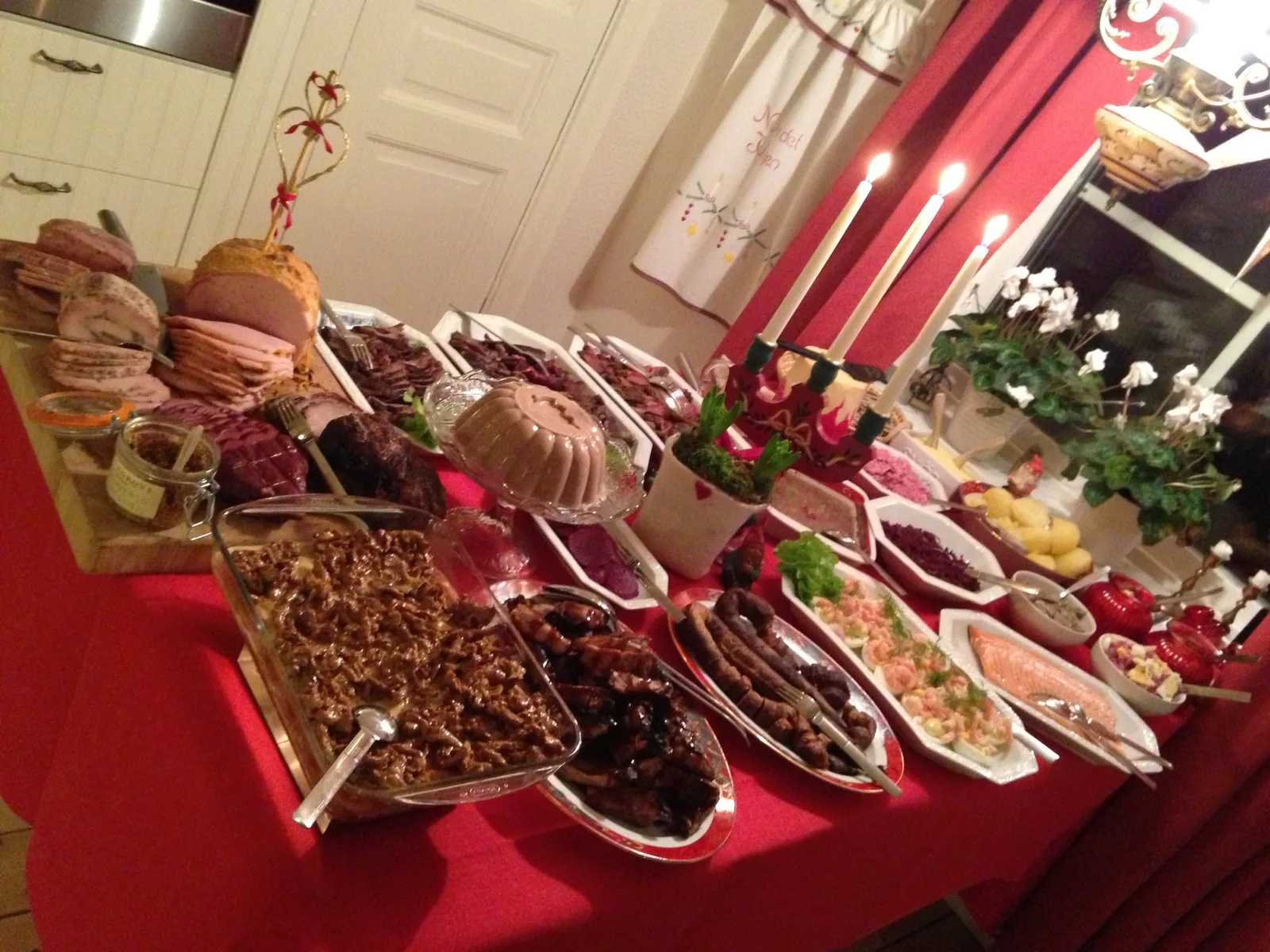
Swedish Christmas food is the dishes on the julbord, the Swedish Christmas buffet, and they're eaten in four rounds: herring first, then cold dishes like gravlax and Christmas ham, then hot dishes like meatballs, prinskorv and Jansson's, and finally sweet things like rice porridge and Christmas sweets. Almost everything can be made in advance. Red cabbage and meatballs can sit in the freezer from Advent, the herring and gravlax wait in the fridge for days and the ham is made a couple of days before, so Christmas Eve is mostly about heating things up.
The dishes on the Christmas buffet – round, when to make them and freezing
| Dish | Round | Made | Can be frozen |
|---|---|---|---|
| Pickled herring | Herring | Three to four days before, in the fridge | No, it goes soft and watery. Keeps about a week in the fridge |
| Gravlax with hovmästarsås | Cold | Cured two days before, in the fridge | Yes, finished gravlax, whole and tightly wrapped |
| Christmas ham | Cold | Baked in the oven a couple of days before or the day before | Yes, leftovers in pieces |
| Red cabbage | Hot | Weeks before | Yes, in portions |
| Meatballs | Hot | In Advent, in the oven or a pan | Yes, fried and cooled |
| Prinskorv (small Swedish cocktail sausages) | Hot | Fried or reheated in the oven on Christmas Eve | Yes, shop-bought sausages, or homemade ones after simmering |
| Jansson's temptation | Hot | The day before, at most two days before | Possible, but the potatoes turn floury |
| Spare ribs | Hot | The day before, in the oven | Yes, raw or fried |
| Rice porridge | Sweet | The day before or on Christmas Eve | – |
| Knäck (Swedish Christmas toffee) | Sweet | Around Lucia, in the fridge | Not needed, keeps two to three weeks in the fridge |
| Chocolate truffles | Sweet | A week before at the latest, in the fridge | Yes, balls without coating |
| Gingerbread biscuits and lussekatter | Sweet | Advent | Yes, dough and buns |
| Glögg | Drinks | Grown-up glögg a few days before | Children's glögg in portions |
The times come from the individual recipes. How much you need of each dish is in the guide to quantities per person.
It's the evening of 23 December. You open the freezer to look for ice cubes and find a tub of red cabbage that someone made one Sunday in November, with a bag of meatballs next to it. Suddenly Christmas Eve is two dishes shorter. That's where a calm Christmas buffet is decided: not on Christmas Eve, but in what's already done.
This page gathers all the Christmas food on Swilderness in one place. It gives you a simple model for how the Christmas buffet is eaten and one for when each dish is made. Then comes a short section for each dish, with a link to the recipe, and the few pieces of advice from Livsmedelsverket, the Swedish Food Agency, that are worth knowing by heart when the fridge is full.
What is Swedish Christmas food?
Swedish Christmas food is the dishes on the julbord, and a julbord is a buffet where everyone helps themselves – a Christmas smörgåsbord. The most common dishes are pickled herring, gravlax (cured salmon), Christmas ham, meatballs, prinskorv (small Swedish cocktail sausages), Jansson's temptation (a creamy potato and sprat bake), red cabbage and rice porridge. On top of that come bread, mustard, potatoes and then everything that's particular to your own family: spare ribs, beetroot salad, brawn, egg halves or a herring of your own.
Most of what's on the table is younger than you'd think. Dopp i grytan (dipping bread in the ham stock), Christmas sausage and lutfisk (lye-cured fish) belong to the old traditions. Rice porridge arrived in the 19th century. Christmas ham, prinskorv, gravlax and Jansson's only became common in the 20th century, and meatballs didn't earn their place on the Christmas buffet until after the Second World War. That's a comfort for anyone who thinks the Christmas buffet has to look a certain way: it has always changed.
The memory model – four rounds and three appliances
The Christmas buffet gets easier both to eat and to cook if you think in two orders at the same time.
Four rounds on the table. This is how you eat it:
- Herring. Pickled herring with potatoes, bread and sour cream.
- Cold. Gravlax, eggs, Christmas ham with mustard, pâté and cold cuts.
- Hot. Meatballs, prinskorv, spare ribs, Jansson's and red cabbage.
- Sweet. Rice porridge, ris à la Malta (creamy rice dessert), gingerbread biscuits and Christmas sweets.
Take a clean plate between rounds. In restaurants the Christmas buffet is often split into more rounds, with cold fish, cold meat and cheese as rounds of their own. At home, four is enough.
Three appliances in the kitchen. This is how you cook it:
- The freezer – weeks before. Red cabbage, meatballs, gingerbread dough, lussekatter (saffron buns), homemade prinskorv and children's glögg.
- The fridge – days before. Herring, gravlax and Christmas sweets, and the ham once it's baked.
- The oven – on the day. Heating the hot dishes, frying the prinskorv, baking the Jansson's if it isn't done and cooking the rice porridge.
The table on this page shows each dish with its round and its appliance. The more dishes that end up in the first two appliances, the more of Christmas Eve is left for something other than washing up.
Cold – herring, salmon and ham
The cold dishes are the backbone of the Christmas buffet, and most of them are made days before.
The herring
Pickled herring is based on the 1-2-3 brine, and the same batch makes three Christmas herrings: classic, onion herring and mustard herring. Herring is one of the few dishes that's completely ready several days ahead, and it needs that time to taste good. If you'd like a wilder version, there's wilderness herring with spruce shoots, pickled with juniper berries and rosemary.
The gravlax
Gravlax with hovmästarsås is cured in the fridge for two days with one part salt and two parts sugar. The important thing to know in advance is the freezing: fresh wild-caught fish that's going to be cured must be frozen at minus 18 °C for at least three days to kill parasites, and a larger whole fish a couple of days more. Farmed salmon doesn't need freezing. If there's salmon left over after Christmas, it goes well with dill-creamed potatoes with gravlax.
The Christmas ham
The ham is the only big project, and it's done a couple of days before or the day before. Glazed Christmas ham in the oven covers cured or boiled ham, core temperature, time per kilo and four kinds of glaze. The stock is saved for dopp i grytan. If you want a smoky flavour, there's christmas ham in a smoker box, which is baked at home and then smoked and glazed outdoors.
Hot – meatballs, prinskorv and Jansson's
The hot dishes are the round that takes up the most oven time on Christmas Eve. That's why this is where it pays most to have things done in advance.
Meatballs and prinskorv
Meatballs for the Christmas buffet can be fried in a pan or baked in the oven, and they freeze well. Make them on a weekend in Advent, and they only need reheating on Christmas Eve. Prinskorv (small Swedish cocktail sausages) is the dish that's made last and fastest: shop-bought sausages are fried in a pan or heated on a tray in the oven for the last ten minutes. If you want to make your own, there's also a recipe for homemade prinskorv in sheep casings, which are simmered until cooked and frozen in Advent. Christmas sausage grilled over the fire is in christmas sausage on skewers.
Jansson's temptation and spare ribs
Jansson's temptation is made with Swedish ansjovis, which is spiced pickled sprat, and not with anchovies. Bake it no more than two days before and reheat it on Christmas Eve, because the potatoes turn floury if it's frozen. Oven-baked spare ribs with ginger, cloves and mustard are made the day before and reheated on Christmas Eve.
The red cabbage
Red cabbage with apple and Christmas spices is the dish that can be prepared furthest in advance. Cook it at the beginning of Advent, freeze it in portions and reheat it on the hob. Its acidity cuts through the fat from the ham and the ribs. Stirred lingonberries or lingonberry jam do the same job next to the meatballs.
Sweet – rice porridge, sweets and baking
The sweet round starts in Advent and ends in the days after Christmas.
- Rice porridge rounds off the Christmas buffet, with an almond hidden in the pot. The recipe can be cooked on the hob just as well as over the fire.
- Ris à la Malta is made from the cold porridge with whipped cream and orange, and it's the best way to use up the leftovers on Christmas Day.
- Gingerbread biscuits and lussekatter are baked in Advent. Gingerbread dough keeps in the freezer for up to three months, and lussekatter frozen on the day they're baked taste freshly baked once thawed.
- Saffron kladdkaka is the easy option for anyone who can't face proving a dough.
- Christmas sweets: knäck toffee keeps for two to three weeks in the fridge, chocolate truffles are rolled from cream and chocolate, and swedish ice chocolate is the easiest of all, since you don't need a thermometer. Anyone who wants to make their own marzipan pigs starts with homemade almond paste.
Drinks – glögg, julmust and something hot
Glögg is how many Christmas buffets begin. Glögg over an open fire has both a grown-up glögg and a children's glögg made with cordial, and the children's glögg can be frozen in portions. Julmust arrived in 1910 as an alcohol-free alternative to Christmas beer, and it's still what many children would rather drink with their food.
When to do what
Four rounds on the table doesn't mean four days in the kitchen. With the three appliances, December looks roughly like this:
- First Sunday of Advent, Sunday 29 November: plan the menu and make room in the freezer. Red cabbage, meatballs and gingerbread dough go in during the first two weeks of Advent. Ask your shop whether it takes pre-orders, if you want a particular ham.
- Lucia, Sunday 13 December: knäck and ice chocolate into the fridge, lussekatter and uncoated truffles into the freezer.
- Wednesday 16 December: last day to put wild-caught fish in the freezer, if it's going to be cured on Monday.
- Monday 21 December: pickle the herring and cure the salmon.
- Tuesday 22 December: bake the ham and move the meatballs and red cabbage from the freezer to the fridge.
- Wednesday 23 December: glaze the ham, make the ribs, the Jansson's and the hovmästarsås.
- Christmas Eve, Thursday 24 December: heat the hot dishes, fry the prinskorv and cook the rice porridge if it isn't already done.
The whole plan day by day, with an oven schedule for Christmas Eve and what can share the oven, is in the Christmas buffet step by step.
How much Christmas food do you need?
A common mistake is to count every dish as if it were the whole dinner. At a Christmas buffet with lots of dishes, an adult eats roughly half a kilo of food in total, and each dish only gets a small share of that. How much ham, herring and meatballs you need per adult and per child, and how much you can cut back when there are more dishes, is explained in this guide: how much Christmas food per person.
Christmas dinner outdoors
Not everything has to be eaten indoors. Herring, ham and eggs cope with the cold in a cool bag, and meatballs, Jansson's and rice porridge can be heated in cast iron over the embers. The menu, the timeline and what the children can do by the fire are in christmas dinner outdoors.
Safe Christmas food – the fridge, food left out and leftovers
The Christmas buffet is the meal of the year when the most food is left out for the longest. A few pieces of advice from Livsmedelsverket that are worth knowing:
- The fridge at 4 °C. At that temperature food keeps about twice as long as at 8 °C. A packed fridge in December can get warmer than you'd think, so a fridge thermometer earns its place.
- No more than four hours out. Chilled food shouldn't be left out for more than four hours in a room that's 20 °C or less, and no more than three hours if it's up to 25 °C. Put out a little at a time and top up from the fridge.
- Leftovers in fast. Let hot food cool quickly and put it in the fridge as soon as it has cooled. Cooked food often keeps for several days in the fridge and sometimes up to about a week. Freeze whatever you won't get round to eating.
- Cured fish. Wild-caught fish that's going to be cured is first frozen at minus 18 °C for at least three days, and home-cured gravlax is eaten within a week or frozen. The freezer compartment in a fridge doesn't always get that cold, so use the freezer.
Pregnant at the Christmas buffet? Most things are fine. Pickled herring is fine, and ham carved from a whole piece just before serving is fine. Shop-bought smoked and cured fish should be eaten within a week of the packing date, and home-cured gravlax should be eaten within a week or frozen. Avoid cold creamy salads with cured fish, blue cheese or cured meats, and don't eat herring from the Baltic Sea too often. Julmust, alcohol-free glögg, gingerbread biscuits and saffron buns are fine.
The children and the Christmas food
Children rarely eat the whole Christmas buffet, and they don't need to. Prinskorv, meatballs, ham and rice porridge usually go a long way, and the herring can wait a few years. Let the children make something that shows on the table: rolling truffles, cutting out gingerbread, hiding the almond in the porridge or setting out the egg halves. It's a good idea to put small labels by the dishes saying what's in them, so anyone allergic to fish, nuts, milk or eggs can see straight away.
More ideas for a Christmas with more time together, from Advent to New Year, are in christmas with kids.
Frequently asked questions
What should be on a Christmas buffet?
The most common dishes are pickled herring, gravlax, Christmas ham, meatballs, prinskorv, Jansson's temptation, red cabbage and rice porridge, with bread, mustard and potatoes on the side. You don't need more than that. A Christmas buffet at home is better with fewer dishes made calmly than with lots made at the last minute.
In what order do you eat the Christmas buffet?
Herring first, ideally with potatoes and bread. Then the cold dishes, like gravlax, eggs, ham and pâté. Then the hot dishes, like meatballs, prinskorv, spare ribs and Jansson's. Finally the sweet things, like rice porridge, ris à la Malta and Christmas sweets. Take a clean plate between rounds, so the herring doesn't flavour the porridge.
Which Christmas dishes can you make in advance?
Most of them. Red cabbage, meatballs, gingerbread dough and lussekatter can be frozen weeks before. Knäck keeps in the fridge for two to three weeks, and the herring is pickled three to four days before, since it needs a few days to taste good and keeps for about a week. The gravlax is cured two days before, and the ham, ribs and Jansson's are made the day before or a couple of days before. On Christmas Eve you heat the hot dishes, fry the prinskorv and cook the rice porridge.
How long can the Christmas buffet stay out?
Livsmedelsverket advises that chilled food shouldn't be left out for more than four hours in a room that's 20 °C or less, and for a shorter time if it's warmer. Put out a little at a time and top up from the fridge instead of leaving everything out all evening.
Can you eat from the Christmas buffet when you're pregnant?
Yes, most things are fine. Pickled herring is fine, and ham carved from a whole piece just before serving is fine. Be careful with smoked and cured fish, which should be eaten within a week of the packing date, and avoid cold creamy salads containing cured fish, blue cheese or cured meats. Herring from the Baltic Sea shouldn't be eaten too often.