


Finding the right heat in the pan
Where the embers should go, what the fat looks like when it's just hot enough, and which fats take the most heat before they smoke.
To the griddle guidePlenty of fat, low over the embers and the sugar once they've cooled a little
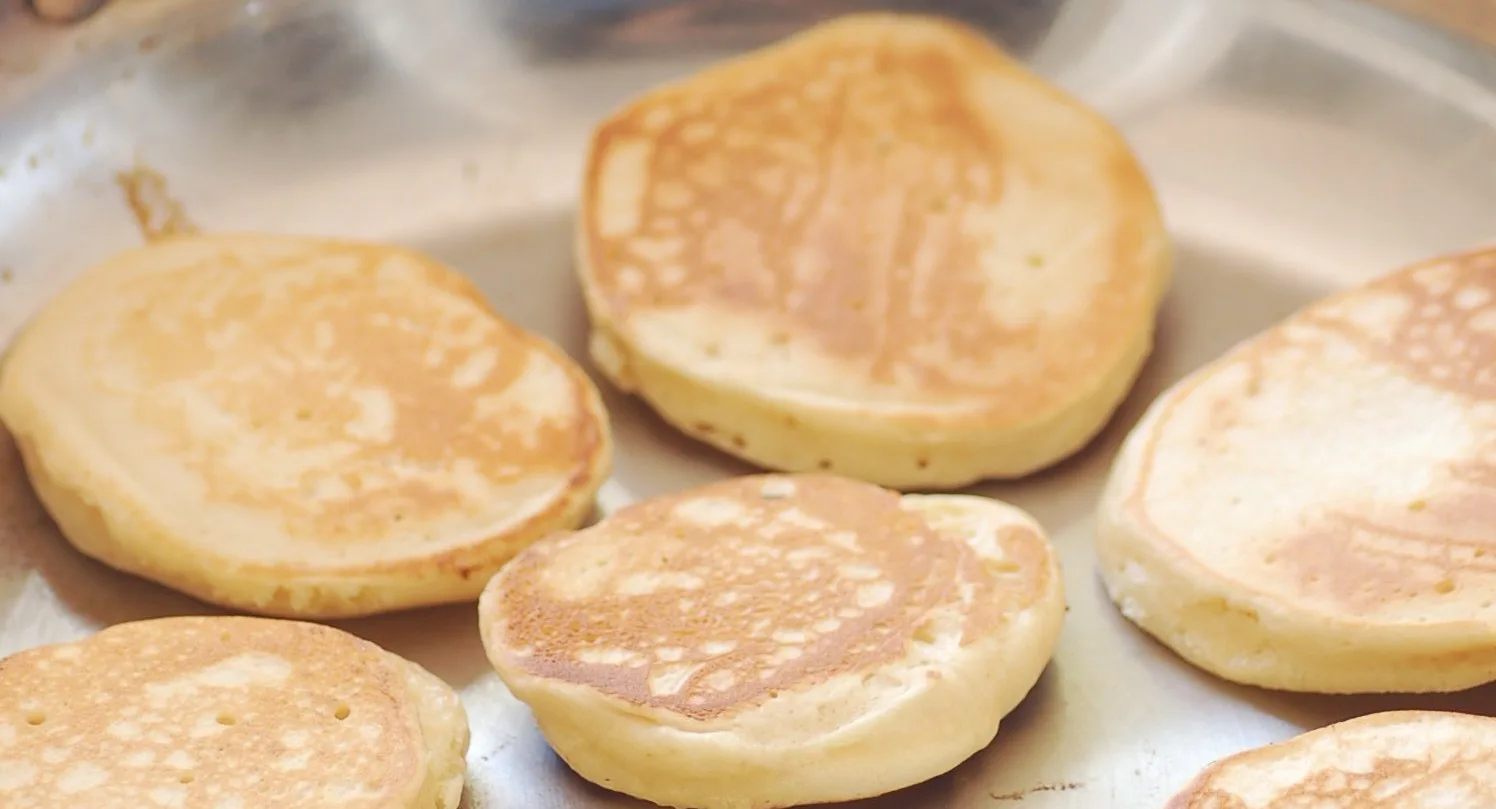
The pan is sitting steadily on the grill and the butter has stopped foaming. One spoonful of batter at a time, plop, plop, plop, until there are six small round cakes in the pan, slowly puffing up and getting little holes on top. A little way off, the children are sitting by a stump with a bowl of cinnamon sugar, waiting to shout "now!".
Krabbelurer are small, thick Swedish pancakes with baking powder in the batter, somewhere between a pancake and a sponge cake, usually rolled in cinnamon sugar. In most Swedish recipes they're dolloped into a frying pan or a plättlagg (a Swedish pan with small round hollows) with butter and then tossed in sugar and cinnamon. So at heart they're not deep-fried food, even though some recipes, Norwegian ones among them, deep-fry them. By the fire it's exactly the right choice, too, and here's why.
The fat goes home with you, and it must never end up in nature.
Here's what to do instead. Let the pan cool completely. Wipe out most of the fat with kitchen roll and put the paper in a sealed bag or jar that goes home with you to the food waste. If there's more fat than the paper can soak up, pour the cooled fat into a sealed, burnable container, such as a milk carton or a plastic bottle, and screw the lid on. The rules for where the container should be thrown away vary between local councils, so follow what applies where you live. Used fat can take less heat before it smokes, so don't save it for next time. How to wash and dry the pan outdoors is explained in hygiene and washing up outdoors, and how to look after the cast iron afterwards in the guide to cast iron.
Have you made this recipe? Rate it
0.0 out of 5 · 0 votes
out of 5
vote
votes
Be the first to rate this recipe.
Thanks for your vote!
Your vote could not be saved right now. Please try again later.
 🔥 Over fire
 🔥 Over fire
 🔥 Over fire
 🔥 Over fire
It makes about 25 krabbelurer, depending on how big the dollops are.
Deep-frying means several centimetres of oil in a deep pot, heated to about 170–180 degrees. At home on the hob you can control that with a dial and a thermometer. Over an open fire it's a different matter.
With a thin layer of fat in a pan, the krabbelurer turn out just as they should, and if something goes wrong it's a few tablespoons of fat, not a whole pot. That's why we make them this way by the fire. If you still want to try deep-fried ones, do it at home in the kitchen with a thermometer and a lid, not by a campfire.
Remember three words and you have the whole recipe.
Lid close at hand. Keep the lid within reach the whole time, not in the rucksack. If the fat in the pan catches fire: put the lid on and leave it there. Never pour water on burning fat, and never throw snow on it. The water turns to steam instantly and can throw burning fat into the air. Don't try to carry a burning pan. Leave the lid on until the pan has cooled down.
Keep the pan dry. No water, no snow and no wet utensils in the fat. Dry the ladle and spatula, and never leave a cup of water where it could tip over towards the pan. A wet dollop causes spatter, and spatter on hands and faces is the most common burn at a pan.
Children at a distance from the pan. Set a boundary around the fire site, about two steps behind the person frying, that the children don't cross. It's the adult who fries, turns and lifts the pan. More about a safe zone around the fire can be found in fire safety in nature.
Take the pan off the fire when you're done. Don't leave it over the embers with fat in it while you eat. Put it on a flat stone and let the fat cool for a long time, ideally with the lid on. Iron that has been over embers stays hot long after the fat has stopped sizzling.
If someone burns themselves: cool with cool water for about a quarter of an hour, no longer, and never with ice or snow. Seek medical care if the blisters cover an area larger than the injured person's own hand, if the burn is on the face or hands, and always if the child is one year old or younger.
Don't taste raw batter. That goes for adults and children alike, even if the eggs are Swedish. Flour isn't heat-treated and can carry bacteria, including EHEC. No Swedish cases are known, but outbreaks in North America have been linked to flour and unbaked cookie dough, and the batter only becomes safe once the krabbelurer are cooked through. This applies especially to young children. Give the children a finished krabbelur each instead, and wash your hands after handling the flour.
The eggs. Eggs from Sweden, Norway, Finland and Denmark are fine to bake with, because salmonella is very rare in them. Eggs from other countries should not be eaten raw. In a krabbelur that's cooked through they pose no risk, but it's one more reason to leave the batter alone. More about eggs outdoors can be found in boiled eggs over a fire.
The fire. Check whether there's a fire ban before you light up. It's the county administrative board's or the municipality's decision that counts, and the rules are in lighting fires outdoors.
Allergens: the krabbelurer contain egg, milk and wheat. The milk and butter can be swapped for plant-based alternatives, and you can use a gluten-free flour mix, but then they often turn out a little denser.
Dry in a bag, wet in a bottle. Measure the flour, sugar, vanilla sugar and salt into a sealed bag at home, and put the baking powder in its own small bag inside. The eggs, milk and melted butter can be shaken together in a sealed bottle. Mix the cinnamon sugar in a jar with a lid, so it can be shaken up again by the fire.
The whole batter in a squeeze bottle. If you'd rather skip the mixing bowl, you can mix the whole batter at home and pour it into a clean squeeze bottle with a wide nozzle. It makes it easy to pipe even dollops, with no mess. The baking powder starts working as soon as the batter gets wet, so the krabbelurer get a little flatter the longer the batter stands. Ideally, fry them the same day.
The cool box. Eggs, milk and butter are chilled foods, and so is ready-made batter. On a warm day they mustn't be left out for more than two hours at most, and never in the sun. Pack the bottle in the cool box and take it out when the pan is hot.
By the fire. Light the fire before anything else. While it burns down, set up the sugar station, put out the lid, spatula and kitchen roll, and mix the batter. A saucepan of warm apple juice or a pan of kokkaffe (boiled coffee) can sit at the edge of the embers while the krabbelurer are frying.
Krabbelurer are one of the best things to make by the fire with children, because most of the fun happens well away from the pan. The ages are a rough guide. Go by your child's experience and maturity.
An adult takes care of the pan, the fat and the turning. More ways to give the children roles by the fire can be found in cooking with children over a fire.
Usually not. In most Swedish recipes, krabbelurer are dolloped into a frying pan or plättlagg with butter and then tossed in sugar and cinnamon. Some recipes, Norwegian ones among them, deep-fry them, but over an open fire a pot of hot oil is too risky, so here they're fried in a thin layer of fat.
Only enough to cover the bottom, a few millimetres. Start with a tablespoon of butter and a tablespoon of oil and top up a little between batches. More fat than that makes them half deep-fried and spattery.
Put the lid on and leave it there. Never pour water on it and never throw snow on it, because the water turns to steam and can throw burning fat into the air. Don't try to carry the pan. That's why the lid should be out and ready the whole time.
Yes, if it's cast iron and sits steadily on a grill over even embers. The dollops come out the same size and nicely round. Turn it now and then, because the hollows at the edge are often cooler than the ones in the middle.
Let the pan cool completely, wipe out the fat with kitchen roll and take the paper home in a sealed bag for the food waste. Larger amounts go into a sealed, burnable container, and your local council decides where it should be thrown away. Never pour the fat into the fire, out in nature or down the drain.
More good things from the pan
Finding the right heat in the pan
Where the embers should go, what the fat looks like when it's just hot enough, and which fats take the most heat before they smoke.
To the griddle guideWarm apple juice with the krabbelurer
A saucepan of apple juice at the edge of the embers while the first batch fries, so the children have something warm to drink with the sugar.
To the apple juiceGive the children their own jobs by the fire
The sugar bowl is a good start. More ways to let the children join in by the fire, by age and experience, and where the boundary goes.
To campfire cooking with children