


The right stick before the bacon
Fresh hazel, willow or birch, a metre long and peeled at the tip. How to choose and whittle the stick, and which bushes to leave alone.
Whittle a roasting stickCrispy pork, a long stick and bread to catch the drips

Time: about 10 min at home + 30–45 min until the embers are ready + 8–12 min on the stick
The fire has been burning for half an hour and the children have already asked three times whether it's time. Someone has found bacon in the cool box. The first rasher goes up on the stick like a limp glove, is held straight down in the flames and catches fire after ten seconds. The second slides off and lands in the ash.
Bacon on a stick is easy once you know three things: how the rasher stays on, where the heat should come from and where the fat ends up. That's what this recipe is about, along with thin slices of meat that can be grilled the same way.
Have you made this recipe? Rate it
0.0 out of 5 · 0 votes
out of 5
vote
votes
Be the first to rate this recipe.
Thanks for your vote!
Your vote could not be saved right now. Please try again later.
 🔥 Over fire
 🔥 Over fire
 🔥 Over fire
 🔥 Over fire
Most of the prep is done at home. Cut the minute steak or pork into pieces about three fingers wide and a palm long. Toss them in oil, thyme, salt and pepper and put them in a sealed food box. The chicken is cut into strips no more than one centimetre thick and goes in a separate box. The bacon can stay in its packaging.
Everything raw is packed at the very bottom of the cool box, so nothing drips onto the bread and vegetables. In summer heat, chilled food shouldn't be left out for more than two hours in total, and never in the sun. So keep the cool box in the shade and only take the meat out once the embers are ready. More about the cool box and keeping raw and cooked food apart can be found in hygiene and washing up outdoors.
Cut the sticks at home or take them with the landowner's permission. Fresh wood is best because it doesn't catch fire as easily. Which kinds of wood are suitable, and which aren't, is covered in whittling a roasting stick, pot hanger and tripod.
By the fire, it's the embers that decide. Light it in good time and let the wood burn down for 30–45 minutes, until the flames have died down and the coals are covered in a grey layer. How to build a fire that gives plenty of embers is explained in lighting a fire.
In Hungary, people have long grilled smoked pork belly on skewers over a fire in their own particular way. When the fat starts to drip, they hold a slice of bread underneath so the fat lands on the bread instead of in the embers. Then cucumber, red onion and tomato go on the bread and get even more dripping fat over them.
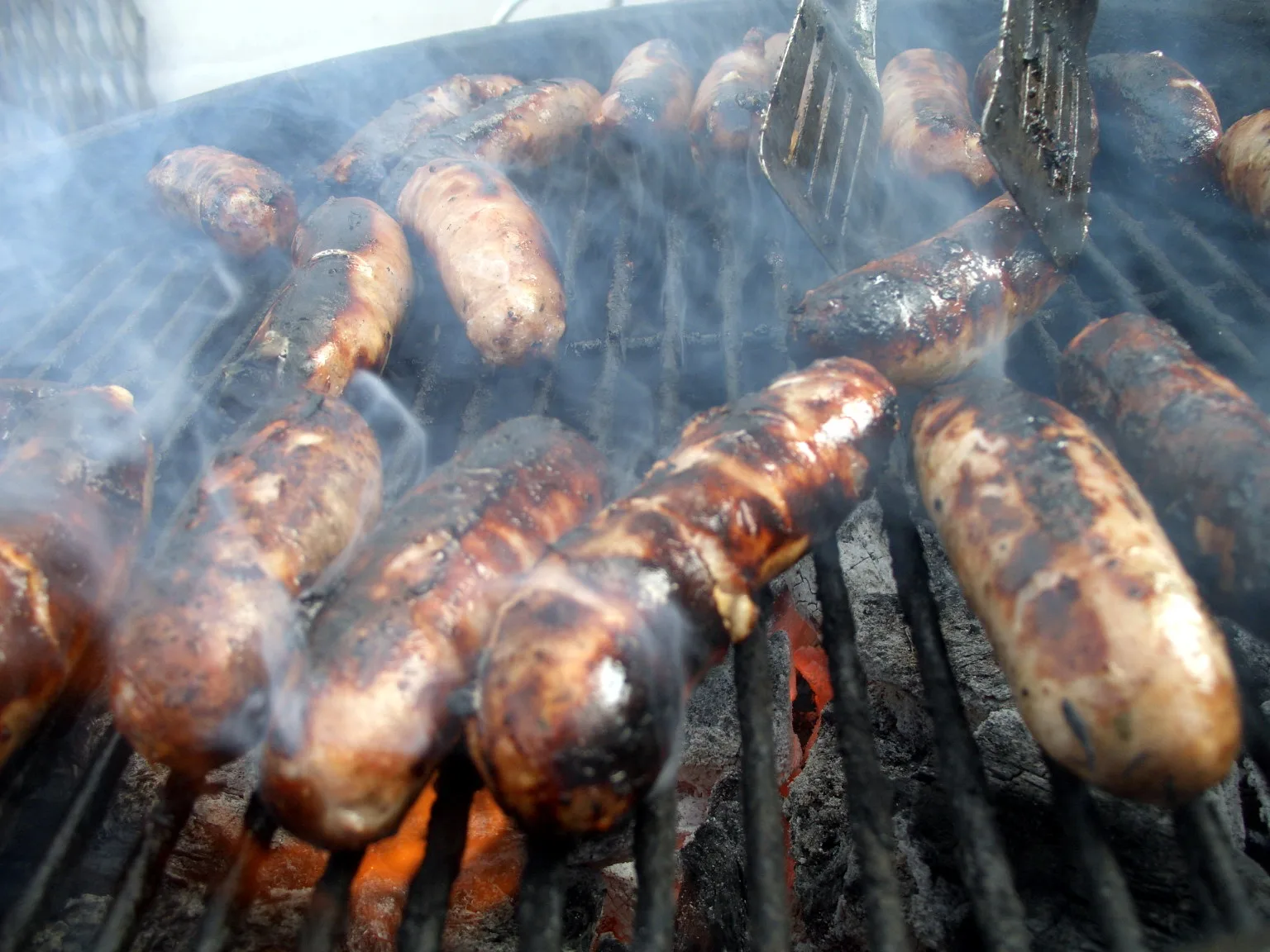
It's a good trick with ordinary bacon too. The embers don't flare up, and the bread becomes the tastiest bit. Use a sturdy slice of wholemeal bread and hold it a few centimetres below the stick, outside the bed of embers. The picture above shows exactly that kind of thick, scored pork belly being grilled. Note the flames in the corner of the fire pit: that's where the skewers should be kept away from.
Flames are the first thing to avoid. Livsmedelsverket (the Swedish Food Agency) advises letting the wood burn until the flames have gone and the coals are grey, and avoiding fat dripping down and making the embers flare up. Grilling produces unwanted substances, including PAHs, and Livsmedelsverket writes that they are found above all in the flames. PAHs also form when fat melts and drips into the embers, and heavily charred food can contain higher levels. Bacon releases a lot of fat, so the drip edge or the slice of bread underneath is useful here. Golden brown is the goal, not dark brown or burnt, and black bits are scraped off. Never grill over pine cones or treated timber.
Raw meat. For slices of beef and pork, it's enough for the surface to be properly cooked, because the bacteria are on the surface. Even so, anyone who is pregnant should not eat rare meat unless it has been frozen for at least three days. Chicken must always be cooked through, and 70 degrees in the centre is a good measure. The same goes for mince and raw sausages. Treat bacon as raw pork, even though it is cured and smoked. Cook it properly, until the fat has turned golden and the meat reddish-brown, and don't eat any pale, rubbery bits.
One stick, one job. A stick that has carried raw meat shouldn't carry bread or marshmallows afterwards. Never put the cooked meat back in the box where it lay raw, and wash your hands after touching raw meat.
Burning fat. If a rasher catches fire, lift it away from the embers and blow it out. If you're frying in a pan to one side and the fat there catches fire, put a lid on it and never pour on water. Don't pour leftover fat into the fire either. It flares up. Let it set and take it home.
Burns. Fat splashes and hot metal skewers are the most common causes. Cool with cool water for about fifteen minutes, no longer, and never with ice or snow.
Fire bans. The county administrative board's or the municipality's decision determines whether you can light a fire. How to make a fire safely and what applies in different places is explained in fire safety in nature.
Bacon is a processed meat, meaning it's cured, smoked and usually preserved with nitrite. The nitrite protects against the bacterium that causes botulism and appears in the ingredients list as E 249 or E 250. When food containing nitrite, such as bacon, is cooked, nitrosamines can form, and some of them can damage DNA and increase the risk of cancer. That's one of the reasons for the dietary advice on processed meat below.
That doesn't mean the bacon has to stay at home. Livsmedelsverket's advice is to eat no more than 350 grams of cooked red meat and processed meat a week, and that only a small part of that should be processed meat. A couple of rashers of bacon by the fire fit in easily, especially if the rest of the meat is minute steak, pork or chicken.
Bacon is also salty, about 2–3 grams of salt per 100 grams. That's why the bacon shouldn't be salted, and why bread, cucumber and apple belong with it.
Bacon on a stick is a good first grilling dish for children who can hold a stick still. It's easy to see when it's done, because the fat goes from white to golden. Let the children sit or kneel at the edge of the fire with their own long stick, and have an adult beside them. Nobody runs behind someone holding a stick.
The dripping fat is hot and spits. The cool edge of the bed of embers gives fewer splashes than right over the embers. Show your child how to lift the stick away from the embers and blow out the rasher if it catches fire, so it becomes part of the game instead of something scary.
When the bacon is done, the stick is hot at the tip, and a metal skewer gets hot a long way up towards the handle. Let the child hand the stick to an adult, who slides off the bacon and stands the stick with the tip pointing towards the fire. Nobody waves the stick around or eats straight off it.
Two rashers are enough for a younger child. The bacon is salty, so let it be a taster alongside bread, cucumber and apple rather than the whole meal. More ways to give the children jobs by the fire can be found in cooking with children over a fire.
More things to hold over the fire can be found in food on a stick.
About 8–12 minutes a hand's width above the embers, depending on how thick the rashers are and how hot the embers are. It's done when the fat has turned golden and bubbling, and crispy when it firms up after resting for half a minute.
Push the stick through the lean part of the rasher and thread it in folds, with a finger's width of air between the folds. Leave the last few centimetres of the tip empty. Cold, thick-cut bacon stays on better than thin bacon at room temperature.
The fat drips into the embers and flares up, or the stick is held in flames instead of over embers. Hold the stick at the edge of the bed of embers, or have a slice of bread underneath to catch the fat.
Yes, if the fat has turned translucent and golden and the meat is reddish-brown. Bacon should be cooked properly, but it doesn't have to be crispy to be done. Pale, rubbery fat means it needs more time.
Thin slices that cook quickly: minute steak, thinly sliced unsalted pork belly and strips of chicken breast. For sliced beef and pork, it's enough for the surface to be properly cooked. Chicken must always be cooked through.
Yes, but in small amounts. Bacon is salty and counts as processed meat, and Livsmedelsverket advises that only a small part of the week's meat should be processed meat. A couple of rashers together with bread and vegetables is a suitable taster for a child.
More to hold over the embers
The right stick before the bacon
Fresh hazel, willow or birch, a metre long and peeled at the tip. How to choose and whittle the stick, and which bushes to leave alone.
Whittle a roasting stickLots of mouths and not much time?
When the whole gang wants bacon at the same time, it's quicker on a grill. How to split the bed of embers into a hot side and a cool side.
Read about grills and fish basketsBread on the next stick
A sausage of dough around a new stick while the bacon cools. Roll a rasher of bacon into the dough if you want both at once.
Bake stick bread