



A stick that holds the mince
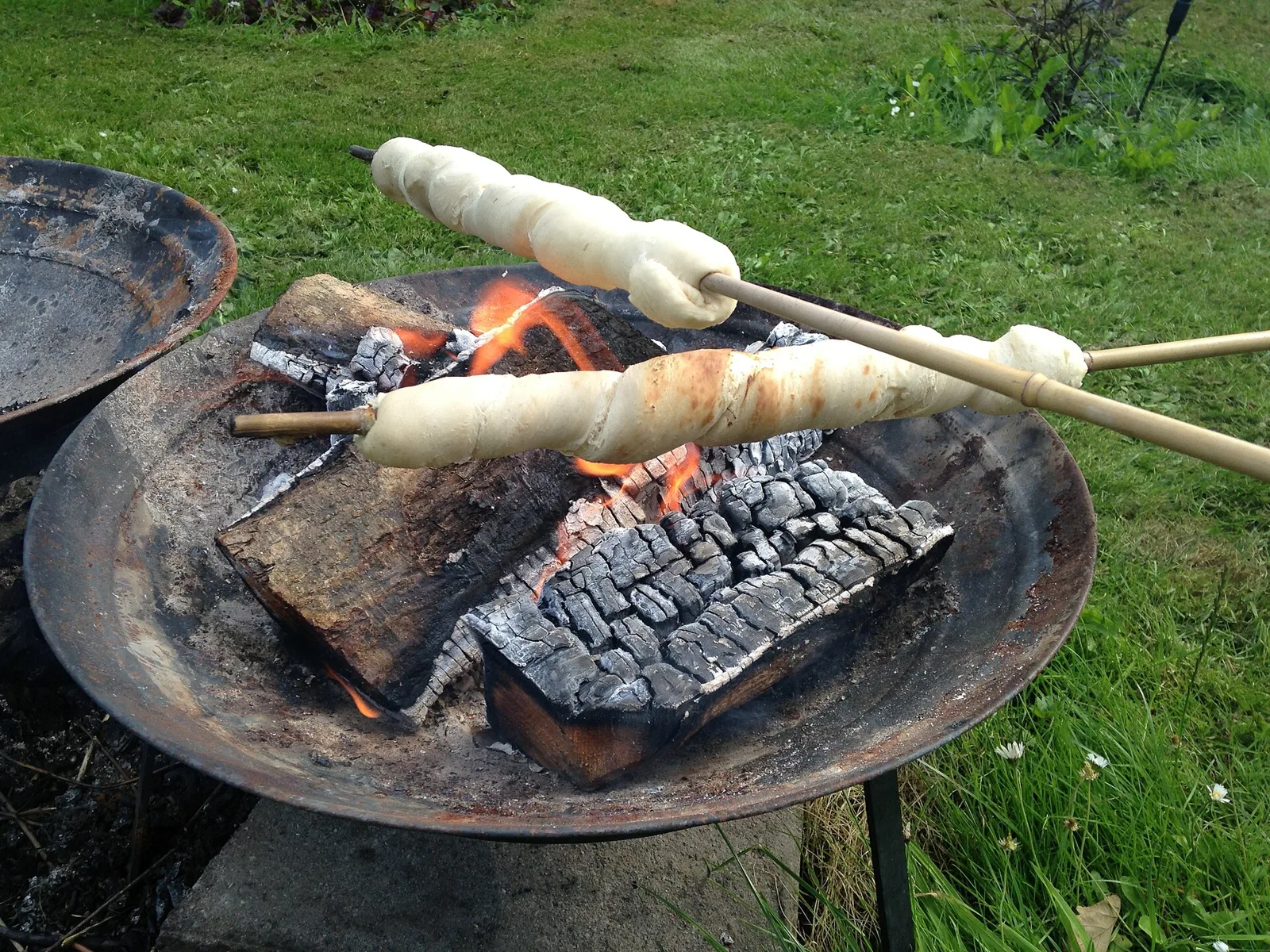
As thick as your thumb, fresh and peeled at the tip, or two thin ones side by side. How to choose and whittle the stick, and which bushes to leave alone.
Whittle a roasting stickSpiced mince around a flat stick, cold sauce and warm bread

Time: 25 min at home + 30 min in the fridge + 30–45 min until the embers are ready + 10–14 min on the stick
The first roll of mince round the stick looks perfect. Then it starts to warm up, a crack opens on the underside and after two minutes half the roll slides off into the embers. The second spins round the stick like a loose sleeve every time it's turned. The third is black outside and pink inside.
Mince on a stick is harder than sausages, but only until you know why the mince lets go. It comes down to three things: a mixture that sticks, a skewer that is cold and firm when it meets the heat, and a stick that is turned often at the start. The flavours are borrowed from köfte and kofta, the spiced mince skewers grilled over charcoal from the Balkans to Iran.
The colour on the outside isn't enough. Mince can brown and look done before it's hot enough in the middle. The thermometer is the safest option. If you don't have one, break or cut open the thickest skewer. Mince that is cooked through isn't stringy, and the juices run clear with no trace of pink.
Have you made this recipe? Rate it
0.0 out of 5 · 0 votes
out of 5
vote
votes
Be the first to rate this recipe.
Thanks for your vote!
Your vote could not be saved right now. Please try again later.
 🔥 Over fire
 🔥 Over fire
 🔥 Over fire
 🔥 Over fire
Mince is heavier than sausage, and it has no skin to hold it together. That's why the shape of the stick matters more than usual.
Which kinds of wood are suitable, which are poisonous and how to whittle without cutting yourself is explained in whittling a roasting stick, pot hanger and tripod.
The onion first. Grate the onion on the finest side of the grater, sprinkle over a pinch of the salt and leave it for five minutes. Then put the grated onion in a clean tea towel and squeeze out as much liquid as you can. There's more than you'd think, often several tablespoons. Onion juice in the mince is the most common reason skewers slide off. You can save a little of the juice and brush the skewers with it by the fire if you want more onion flavour.
Knead for a long time. Put the mince, onion, crushed garlic, the rest of the salt, the herbs and the spices in a mixing bowl. Knead by hand for three to four minutes, longer than you'd think. The salt dissolves the protein in the meat, and after a while the mince turns glossy and tacky and sticks to your fingers. That's how it should be. Egg and breadcrumbs aren't needed. They make the mince softer, and soft mince drips off a stick.
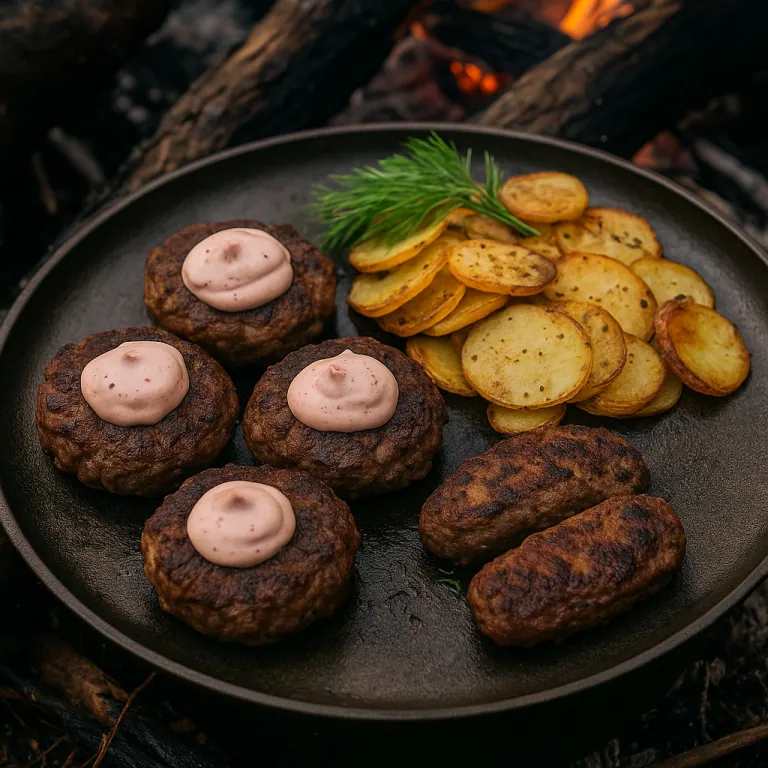
Shape with wet hands. Divide the mince into eight to twelve equal pieces. Dip your hands in cold water, put a piece in your palm and press it round the skewer into an oblong roll about 2 centimetres thick and 12–15 centimetres long. Pinch it tight at the top and bottom so the ends close firmly round the stick, and nip lightly along the roll with your fingers to give it small dimples. The dimples give more browned surface and help the mince stay put. The skewers shouldn't be thicker than two centimetres, because then the surface burns before the middle is done.
If you're grilling on fresh wooden sticks at the fire, shape the mince into oblong sausages at home and mould them onto the sticks on site, with wet hands.
Chill and pack. Put the skewers in a flat box with baking paper between the layers and leave them in the fridge for at least 30 minutes, ideally a few hours. In the cool box, the box goes at the bottom, under the bread and vegetables, so meat juices can never drip onto anything that's eaten without being cooked. In summer heat chilled food shouldn't be out for more than two hours in total, and never in the sun. How to pack the cool box and keep raw and cooked food apart is explained in hygiene and washing up outdoors.
The sauce. Grate the cucumber coarsely, squeeze it out in the tea towel and stir it into the yoghurt with crushed garlic, mint, lemon and salt. It's even better after an hour in the fridge and travels in the cool box in a tub with a lid. At the fire it only comes out once the skewers are ready and goes back in the cool box after the meal. The yoghurt needs to be kept cold just like the mince, and sauce that has been out for more than two hours in the heat gets thrown away.
The fire. Light the fire in good time and let the wood burn down for 30–45 minutes, until the flames have died down and the coals are grey. Mince needs even, medium heat. How to build a fire that gives plenty of embers is explained in lighting a fire.
Mince must always be cooked through. That's the difference from a whole cut of meat. In a whole piece the bacteria sit on the surface, but when the meat is minced they're mixed into all of it. Livsmedelsverket (the Swedish Food Agency) states that mince should reach 70 degrees to be cooked through. That applies to all mince, whatever the animal.
Raw mince and hands. Wash your hands with soap and water straight after shaping the skewers and after touching raw mince by the fire. A skewer that has had raw mince on it has done its job for the day, so stick bread and marshmallows get their own sticks. Cooked skewers go on a clean plate or straight onto the bread, never in the box the mince came in. Wash the skewers, or throw the wooden sticks in the fire when you've finished.
Wild boar mince. Wild boar can carry trichinella, tiny parasites that live in the muscles. Meat from your own hunting should be tested for trichinella before it's eaten, and meat you don't know has been tested must be cooked through. Trichinella dies in heat, but when grilling it takes more than 70 degrees. Without a thermometer, the meat should be greyish-brown all the way through and the muscle fibres should fall apart easily. Freezing isn't a completely reliable method, since some trichinella can survive cold. If you want wild boar, wild boar patties in a frying pan are an easier way to get the mince evenly cooked through.
Flames and a black surface. Grill over grey embers and not in flames. It's in the flames and in the black parts of the food that most of the harmful substances form. Golden brown, and dark brown in the dimples, is the goal, not black. Never grill over pine cones or treated timber.
Burning fat. If you're frying skewers in a pan or on a griddle pan and the fat catches fire, put on a lid and never pour on water. Don't pour frying fat into the fire either.
Burns. A metal skewer gets hot all the way up to the handle. Cool a burn with cool water for about a quarter of an hour, no longer, and never with ice or snow.
Fire bans. The county administrative board's or the municipality's decision determines whether you can light a fire. More about safe fires outdoors can be found in fire safety in nature.
The most fun job for the children is at home by the kitchen sink. Kneading mince and shaping rolls round skewers is messy and just tricky enough, and the children get to see how the mince changes when it starts to stick. Let them dip their hands in a bowl of cold water between each skewer.
Two rules apply at the mixing bowl. Nobody tastes raw mince, and everyone washes their hands with soap afterwards, before they touch anything else. Livsmedelsverket's advice is not to eat raw mince and not to let small children taste it. Raw mince can contain EHEC, and serious consequences such as the kidney condition HUS are most common in children under five.
By the fire a full-size mince skewer is heavy for a small arm, and it needs turning for over ten minutes. So make mini skewers for the children: three small balls, the size of walnuts, on a stick as thick as a thumb. They're done in 6–8 minutes and can be broken in half to check they're cooked through. The children sit or kneel at the edge of the fire with an adult alongside, and nobody runs behind anyone holding a stick. Let the children turn and an adult check.
Season with the children in mind. Save the chilli for the adults' skewers and go easy on the salt – a teaspoon is plenty for half a kilo of mince. More ways to give the children jobs by the fire are in cooking with children over a fire.
More things to hold over the embers can be found in food on a stick.
Knead the mince with salt for three to four minutes until it turns tacky, squeeze out the onion and skip the egg and breadcrumbs. Shape the skewers at home with wet hands and keep them cold for at least half an hour. Turn often for the first few minutes over the embers, and use a flat skewer or two sticks side by side.
About 10–14 minutes a hand's width above even embers, if the skewers are around 2 centimetres thick. Small children's skewers with walnut-sized balls take 6–8 minutes. The time is only a guideline. It's 70 degrees in the middle that decides.
The safest way is to measure with a meat thermometer in the thickest skewer, which should read 70 degrees. Without a thermometer, break open the thickest skewer. The mince shouldn't be stringy, and the juices should run clear with no trace of pink. The colour on the outside isn't enough.
Lamb, beef or mixed beef and pork mince with 15–20 per cent fat. The fat makes the skewers juicy and helps them hold together. Chicken mince works too, but it's softer and needs chilling for longer.
Yes, but wild boar can carry trichinella. Meat from your own hunting should be tested before it's eaten, and meat you don't know has been tested must be cooked through. When grilling it needs more than 70 degrees, and the meat should be greyish-brown all the way through.
Yes. Shape the skewers the evening before, put them in a flat box with baking paper between them and keep them in the fridge. The mince firms up and the spices have time to develop. Pack them in the cool box with ice packs when you leave home.
More around the embers
A stick that holds the mince
As thick as your thumb, fresh and peeled at the tip, or two thin ones side by side. How to choose and whittle the stick, and which bushes to leave alone.
Whittle a roasting stickTwelve skewers at once
When everyone wants to eat at the same time, the skewers go on a grill over the embers. How to divide the bed into a hot and a cool side and move the skewers when it flares up.
Read about grills and fish basketsAnyone not eating meat?
Vegetable skewers with herb butter fit on the same embers. Grill them first or on separate sticks, so they're kept away from the raw mince.
Make vegetable skewers