Short answer
Winter camping works when you are warm, dry and well fed. Take it in steps: the garden, the lean-to, the tent in the forest and finally the mountains. Put most of your insulation underneath you, air out the moisture, eat and pee before bed, and pitch camp out of the wind but never under dead trees or branches heavy with snow. Only light a fire in a tent built for a stove, with the stove pipe out through the fabric and a carbon monoxide alarm by the sleeping area.
The staircase: four steps to winter camping
| Step | Where | What you practise | Ready for the next step when |
|---|---|---|---|
| 1. The garden | In the garden, on the balcony or on the plot by the summer cottage | Sleeping bag, layered sleeping pads, peeing at night, the morning in the cold | Everyone has slept warm through a night below freezing and wants to do it again |
| 2. The lean-to shelter | A lean-to shelter a short walk from the car | Camp in the snow, cooking and water outdoors, the evening in the dark | You have cooked, melted snow and slept dry without missing anything |
| 3. The tent | In the forest, within reach of the car or a cabin | Stamping out a tent site, condensation, wind, cold tent or stove | You can handle a night that gets colder than expected and you know when to call it off |
| 4. The mountains | The open fells or the mountain birch forest, several nights | Weather, wind, avalanches, route planning and being fully self-sufficient | This is the goal, not the starting point. If you can, go the first time with someone who has done it before. |
One step can take a weekend or a whole winter. What matters is that each step has gone well before you take the next one.
It is a Friday evening in February and the thermometer outside the kitchen window shows minus eight. In the garden stands a tent you put up this afternoon, and the nine-year-old has already carried their sleeping bag out twice “just to check”. The house is twenty metres away. The door is unlocked. That is exactly what a first winter night should be like: the real thing, but with a retreat that takes thirty seconds.
Winter camping is no harder than summer camping, but mistakes cost more. A wet mitten, a sleeping bag that is too thin or a camp under a snow-laden spruce goes unnoticed in July. In January, it does not. This guide gives you the big picture and then points you on to the in-depth guides.
Two things to remember: the staircase, and warm, dry, fed
The ladder is about where you sleep. Take one step at a time: the garden, the lean-to shelter, the tent and, last of all, the mountains. Each step teaches you something the next one requires, and the table above shows what you practise and when you are ready to move on. Nobody needs to start in the mountains, and many families are happy to stay on step three for several winters.
Warm, dry, fed is about how you are doing. It is the basic rule of the Swedish Mountain Safety Council (Fjällsäkerhetsrådet), and it works just as well in a garden in Skåne as on the open fells. Ask yourself and the children three things a few times during the evening: Are you warm? Are you dry? Are you fed? If anyone answers no to one of the questions, fix it before you do anything else.
What is different in winter
Three things set a winter night apart from a summer night. If you can handle them, the rest is ordinary tent know-how.
Moisture freezes
Your body and breath give off moisture all night. In summer it escapes through the tent fabric. In winter it freezes into hoarfrost on the inside of the fabric, and when you touch the tent in the morning it falls down onto your sleeping bag. Clothes that were a little sweaty in the evening turn cold and heavy at night. That is why dry is one of the three words. Keep the vents open unless there is a storm, brush off the snow before you crawl in, and shake off the frost before it melts.
The cold comes from below
The snow and the frozen ground draw heat out through whatever you are lying on. Most of the sleeping bag's warmth is lost downwards, not upwards. A thick sleeping bag on a thin summer pad will therefore be cold, while a mid-weight sleeping bag on two layered pads often goes a long way. It is also a good idea to put a foam pad or an insulating mat under the whole tent floor.
The days are short
Around midwinter it is dark by the afternoon across the whole of Sweden, and in the far north the sun does not rise at all for a period around Christmas. Everything also takes longer in the cold: getting dressed, pitching the tent with mittens on and melting snow into water. Reach your campsite in daylight, have a head torch for everyone and plan the evening so there are things to do. Darkness is long when you are cold and short when you have a fire and a pot.
Choosing a site and pitching camp in snow
Look for shelter from the wind, but look up first.
- No dead trees and no snow-laden branches above the tent. Snow and ice make branches heavy, and a dead tree can fall in the wind. Pitch the tent a tree's length away from anything that looks fragile.
- Shelter behind forest or a hill, with the door facing away from the wind. Avoid the lowest hollows, where cold air collects on a still night.
- Not on the ice. A lake can look like a flat, snowy plain. Do not go out on the ice at all unless you know it will hold, and read ice safety with kids before you head out. Clear ice should be at least ten centimetres thick, and the ice can be much thinner at inlets, outlets and narrows.
- Not at the foot of a steep slope in the mountains, where snow can slide, and never on a snowmobile trail.
Stamp out the site. Use skis or snowshoes to stamp down an area larger than the tent, and wait a while so the snow has time to firm up. You get a level floor, and the tent does not sink during the night. Ordinary tent pegs hold poorly in loose snow. Use wide snow stakes, or bury pegs, sticks or filled bags crosswise in a small trench and stamp it closed (deadman anchors).
The tent: cold tent or tent with a wood stove
A cold tent is an ordinary tent without heating. It is light, quick to pitch and works well in the forest, but it never gets much warmer than the air outside. The warmth comes from your own body, so it is the sleeping bag, the sleeping pad and the food that decide how the night goes. In the mountains you need a tent that can withstand storms and snow loads.
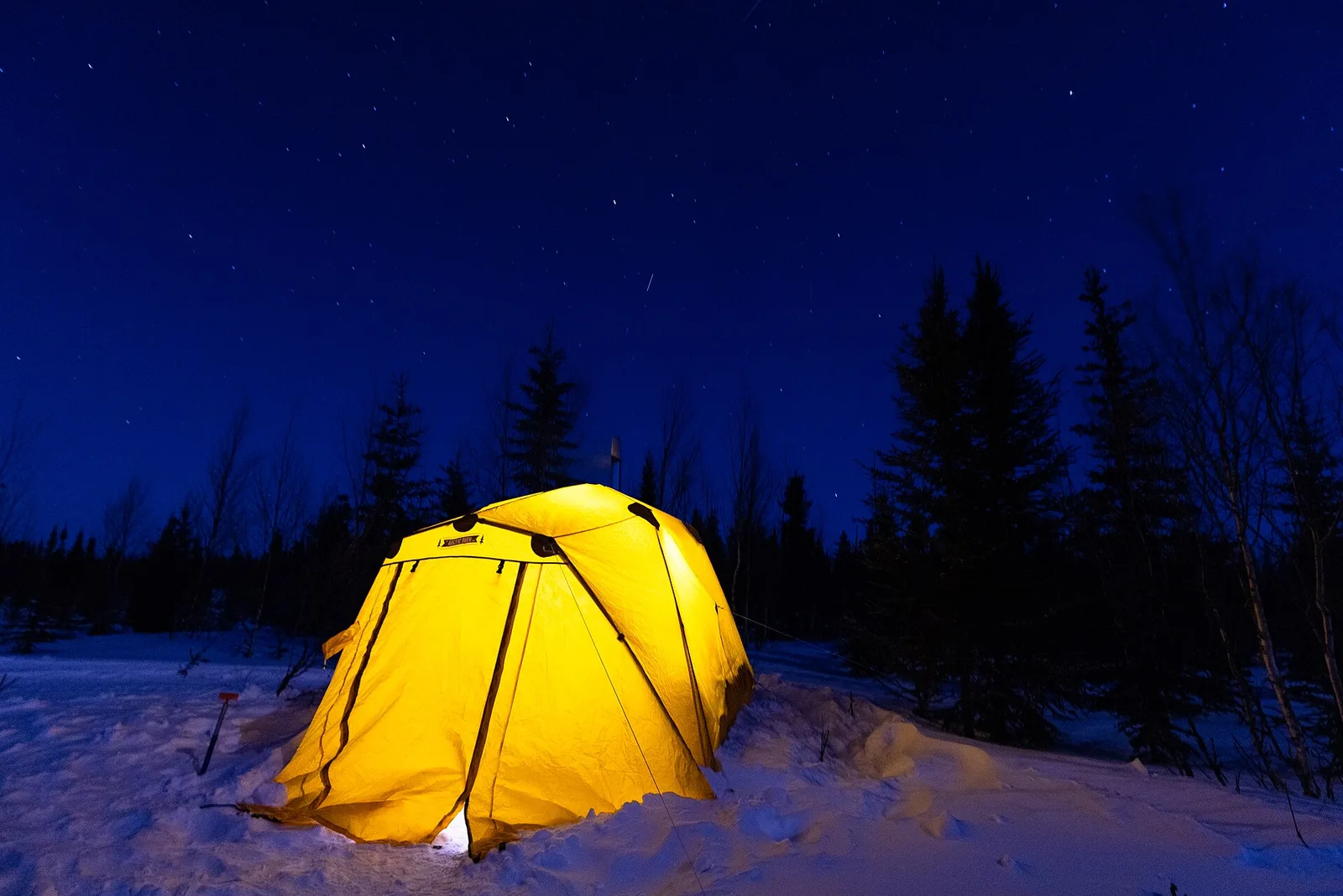
A tents with a stove, known as a hot tent, has an opening where the stove pipe is led out through the fabric. We explain what it is and which types there are in what is a hot tent. We go through how to choose a tent and stove, where the stove should stand, stove pipes, spark arrestors and firewood in tents with a stove.
Our test of a simple hot tent on a night around one degree above freezing shows both sides. While the stove was burning you could sit in a T-shirt, but condensation still came during the night. In the tent stove test, the wood burned out at some point during the night, and the sleeping bag had to do the rest. That is the most important lesson about a stove in a tent: a tent is not insulated, and when the fire goes out it gets cold again. The sleeping bag and sleeping pad must be enough even without the stove. Use the stove for the evening and the morning, and let it burn down before you fall asleep. A stove must never burn without an adult being awake.
The stove must stand on something that can withstand heat and embers. You can see how a stove mat works in practice in our stove mat test.
Sleep: warm from below, dry from within
A good night is built in this order: the sleeping pad, the sleeping bag and, last, what you do before you go to bed.
- Sleeping pad first. Two pads in layers, ideally a foam pad under an inflatable one. The foam pad insulates even if the other one fails.
- Choose the sleeping bag by its comfort temperature. Sleeping bags tested to the EN ISO 23537 standard have three temperatures: comfort, limit and extreme. The comfort temperature is the one to plan by. The extreme temperature is a limit for survival, not for sleeping. Two sleeping bags, one inside the other, also work. The standard does not cover children's sleeping bags, so the temperature rating there is the manufacturer's own and needs a margin.
- Warmth before you go to bed. Eat, pee, change into dry clothes and take a bottle of hot water with you. The checklist further down the page sums it up.
Everything about layers, sleeping pads, food before bedtime and damp sleeping bags is in staying warm in a tent in winter.
Food and water
Eat more than usual, and eat often. Your body uses a lot of energy to keep warm. Warm, fatty and simple food works best, ideally prepared at home so it only needs heating up. A flask of something hot makes the breaks longer and the evening cosier.
Gas in the cold. Ordinary summer gas contains a lot of butane, which stops vaporising at around zero degrees. The stove then hisses weakly or not at all, even though the canister is full. Buy a winter gas blend with propane, and keep the canister warm inside your jacket until you are ready to cook. Even winter gas gets weak in real cold and wind, and spirit stoves lose power too. A multi-fuel stove is the safest choice when it gets really cold. Put the stove on a thin board so it does not melt down into the snow, and cook with a lid on.
Melting snow. Always pour a little water into the bottom of the pot first, otherwise the snow scorches and the water tastes burnt. Fresh snow is mostly air, and a full pot of fresh snow gives you only a splash of water. Take packed snow from a drift or from below the surface instead, and avoid snow that is discoloured or full of pine needles. Let the water boil for a while once the snow has melted. Melt snow for both the evening and the morning, and fill the flasks before you go to bed.
Safety: clear limits
Most things that go wrong on a winter night can be foreseen. Here are the four things to keep an eye on.
Carbon monoxide
Carbon monoxide forms when something burns with too little air. The gas cannot be seen and has no smell. The first symptoms are headache, dizziness, tiredness and nausea, and they are easy to mistake for the cold or ordinary tiredness. That is why three rules apply, without exception:
- Never a barbecue, charcoal stove or gas heater in a tent. Not even a barbecue that has just gone out.
- A stove only in a tent made for a stove, with the stove pipe out, open vents and a battery-powered carbon monoxide alarm close to the sleeping area.
- If there are symptoms: get out into fresh air immediately, and take everyone with you. Call 112 if anyone is dazed, vomiting or hard to wake.
Why carbon monoxide is so dangerous in a tent, and where the alarm should go, is covered in carbon monoxide in a tent.
Hypothermia
Early signs are that someone is shivering, turns pale and cold, and would rather stand still to save heat. Small children may find it hard to say that they are cold, so feel the back of their neck and their forehead. If it is cold there, the child is too cold. Someone who is shivering but awake and talking as usual has mild hypothermia. Do this: get into the tent or out of the wind, change into dry clothes, have something warm to eat and drink, and get into the sleeping bag. If someone becomes sluggish, confused or hard to get through to, or stops shivering while still cold, it is serious. Call 112, wrap the person in warm layers with something windproof on the outside, place bottles of hot water on the outside of their clothes and not against the skin, and handle them gently. We go through how cold it can be for children outdoors during the day in how cold is too cold on the slopes.
Frostbite
Cheeks, nose, ears, fingers and toes first turn white, cold and numb. Look at each other's faces. Warm skin against skin, for example fingers in the armpit or a warm hand against the cheek. Do not rub, and do not use hot water or anything heated. If blisters form, or if colour and feeling do not come back, the injured person needs medical care. A deep injury should only be warmed if it can then be kept warm, because it gets worse if it thaws and freezes again.
Plan B
Before you leave home, decide when you will call it off, for example if someone cannot get warm again, if the gear gets wet or if the weather turns. Tell someone where you are and when you will be back. On the lower steps of the staircase the retreat is close, and that is exactly why they are good places to start.
Winter camping with kids
Children can sleep outdoors in winter, but they need more steps on the staircase than adults do. Start in the garden. Make the evening fun, with a snow lantern, sausages on the fire and torches in the tent, and let sleep be a bonus. A child who wants to go inside at ten o'clock has still done something big.
Our story about Leo's first time camping in a tent is about a warm summer night, but the lessons about choosing an easy-to-reach spot and expecting everything to take longer than you think apply just as much in the snow. Age, sleeping bags for children, peeing at night and when it is time to carry the child inside are covered in winter camping with kids.
The idea behind the whole staircase is the same as when you keep warm at home without electricity: shrink the space and keep the heat close to your body. There is more about that in a warm room.
Where can you camp in winter?
Allemansrätten, the Swedish right of public access, applies all year round, even when there is snow on the ground. It gives you the right to camp for one or two nights in the same spot, but not just anywhere:
- Well away from houses, and the more secluded the better.
- On ground that can take it. Not on fields or pasture, and not in a ploughed driveway or on a snowmobile trail either.
- A couple of tents is fine, for example two or three. If you are a larger group with many tents, you need the landowner's permission.
- National parks and nature reserves have their own rules. Often you may only camp at designated sites, and sometimes not at all. Read the notice board at the entrance or ask the municipality or the county administrative board.
- The municipality may ban camping in parks and recreation areas.
There is more about what you may and may not do in allemansrätten (the right to roam). Most of what you pack for a summer trip is also needed in winter, so feel free to start from our packing list for tent camping and add winter's extra sleeping pad, a warmer sleeping bag, a flask and winter gas.
Before you crawl into your sleeping bag
Frequently asked questions
How cold can you camp in winter?
There is no fixed limit. What decides it is whether your sleeping bag and pads are enough for the night's temperature, and whether you can stay dry. Start with a night a few degrees below freezing close to the house, and only go lower in temperature once that night has gone well. The sleeping bag's comfort temperature is the figure to trust, not the lowest figure on the label.
Do you need a special winter tent?
Not for the first nights in the forest. A sturdy tent that can take a little snow on the fabric and can be ventilated works well in sheltered terrain. In the mountains, where the wind really picks up, you need a tent built for storms and snow loads. If you want to be able to have a fire in the tent, you need a tent made for a stove, with a fireproof stove jack for the stove pipe.
Can you camp anywhere in winter?
The right of public access applies all year round. Camp for one or two nights, well away from houses and on ground that can take it. A couple of tents is fine, but if you are a larger group with many tents you need the landowner's permission. In national parks and nature reserves you can usually only camp at designated sites, and the municipality may have bans in parks and recreation areas.
How do you avoid condensation in a tent in winter?
You can't avoid it completely, because your breath and body give off moisture that freezes on the tent fabric. Keep the vents open unless there is a storm, brush off the snow before you crawl in, leave wet clothes in the vestibule, and shake or brush off the hoarfrost in the morning. Air out your sleeping bag every day.
Does a gas stove work in the cold?
A stove running on ordinary summer gas loses power at around zero degrees, because butane does not vaporise in the cold. Choose a winter gas blend with propane, and keep the canister warm inside your jacket or in your sleeping bag until you are ready to cook. Even winter gas gets weak in real cold and wind. A multi-fuel stove works better then.
Can you cook inside the tent in winter?
Ideally cook outdoors or in the vestibule with the door open, never in the closed sleeping tent. A gas stove in a closed-up tent can produce carbon monoxide, which you can neither smell nor see. A barbecue, charcoal stove or gas heater never belongs in a tent.