
Short answer
Start from your summer packing list and swap out whatever can't handle the cold: two sleeping mats instead of one, a sleeping bag rated for the night's temperature, winter gas, a flask and snow pegs. Then sort the rest into three piles: the body (what you walk in), the break (an insulated jacket for stops, seat pads, a flask and dry mittens on top) and the night (dry base layers, a sleeping hat and tomorrow morning's clothes in the sleeping bag). Children need two of everything that gets wet.
Swap out from the summer list
| On the summer list | Swap for in winter | Why |
|---|---|---|
| One sleeping mat | Two mats: closed-cell foam next to the snow and a thicker one on top | Most of the heat is lost downwards, and the foam mat still insulates if the other mat fails |
| Summer sleeping bag | A sleeping bag rated for the night's lowest temperature, or two bags one inside the other | The comfort temperature is the number to plan by, not the lowest one on the label |
| Ordinary gas canister | Winter gas, or a multi-fuel stove when it gets really cold | Summer gas only sputters weakly around zero degrees, and even winter gas loses power in hard frost and wind |
| Water bottle | A flask and an insulated bottle kept inside a wool sock | Water in an ordinary bottle freezes, and fresh snow takes a long time to melt |
| Tent pegs | Wide snow pegs, or pegs and sticks buried crosswise | Ordinary pegs slip out of loose snow |
| Camp shoes or sandals | Warm slippers or down socks for the tent | Feet get cold fast once the boots come off |
| Head torch | Head torch and spare batteries in an inside pocket | It gets dark early, and the cold drains batteries |
| Insect repellent and sun hat | A small brush and a shovel | Snow has to be brushed off before you crawl in, and the camp has to be dug out and stamped down |
Everything else on the summer list can stay. The table only shows what can't handle the cold.
It's Thursday evening and the hall floor is covered. The summer packing list is still on the fridge from July, with ticks next to tent, sleeping bag, insect repellent and swimwear. Now the same family is going to sleep outdoors for a night in February. You stand there with the list in your hand and see that almost everything is right, but nothing is quite enough. The sleeping mat is too thin, the gas canister is the wrong kind and the water bottle will be a block of ice by breakfast.
This packing list starts where the summer list ends. It shows what to swap out, what to add and where everything should go, so that the right thing is to hand when someone gets cold. The bigger picture on cold, sleep, safety and where you can camp is in our guide to winter camping: camping and sleeping outdoors in winter.
Start with the summer list
Most of what you pack for a summer night in a tent is needed in winter too. So there's no reason to write a new list from scratch. Get out our packing list for tent camping, or the packing list for camping with kids if the children are coming, and do two things:
- Swap out whatever can't handle the cold. The table at the top of the page shows which summer items that applies to, and why.
- Add the winter extras. That's the rest of this page, sorted into three piles.
If you're going on a ski trip and staying in a cabin or a hotel, that's a different list. You'll find it in the packing list for a ski trip with kids. This one is about sleeping outdoors.
The way to remember it: three piles on the hall floor
Don't put everything in one big pile. Make three, and ask yourself when you'll need each thing.
- The body. What you're wearing while you walk. It should ventilate and not be too warm, because sweat is what makes you cold later.
- The break. What you need the moment you stop. An insulated jacket for stops, seat pads, a flask and dry mittens. It should be at the top of the rucksack or the pulk and be easy to get out with your mittens on.
- The night. What needs to be dry and warm when you crawl in. Sleeping mats, sleeping bag, dry base layers and tomorrow's clothes. These are packed deepest inside, in waterproof bags, and opened only in the tent.
The piles also decide where things end up in your pack. That's where most packing lists stop, and it's where winter is won or lost: an insulated jacket at the bottom of the pulk is no use during the break.
Pile 1: the body
Dress in layers you can take off and put on. The aim is to be slightly cool while you walk. If you're warm while moving you get sweaty, and the sweat freezes when you stand still.
- Wool base layers next to the skin. Wool keeps you warm and keeps your skin dry. Cotton gets damp and chills you, so leave the cotton top at home.
- Mid layer in wool or fleece, which comes off on the uphills.
- Windproof shell clothing on the outside. Unlined shells are easiest to regulate, because the warmth comes from the layers underneath.
- A thinner pair of gloves to work in, so you can put up the tent without taking them off.
- A thin hat or a headband to walk in.
- Boots with room for an extra wool sock. A boot that's already tight with one sock will be cold.
- Gaiters if the snow is deep, so it doesn't creep into your boots.
Pile 2: the break
It's during the breaks that the cold gets a grip. The body has just stopped producing heat and your clothes are damp. So everything in this pile should be within reach in half a minute.
- An insulated jacket for stops that's big enough to pull on over all your other clothes. Put it on straight away when you stop, before anyone has time to get cold, and take it off when you set off again.
- Seat pad for everyone. Snow draws the heat out of anyone sitting directly on it.
- A flask with a hot drink and ideally a food flask with soup or stew made at home. The hot food is on the table the minute you stop.
- Food you can eat with mittens on. Fatty and sweet, in pieces that don't freeze rock-hard.
- A warm hat and a warm pair of mittens to change into when the first ones are sweaty.
- Matches in a waterproof bag, and fire starters. Wood is often damp in winter, and the matches will be too if they're loose.
Tip: Put the break items in their own bag in a colour that stands out. Then everyone knows what to look for, even in the dark.
Pile 3: the night
The night comes down to two things: what you lie on, and keeping what you sleep in dry. This pile is packed in waterproof bags and opened only in the tent.
- Two sleeping mats per person. One closed-cell foam mat next to the snow and a thicker one on top. An inflatable mat can fail, and then it's the foam mat that saves the night.
- A sleeping bag rated for the night's lowest temperature. What comfort, limit and extreme mean on the label, and when two bags one inside the other is a better choice, is covered in our guide to winter sleeping bags.
- Dry base layers used only at night. They haven't been worn during the day, so they're properly dry.
- A sleeping hat, that hasn't been sweaty.
- Thick wool socks for the tent and warm slippers, so your feet don't get cold when the boots come off. If you need to go out of the tent in damp boots, a thin plastic bag over your dry socks can keep them dry.
- An insulated bottle with a wool sock over it, so the drinking water doesn't freeze by morning.
- A bottle that can take hot water and has a tight lid, for prewarming the sleeping bag. In the children's sleeping bags it should only stay for a short while before they crawl in.
- A pee bottle or a jar with a lid, labelled so nobody mixes it up with the water bottle.
- Earplugs, in case it's windy and the tent fabric flaps.
What should go in the sleeping bag overnight, and why the day's clothes shouldn't, is covered in our guide to staying warm in a tent in winter.
The camp: tent, stove and water
As well as the tent and stove from the summer list, the camp needs a few things that are only needed in snow.
- Snow pegs. Wide pegs for snow, or ordinary pegs and sticks buried crosswise in a small trench and stamped down.
- A shovel. For levelling the tent pitch, digging out firewood and building a wind wall. The kids will want to borrow it all evening.
- A small brush for brushing the snow off your clothes before you crawl in. Snow that melts in the tent turns into moisture in the sleeping bag.
- Insulation under the whole tent floor, for example an extra foam mat or a space blanket, if you have room.
- A stove that works in the cold. Winter gas goes a long way in the forest when the canister is kept warm in an inside pocket. When it gets really cold and windy, a multi-fuel stove is more reliable.
- A thin board under the stove, so it doesn't melt down into the snow.
- A large pan with a lid and more fuel than in summer. If there's no running water, all your drinking water has to be melted from snow, and that takes time.
How gas behaves in the cold, and how to cook food the kids will actually eat, is in our guide to cooking outdoors in winter. Never cook on your camping stove in a closed tent. A gas stove can produce carbon monoxide when there isn't enough air.
The stove box: if you have a fire in the tent
If you have a tent with a stove, your pack gets heavier but the evening gets warmer. Keep everything to do with the fire in its own box or bag, so nothing gets forgotten and nothing ends up in the wrong place in the tent.
- The stove and the stove pipe, with a spark arrestor on top.
- A fireproof mat under the stove. Our stove mat test showed that a small mat only covers the area directly under the stove. Bear that in mind when you plan the distance to the tent floor and the sleeping bags.
- Work gloves for the stove door and the pipe.
- A water container and a small fire extinguisher within reach.
- Dry wood, thin kindling and fire starters. Assume the wood at the site will be wet or under the snow.
- A saw for the wood.
- A battery-powered carbon monoxide alarm and a spare battery. Test it at home, and hang it close to where you sleep.
How to choose a tent and stove, where the stove should stand and how to burn safely is covered in our guide to tents with a stove. Carbon monoxide can't be seen or smelled, and the first symptoms feel like ordinary tiredness. That's why the alarm is the one item in the stove box that must never be replaced with anything else. Why, and where it should go, is explained in our guide to carbon monoxide in a tent.
The children's kit: two of everything that gets wet
Children play in the snow, fall over and dig. They get wet long before the adults have managed to put up the tent. So the rule of thumb for children is simple: pack two of everything that gets wet.
- Mittens, socks and hats – several pairs of each. One spare pair is rarely enough for a child who spends the whole afternoon digging a snow cave.
- A complete dry change of clothes kept in the night pile, and base layers used only at night.
- Warmer clothes in the pulk than on skis. A child who walks or skis on their own warms up quickly. A child sitting still in a pulk gets cold. Have an extra jacket or a blanket for the pulk.
- A neck gaiter instead of a scarf, and clothes without loose drawstrings. A scarf or a cord can get caught in the pulk or on a branch.
- Windproof mittens with a lining, ideally with wide cuffs the child can put on themselves.
- Reflectors on the jacket and rucksack, since it's dark for most of the evening.
- Their own little rucksack with a camping mug, a water bottle and snacks the child likes. Children get hungry and cold fast, and it helps to be able to get something out themselves.
- Something to do: a small shovel, a snowball maker or a head torch the child can switch on themselves.
The child's sleeping bag and mat, night-time wees and how to tell if a child is cold are covered in our guide to winter camping with kids. There's also a separate list there for the child's kit for the night.
The safety kit that comes every time
This comes along whether you're sleeping in the garden or in the forest. In winter, a small mistake has bigger consequences than in summer.
- A charged phone in an inside pocket. Close to the body, the battery lasts longer. Bring a power bank, and read about how cold affects batteries in our guide to charging your phone without electricity.
- A head torch for everyone, with spare batteries in a pocket close to the body.
- First Aid kit and blister plasters.
- A plan that someone at home knows about: where you are, when you'll be back and when you'll turn back.
- A cold kit on top of your pack: an extra foam mat, something wind- and vapour-proof such as a bivvy bag or a heavy-duty plastic sack, and dry mittens, socks and hats. With it, you can wrap up someone who's getting cold without searching in the dark.
- Knowing about cold. Know what to do if someone gets hypothermic or gets white patches on their cheeks. The signs and the first aid, and the full contents of the cold kit, are in our guide to hypothermia and frostbite.
If the trip goes to the open fells, you need more: map and compass, a bivvy shelter, ski goggles and a shovel that can handle packed snow. Start in the forest and save the mountains until your forest nights have gone well.
What you can leave at home
A winter pack easily gets too heavy. These can stay on the hall floor:
- Insect repellent, swimwear and sun hat from the summer list.
- Cotton clothes, which get damp and chill you.
- A third change of clothes for adults. Dry base layers for the night and extra mittens are enough for one night.
- Large amounts of water. Bring what you need for the journey there and melt the rest on site, if you have the fuel for it.
- Things that are just nice to have. Every item that isn't used still has to be carried or pulled.
Packing the pulk or the rucksack
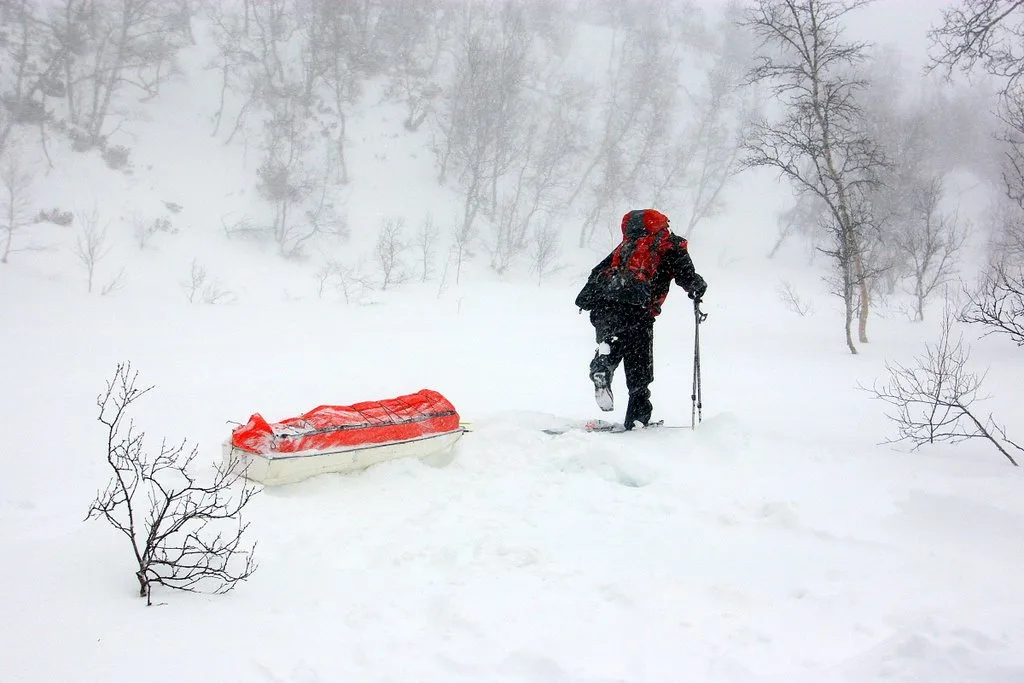
For a night close to the car, one big rucksack per adult will do. Winter sleeping bags and mats take up more space than summer ones, so on longer trips, or when children are coming, a pulk is often the simplest option.
Pack by the piles:
- The night pile deepest inside or at the bottom, in waterproof bags. The sleeping bag must be dry when you arrive, however much it snows.
- The heavy stuff in the middle and close to your back, or low down in the pulk so it doesn't tip over.
- The break bag on top, so the insulated jackets, the flask and the seat pads come out first.
- The shovel and brush easy to reach, because they're needed before anything else is unpacked.
Bring a rubbish bag and carry home everything you brought with you. Where you're allowed to pitch your tent in winter, and the rules in nature reserves and national parks, are covered in our guide to where you can camp in winter.
Winter additions to the summer list
Frequently asked questions
What do you need for winter camping in a tent?
The same basics as in summer, but with warmer sleep and drier clothes. The most important things are two sleeping mats, a sleeping bag good enough for the night's temperature, dry base layers used only at night, an insulated jacket that goes over everything, extra mittens and hats, a flask, a stove with winter gas and snow pegs for the tent. If you have a fire in the tent, add the stove box with a carbon monoxide alarm.
What should children bring on a winter camping trip?
Two of everything that gets wet: mittens, socks, hats and a complete change of clothes. A sleeping bag of the right length and two sleeping mats. Warmer clothes if the child sits in the pulk than if they walk or ski themselves. A neck gaiter instead of a scarf, and clothes without loose drawstrings. Ideally their own little rucksack with a camping mug, snacks and their cuddly toy.
Is the summer packing list enough for winter camping?
It works as a starting point, but several things need swapping out. A summer sleeping mat gets cold against the snow, summer gas sputters weakly in the cold, an ordinary water bottle freezes and ordinary tent pegs hold poorly in loose snow. Swap them as shown in the table on this page, and add what belongs to the break and the night.
How many gloves and hats do you need?
Count on at least two pairs per person: a thinner pair of gloves to work in and a warm pair of mittens for the breaks. Children who play in the snow need more. Hats get sweaty when you walk, so take three if you can: a thin one to walk in, a warm one for breaks and a dry one used only in the sleeping bag.
Should you take a pulk or a rucksack on a winter camping trip?
It depends on the trip. For a night close to the car or the house, one big rucksack per adult will do. Winter gear takes up more space than summer gear, so on longer trips or when children are coming, a pulk is often the simplest option. Pack so that the break items are on top and the sleeping bag stays dry in a waterproof bag.
What extra do you need to pack if you have a fire in the tent?
Keep everything to do with the fire in its own box: the stove and stove pipe with a spark arrestor, a fireproof mat, work gloves, water and a small fire extinguisher, dry wood and fire starters, a saw, and a battery-powered carbon monoxide alarm with a spare battery. The alarm is the one thing in the box that must never be replaced with anything else.
