
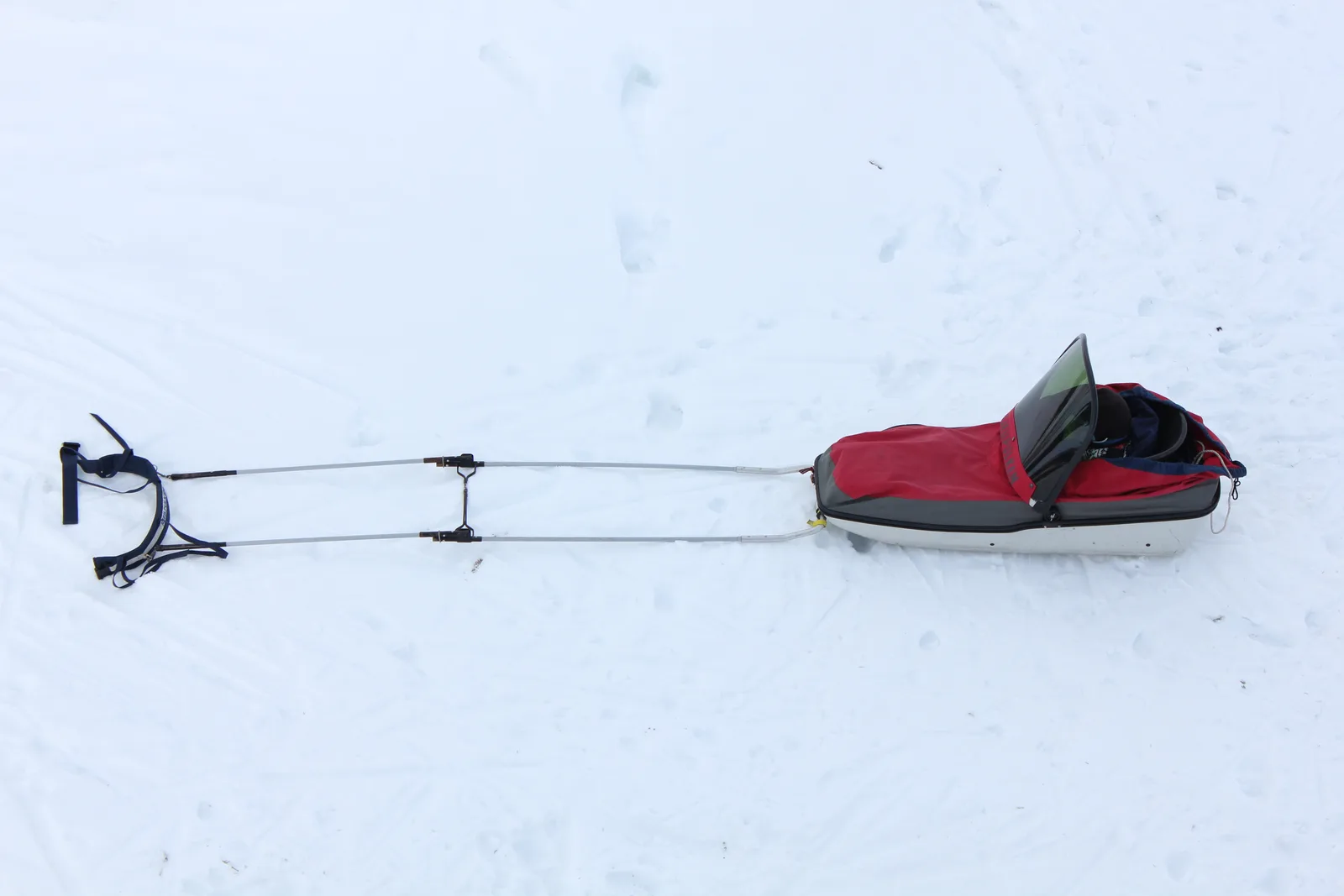
Short answer
Pull the pulk with poles and a hip belt, not with a rope, whenever there is a slope or a child is riding in it. Pack heavy items low and in the middle, and what you need at breaks on top at the front. The child in the pulk sits still close to the cold ground and needs more clothes than the person pulling. Feel the back of the neck and look at the cheeks at every stop, and plan on a couple of hours at a time.
Rope, poles or brake line
| Towing set-up | Suited to | Keep in mind |
|---|---|---|
| Rope | A light load over a short distance on flat ground, for example from the car to the cabin | The pulk runs into your legs downhill and slides sideways on slopes. Never with a child in the pulk |
| Poles (shafts) | Any trip over rough terrain, and always when a child is riding | Keeps its distance downhill and steers the pulk past trees, even when traversing a slope. Can snap on turns that are too sharp |
| Brake line at the back | Downhill stretches with a child in the pulk, when there are two adults | The person walking behind brakes and holds back so the pulk does not tip over. Attach it so it does not end up under the runners |
The belt should have a quick-release buckle, so the person pulling can unhitch the pulk straight away if something happens.
It is Saturday morning, and the car is in the car park by the lake. The pulk has been packed since last night: the tent at the bottom, the sleeping bags in waterproof bags on top, the flask and the sausages at the very top. Only one thing is missing, and he is already sitting in it, four years old and dressed like a little astronaut. After half an hour on the path along the shore, the adult pulling is so warm that the jacket comes off. The child in the pulk has not said anything for a while.
That is what the pulk is all about. It is a pack animal that lets you bring the whole camp without carrying it on your back. And it is a ride for a child who sits completely still, close to the cold ground, while the rest of you sweat. This guide covers both: how you pull and pack, and how the child is doing back there.
Two thermostats and the stop check
Two thermostats. The one pulling has a furnace inside, and the one riding has none. You will always be at different temperatures, and you cannot go by how you feel yourself. Take layers off yourself when you get warm, and put more on the child than you think is needed.
The stop check is three words to go through at every stop, in the same order:
- The neck. Slip your hand into the back of the child's neck. A cold neck means the child is cold.
- The cheek. Look for white patches on the cheeks, nose and ears, and chat for a while. Is the child answering as usual?
- The hitch. Check the belt, the pole attachments and the cords on the cover. Has the load shifted?
If you do the stop check every time, you notice both a cold child and a loose strap before they become a problem.
Rope or poles
A pulk can be pulled with a rope or with two poles, also called shafts. You notice the difference on the first downhill stretch.
With a rope the pulk slides straight into the heels of the person pulling as soon as there is a slope. On a sidehill it pulls downwards to the side, and between trees it takes its own route round the trunks. A rope is enough for a light load over a short distance on flat ground.
With poles the pulk keeps its distance. The poles stop it bumping into your legs on the way down, and they steer it so it follows on the same side of the trees, even when you are traversing a slope. That is why poles are a must when a child is riding in the pulk. A child must never ride in a pulk that can catch up with the person pulling.
Two things to know about the poles:
- They can take pulling but not twisting. On a turn that is too sharp, or when the pulk tips over on a sidehill, a pole can snap. Take the turns wide.
- The attachments should be tight. If the straps are slack, the pulk will bang into your back all day. Tighten them before you set off.
A brake line is a rope attached to the back of the pulk. On downhill stretches, the second adult walks behind and holds back so the pulk does not pick up speed or tip over. That is one of the reasons it is best to be two when a child is riding.
The harness
The harness is a hip belt, often with shoulder straps, that the poles attach to. It lets you pull with your hips and legs instead of your arms and shoulders. The pulk is easier to pull, and your back stays drier than with a rucksack, because there is no gear pressing against your clothes.
- Quick-release buckle on the belt. You should be able to unhitch the pulk in one movement, even if you fall on a slope.
- The belt on your hips, not on your stomach. The pulling force should go through the pelvis.
- Try it at home. Adjust the length of the poles and the harness wearing the clothes you will have on, not in the hallway in thin trousers.
On a longer trip, a spare strap, a spare rope and some tape are worth their weight. It is usually the attachments that break, and those are what you need to be able to fix out there.
Toy sledge, ackja or child pulk
The toy sledge from the sledging hill works for pulling a bag of firewood or a holdall a short distance from the car on flat ground. It has no poles, cover or protection, tips over sideways easily and is not made for rough terrain.
Ackja is really the Sami people's large sled, built like a boat with a keel and pulled by a reindeer. Today many people use the word for a larger gear pulk. A pulk like that has a hull that runs steadily in a ski track, a waterproof cover stretched over the load and attachments for poles. It is built to follow round bends without tipping over.
The child pulk is a pulk with a seat or a lying position for a child. What sets it apart from a gear pulk is the protection: a roll bar in case it tips over, a windscreen in front of the face, a cover over the legs and a harness that keeps the child in place. Many can also be reclined. If the pulk is new, try it on a short trip first, so you know how it behaves before it really matters.
| Sledge | Good for | Not for |
|---|---|---|
| Toy sledge | Short distances on flat ground, firewood from the car | Rough terrain, downhill stretches, children on a trip |
| Ackja or gear pulk | Gear for the camp, longer trips | Children, if it has no protection or harness |
| Child pulk | Children who cannot manage to walk or ski on their own | Heavy gear around the child |
Packing the pulk
What to bring is in the winter camping packing list. This is about where things go.
- Heavy items low and in the middle. Then the pulk runs steadily and does not tip over on slopes. The tent, the water and the fuel belong there.
- Evenly on both sides. A pulk that weighs more on one side pulls crooked all day and rolls onto its side on the first sidehill.
- Break items on top at the front. The break jacket, the flask, the sit mats and dry mittens should be easy to get out without undoing the whole cover.
- Tighten the cover hard. It does more than keep the snow out. The cover is what holds the load in place when the pulk is bouncing about.
- Nothing hard left loose. A loose frying pan or axe will punch holes in both bags and the cover.
When gear and a child share a pulk
Preferably, don't. Whatever rides with the child should be light and soft, for example an extra blanket or the child's own little bag with a cuddly toy and mittens. Put the heavy things in a separate pulk or in a rucksack on the other adult.
The reason is simple. On a downhill stretch everything in the pulk wants to move forwards, and nothing hard should be able to slide into the child. It is also much easier to lift the child out at a break when there is no gear lying around.
The child in the pulk
The one sitting in the pulk does not move, sits close to the ground where the air is coldest and gets the wind from your own pace in the face. It can be cold and unpleasant back there even when you, pulling, do not think it is cold at all. The whole plan starts from that.
The clothes
The child needs warmer clothes than if they had walked or skied on their own. Dress them in several thin layers with wool next to the skin and something windproof on the outside, and put the child in a roomy footmuff. A footmuff that is too snug keeps them less warm.
- Hat, neck gaiter and mittens, even if the hands are down inside the footmuff.
- A mat that absorbs bumps and does not soak up moisture under the child, for example a piece of closed-cell foam.
- Water-free cream on the cheeks when it is below freezing, preferably a while before you go out.
- Sunglasses when the sun is low over the snow, even behind the windscreen.
The harness should be just snug enough around the footmuff. The arms should be free but protected under the cover, so the child can move, point and eat a sandwich.
Not too warm either
The other trap is the opposite. A child wrapped up in a footmuff, cover and windscreen in sunshine can get hot and sweaty, and sweat turns cold in the next patch of shade. If the neck feels warm and damp, take off a layer. In damp weather and strong sun, the footmuff needs airing now and then.
Silence is a sign
Young children don't always say they're cold. They go quiet, sit completely still or want to be carried. That is why the stop check starts at the neck and not with the question "are you cold?". A child who is quiet and still in the pulk should be taken out, warmed up and given something sweet to drink, lukewarm for the youngest, before you carry on. How to recognise and deal with hypothermia and frostbite is in the guide to hypothermia and frostbite.
Clear limits for children in a pulk
- Under six months, the child does not ride in a pulk. The very youngest are particularly vulnerable to jolting, cold and overheating.
- Children under three stay at home when it feels like minus ten or colder, with the wind included.
- Older children in the pulk get cold faster than their siblings who walk or ski on their own, because they sit still. When it is colder than minus ten or the wind is strong, it is only short trips close to the car or the cabin.
- The wind counts. At minus ten and five metres per second, it feels like minus 17 on the skin. Wind chill and how it is calculated are covered in the guide to cold on the ski slopes with kids.
- A child who is ill does not go. If you are unsure, ask your child health clinic before the season.
How long?
There is no set time, and the key question is not how far you go but that everyone has a good trip. A couple of hours in the pulk is plenty for a small child, with frequent breaks where the child gets to climb out and move about.
- Shorter when it is cold or windy. Sitting still is what chills them.
- Plan the trip around the child. Choose a destination that is fun to reach, such as a barbecue spot, a cabin or a lean-to to sleep in over winter, and turn back too early rather than too late.
- Not straight after a meal. The rocking can make the child travel sick. But do not start with a hungry child either, because the body needs energy to stay warm. Eat, wait a while and then set off.
- Keep it short the first time. A one-hour trip to a familiar place tells you more about how your child gets on than any amount of advice.
If you want the child to ski on their own after a while, read about cross-country skiing with kids. Many families switch between the pulk and the child's own skis on the same day.
The terrain
A pulk full of gear does not mind bumps. A child does. Hard knocks and a lot of jolting are not good for a small back or a small head, especially when the child is sitting up.
- Choose smooth tracks and paths, and avoid sidehills and dense forest.
- Walk steadily. An even pace means fewer knocks, and you get less sweaty.
- Lay the child down on downhill runs if the pulk reclines. The pulk becomes more stable and the child is better protected.
- Loose snow: go ahead first without the pulk and stamp or ski out a track. It saves both you and the pulk.
- In the cross-country ski tracks the pulk goes beside the classic tracks, never in them.
- Do not sledge downhill on hiking trails where others are walking. If the children want to sledge themselves, that belongs on a sledging hill, such as the sledging hills in Stockholm or the sledging hills in Gothenburg.
In the mountains, the flat light makes wind ridges and hollows hard to see, and the wind is stronger. More rules apply there, and you will find them in the guide to winter camping in the mountains.
If you are crossing a lake, remember that a pulk with gear and a child weighs more than you do. Never pull out onto ice you do not know will hold, and read ice safety with kids before the season.
Arriving at camp
When you stop for the night, the pulk does more good than just as transport. Stood on its edge it becomes a windbreak for the stove, and with a mat on top it becomes a bench. The child who has sat still the whole way should get up and move about straight away, ideally with a job, like stamping out the tent pitch or collecting twigs, while you adults put on your break jackets.
Start with the warm stuff. Out with the flask, something sweet to drink and then food. How to cook in the cold is covered in cooking outdoors in winter, and how to get drinking water out of the snow when the flask is empty is in melting snow for water. How to make the whole night go well for the children is in winter camping with kids, and the bigger picture, from the garden to the mountains, is in winter camping.
The stop check – at every break
Three things in the same order every time you stop. It takes half a minute.
Frequently asked questions
Should you pull a pulk with a rope or with poles?
With poles as soon as there is a slope, when the terrain is uneven or when a child is riding in the pulk. The poles keep the pulk at a distance so it does not run into the legs of the person pulling on downhill stretches, and they steer it past trees and rocks. A rope is enough for a light load over a short distance on flat ground, for example from the car to the cabin.
How old does a child have to be to ride in a pulk?
A child under six months does not ride in a pulk. Children under three stay at home when it feels like minus ten or colder, with the wind included. Older children sit still in the pulk and get cold faster than someone walking, so when it is colder than minus ten or the wind is strong, it is only short trips close to the car or the cabin.
How long can a child sit in the pulk?
There is no set time, but a couple of hours is plenty. Stop often, let the child climb out and move about, and keep the trips shorter when it is cold or windy. The first time, a shorter trip to a place you know the child likes is enough.
How do you know if the child is cold in the pulk?
Feel the back of the neck with your hand: if it is cold there, the child is cold. Look for white patches on the cheeks and listen for silence. A child who goes still and quiet in the pulk may be getting hypothermic, even if the person pulling is sweating.
How do you pack a pulk?
Put the heavy things low and in the middle so the pulk runs steadily and does not tip over. Spread the weight evenly on both sides. Put what you need at breaks on top at the front, and tighten the cover so the load cannot shift.
Can a child and gear ride in the same pulk?
Only light, soft things, and never anything that could slide into the child on a downhill stretch. Put the heavy things in a separate pulk or in a rucksack on the other adult. It is also easier to lift the child out at a break when there is no gear lying around.