
Short answer
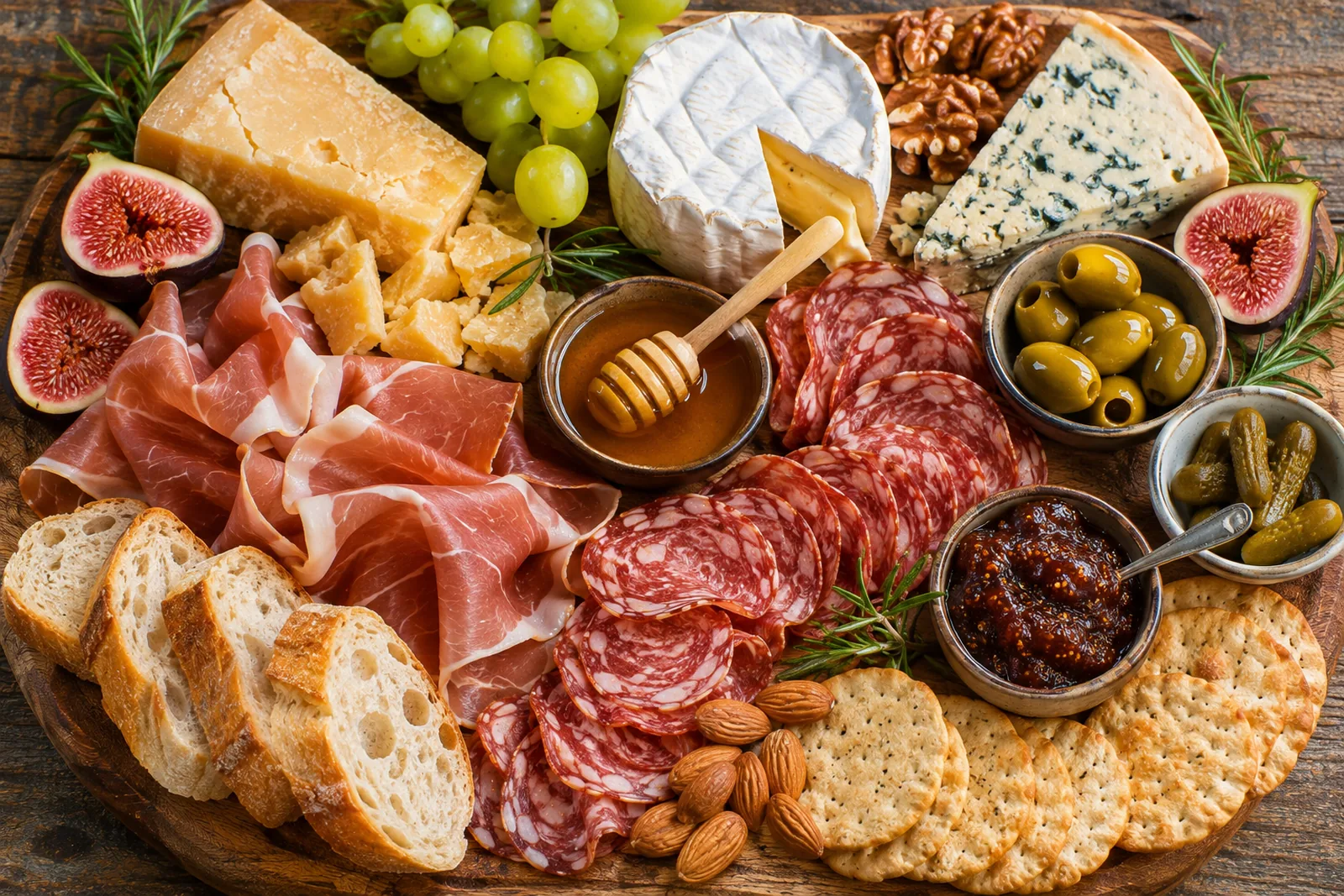
A good charcuterie board has three to five cheeses with different characters (an aged hard cheese, a creamy one and a blue or goat's cheese), three to four kinds of charcuterie, something sweet such as fruit, jam or honey, something salty and sharp such as olives and pickles, nuts and bread or crackers. Allow 30–40 grams of cheese and the same amount of charcuterie per person as a starter, 50–75 grams of each as finger food and 100–125 grams of each as a full dinner.
How much cheese and charcuterie per person?
| Occasion | Cheese per person | Charcuterie per person | Side dish |
|---|---|---|---|
| Starter before dinner | 30–40 g | 30–40 g | A handful of fruit, a few crackers |
| Finger food with drinks | 50–75 g | 50–75 g | Fruit, nuts, olives, bread |
| Full dinner | 100–125 g | 100–125 g | Plenty of bread, dip and vegetables |
| Cheese board as dessert | 50–75 g | – | Fruit, honey, crackers |
| Children as dinner | 50 g | 50 g | Fruit, vegetables, bread |
Guide amounts for adults. If the guests eat a lot of bread and dip, less cheese and charcuterie is needed. Small children eat about half of what is listed for children.
A charcuterie board is perhaps the most rewarding thing you can put out when people come round. No hob, nothing that can burn or be undercooked, and it still looks like a party. But the difference between a board that disappears in ten minutes and one that looks like piles of sandwich fillings is bigger than you might think. It comes down to three things: that the cheeses and charcuterie complement rather than resemble each other, that the amount is right for the occasion, and that the board is built in a particular order.
This guide goes through everything from the basics: what a charcuterie board is, which cheeses and which charcuterie go together, how much you need per person, how to build the board step by step and what can be prepared. At the bottom there are eleven ready-made boards for different occasions, from a classic cheese and charcuterie board to a snack board for kids.
What is a charcuterie board?
The word charcuterie comes from French and means roughly prepared meats: cured ham, salami, sausage, pâté and terrine. In France and Italy, a platter of such things, together with cheese, bread and pickles, has long been a simple starter or a light supper. What is called a charcuterie board today is a more lavish version, where cheese, charcuterie, fruit, nuts, jam, crackers and bread are packed tightly on a wooden board or stone slab so it looks abundant.
A charcuterie board can be a starter eaten before dinner, finger food left out while the guests mingle, or the whole dinner. It is basically the same board, but the amount and the make-up differ a lot. A cheese board is a relative with only cheese and extras, and is often served as dessert or after the main course.
How much per person?
The amount is what most often goes wrong. Either there is so much that half the board is left over, or the cheese runs out before everyone has had some. The rule of thumb is that cheese and charcuterie are counted separately, and that the amount depends on what else is being served.
- As a starter: 30–40 g cheese and 30–40 g charcuterie per person. The starter should whet the appetite, not fill people up. The guests need to have room for the main course.
- As finger food with drinks: 50–75 g cheese and 50–75 g charcuterie per person, plus fruit, nuts and bread. That applies when the board is out for a while before dinner or during a drinks evening with other food.
- As a full dinner: 100–125 g cheese and 100–125 g charcuterie per person. Here the extras matter: bread, dip, salad and vegetables fill people up and make the cheese and charcuterie go further.
The more extras, the less cheese and charcuterie you need. A board with two dips, lots of bread and a salad on the side gets by with the lower figure. A board with only cheese, charcuterie and a little fruit needs the higher one. The table on this page sums up the amounts, including for children and a cheese board as dessert.
The cheese guide: four families that complement each other
The simplest way to get a balanced board is to choose one cheese from each family. That gives different textures, different flavours and different colours, and no cheese competes with another.
- Aged hard cheese. Comté, parmesan, aged gouda, manchego, Prästost, Västerbotten cheese or Grevé. Nutty, salty, sometimes with small crystals. Cut into thin slices or broken into chunks. The hard cheese is the backbone of the board and the cheese most guests reach for first.
- Creamy white-rind cheese. Brie, camembert or a Swedish white-rind cheese. Soft, buttery and mild. It needs to stand out the longest before serving to turn creamy. Leave it whole or as a large piece, with a small piece cut away so the guests understand it is there to be cut.
- Blue cheese. Gorgonzola, roquefort, stilton or a Danish blue. Strong, salty and a little peppery. A small piece is enough – not everyone likes it, but those who do will look for it. Goes especially well with honey, pears and walnuts.
- Goat's cheese or fresh cheese. Chèvre, a mild goat's cheese, mozzarella, burrata or a cream cheese. Tangy and fresh, and gives a white colour that brightens the board.
Three cheeses are enough for four to six people, five cheeses for a bigger party. More kinds than that rarely make it better, just messier. Better larger pieces of fewer cheeses.
Take out the cheese in time. Cold cheese tastes of much less. Take out hard cheese 30–45 minutes before serving and white-rind cheese up to an hour before. Only cut the hard cheese once it is at room temperature, so it crumbles less.
The charcuterie guide: sweet, fatty, spicy and lean
The charcuterie follows the same principle as the cheese. Choose kinds that differ in flavour and appearance.
- Sweet and mild: cured ham such as prosciutto di Parma, San Daniele or serrano. Thin, salty and sweet. Laid in loose folds, not flat.
- Fatty and soft: mortadella, coppa or a soft pâté. Adds creaminess among the salty things.
- Spicy: salami, chorizo, fuet or a pepper salami. Folded into quarters and laid in a winding row, the so-called salami river.
- Lean and dark: bresaola or air-dried reindeer meat. Dark red and lean, and gives a contrast in colour.
Three kinds are usually enough, four on a large board. If lots of people do not eat pork, bresaola, air-dried reindeer, turkey salami and smoked turkey can replace most of it.
The extras: sweet, salty, crunchy and fresh
The extras are what turn a charcuterie board into an experience rather than a plate of cold cuts. Think in four categories and include at least something from each.
- Sweet: grapes, figs, pears, apples, apricots, dates, honey, fig jam, quince paste (membrillo) or a Swedish jam such as lingonberry or cloudberry. The sweet lifts the salty.
- Salty and sharp: olives, cornichons, pickled onions, capers, grilled peppers or artichokes. The acidity cuts through the richness.
- Crunchy: almonds, walnuts, pistachios, roasted chickpeas, grissini, crispbread and thin crackers.
- Bread: baguette, focaccia or a rustic sourdough in thin slices. A dinner board needs more bread than you might think.
Classic pairings that always work: comté with honey, blue cheese with pears and walnuts, manchego with membrillo, brie with figs, prosciutto with melon or figs, and aged Prästost with lingonberry jam.
How to build the charcuterie board step by step
- Choose a board. A large wooden board, chopping board or stone slab. For six people you need about 40 × 30 cm. Better too small than too big – a full board looks generous, a half-empty one looks stingy.
- Set out the bowls. Small bowls of honey, jam, olives and dip go on first, spaced out across the board. They become fixed points to build around.
- Place the cheeses as anchors. Spread the cheeses across the board so they do not sit next to each other. Leave some whole, cut some into slices or triangles.
- Make the salami river. Fold the salami and lay it in a winding row between the cheeses. Lay the cured ham in loose folds or roses, and roll the bresaola or mortadella.
- Fill with fruit and nuts. Put bunches of grapes, fig halves, apple slices and nuts in the gaps that are left. Put the same colour in different places for variety.
- Bread and crackers last. Crackers and bread go along the edges or in their own basket just before serving, so they do not absorb moisture. Top with a few sprigs of rosemary or thyme.
Set out one cheese knife per cheese so the blue cheese does not end up flavouring the brie.
Preparation and how long it keeps
A charcuterie board is perfect for preparing ahead, but not as far ahead as you like.
- The day before: shop, make dips, roast nuts and chickpeas. Put pickles and jam in small bowls covered with cling film.
- An hour or so before: take out the cheese. Lay out the cheese, charcuterie and any fruit that does not brown, cover with cling film and keep somewhere cool.
- Just before serving: cut the apples and pears, add the bread and crackers.
Charcuterie and cheese are chilled foods. Livsmedelsverket (the Swedish Food Agency) advises that they are left out for no more than four hours at room temperature up to 20 degrees, three hours at 25 degrees and two hours if it is warmer. If it is a long evening, lay out half the board and top up from the fridge after a few hours. Anything that has been out for a long time should not go back in the fridge to be served again the next day.
Leftovers that have not been out long are kept in the fridge in a lidded container. Hard cheese keeps for several days wrapped in baking paper. Opened sliced charcuterie should be eaten within the time stated on the packet.
Pregnancy and small children
Pregnant women can eat quite a lot from the board, but not everything. Livsmedelsverket advises pregnant women to avoid mould-ripened and washed-rind cheeses such as brie, camembert and gorgonzola. Hard cheeses such as comté, parmesan and Prästost are fine. Air-dried and cold-smoked charcuterie, such as prosciutto and salami, should have been in the freezer for at least three days or be heated until steaming hot. Sliced ham and other packaged cold meats should have been packed no more than a week earlier. The easiest thing is to put a few pregnancy-friendly favourites on a separate plate.
Small children can choke on food, and a charcuterie board is full of small round things. 1177 (the Swedish healthcare advice service) advises that the youngest children wait before having whole nuts, almonds, grapes and peanuts. Cut grapes, cherry tomatoes and olives lengthways, cut sausage into sticks instead of round slices and remove whole nuts from the children's part of the board. Children should sit down when they eat. If you want to make a separate board for the children, there is a whole guide here: snack board for kids.
Eleven charcuterie boards to choose from
They all build on the same base – anchors, river and filled gaps – but with different flavours and for different occasions.
- Classic cheese and charcuterie board – the basic board with three to five cheeses, three to four kinds of charcuterie, fruit, nuts, crackers and honey. Start here if you are making your first board.
- Italian antipasti board – prosciutto, salami, mortadella, mozzarella or burrata, parmesan, olives, grilled vegetables, grissini and focaccia.
- Spanish tapas board – jamón serrano, chorizo, fuet, manchego, Marcona almonds, olives, pan con tomate and membrillo.
- Christmas board with charcuterie and cheese – Christmas ham, smoked sausage, Prästost and Västerbotten cheese, fig jam, gingerbread with blue cheese and clementines.
- Luxury charcuterie board for New Year's Eve – cured ham, bresaola, truffle salami, brie, comté and bleak roe on blinis, with amounts as a starter and as finger food at midnight.
- Snack board for kids – mild cheeses, turkey and ham, rainbow-coloured fruit, veggie sticks and dip, with advice for the youngest.
- Charcuterie board on a budget – smart choices of cheese and charcuterie from an ordinary supermarket, homemade dip, roasted chickpeas and seasonal fruit.
- Alpine board – Gruyère, Emmental and Appenzeller from Switzerland, Bergkäse and Tiroler Speck from Austria, with pears and walnuts.
- German Brotzeit board – Bavarian Obatzda, liver sausage, ham, pretzels and sweet mustard.
- Polish charcuterie board – grilled oscypek with lingonberries, kabanosy, kiełbasa, smalec and pickled cucumber.
- Grazing table – a whole sharing table for 15–30 guests, with amounts and a shopping list.
Relatives of the charcuterie board
If you want something next to the board, or something built on the same flavours in another form, try these:
- Italian sushi – prosciutto rolled round cream cheese, mozzarella and sun-dried tomatoes, cut into pieces like sushi.
- Tapas salad with fuet and olives – a bowl that turns the Spanish board into a dinner.
- Pickle tacos – salami slices folded like taco shells around cream cheese and gherkin.
- Baked tomato and burrata dip – a warm dip that looks great in the middle of an Italian board.
- Roasted chickpeas – a crunchy, cheap nibble that replaces nuts.
If you want to serve more small dishes next to the board, canapés, crostini, devilled eggs, skewers and mini quiches are collected in party finger food.
If the board is the starter at a dinner party, you will find complete menus in our new Year's Eve menu, and for the Christmas table there is more in the guide to Christmas food.
Common mistakes
- Too many kinds. Eight cheeses in small pieces are harder to eat and look messier than three in large pieces.
- Cold cheese. Cheese straight from the fridge tastes of almost nothing, and the creamy cheese never turns creamy.
- Flat charcuterie. Flat slices in a pile stick together. Fold, roll and lay in folds.
- Only salty things. Without anything sweet and sharp, the board gets heavy after a few bites.
- Crackers too early. Crackers that have sat next to moist fruit for an hour go soft.
- Everything out all evening. Lay out in batches and top up from the fridge.
Shopping list for a classic charcuterie board
Tick off in the shop. The amounts are in the table above.
Frequently asked questions
What should go on a charcuterie board?
Three to five cheeses with different characters, three to four kinds of charcuterie, something sweet such as fruit, honey or jam, something salty and sharp such as olives and cornichons, nuts and bread or crackers.
How much cheese and charcuterie do you need per person?
As a starter, 30–40 grams of cheese and 30–40 grams of charcuterie per person. As finger food with drinks, 50–75 grams of each. If the board is the whole dinner, you need 100–125 grams of each plus plenty of bread and extras.
How long can a charcuterie board be left out?
Livsmedelsverket (the Swedish Food Agency) advises that chilled foods are left out for no more than four hours at room temperature up to 20 degrees, three hours at 25 degrees and two hours when it is warmer. Lay out in batches and top up from the fridge.
How far ahead can you lay out a charcuterie board?
Cheese and charcuterie can be laid out an hour before and covered with cling film. Dips, nuts and cut fruit that does not brown can be prepared earlier. Bread and crackers go on last so they do not go soft.
Which cheeses go on a charcuterie board?
Choose one from each family: an aged hard cheese such as comté or parmesan, a creamy white-rind cheese such as brie, a blue cheese such as gorgonzola and ideally a goat's cheese or fresh cheese. That gives different flavours, textures and colours.
Can pregnant women eat from a charcuterie board?
Partly. Hard cheese is fine. Mould-ripened cheeses such as brie and gorgonzola should be avoided. Air-dried and cold-smoked charcuterie should have been in the freezer for at least three days or be heated until steaming hot, and sliced cold meats should have been packed no more than a week earlier.
How do you make a charcuterie board for children?
Choose mild cheeses, turkey and ham, fruit, veggie sticks and a mild dip. For the youngest, grapes and tomatoes are cut lengthways, sausage is cut into sticks and whole nuts are removed completely.
