Popular searches

    Classic cheese and charcuterie board – three cheeses, three kinds of charcuterie and a salami river

    Anchors first, then the salami river – and fill every gap
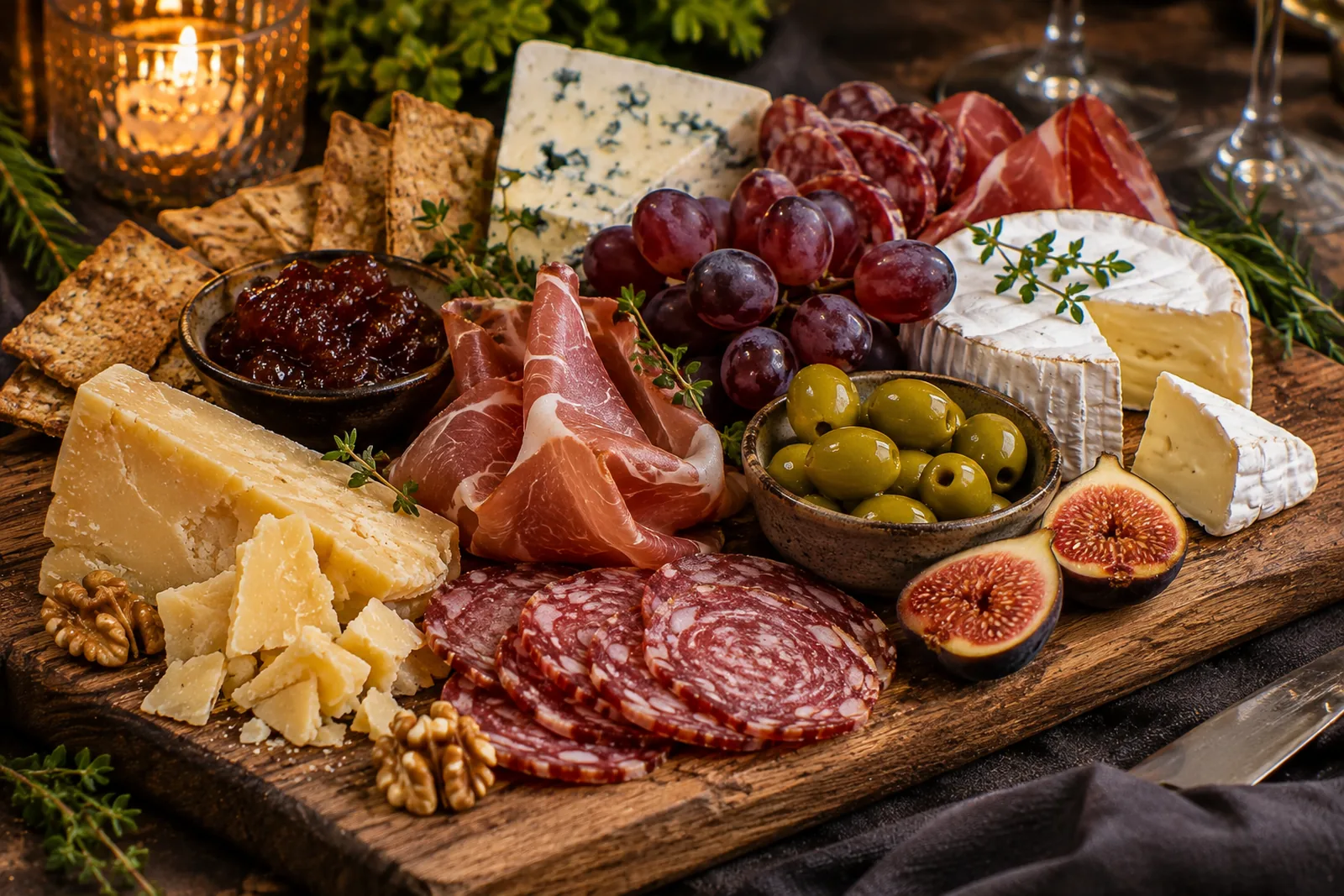
    • 6 servings as a starter
    • Time: 30 min + 30 min for the cheeses to come to room temperature
    • Difficulty: Easy
    • 15 ingredients
    • 10 steps
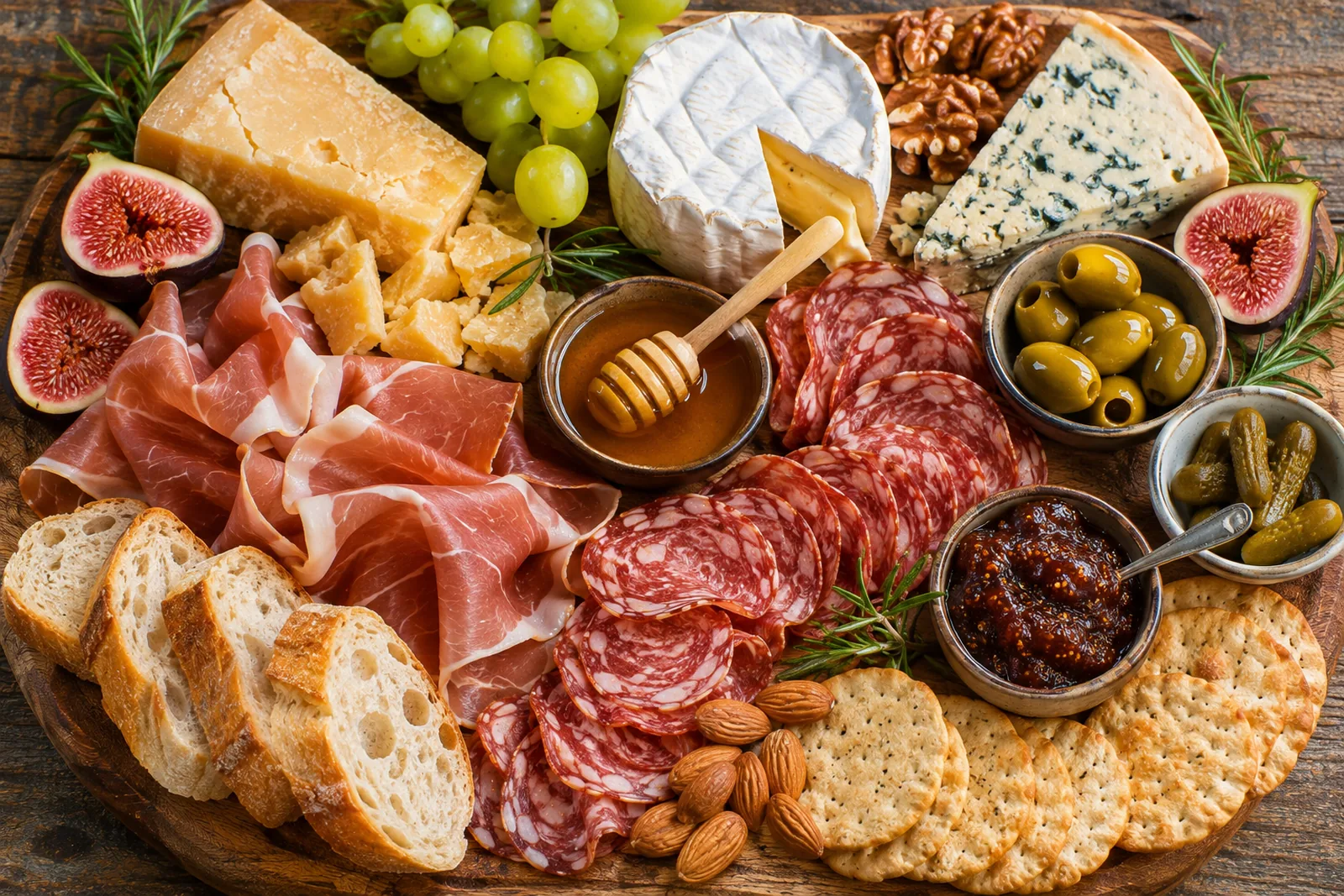
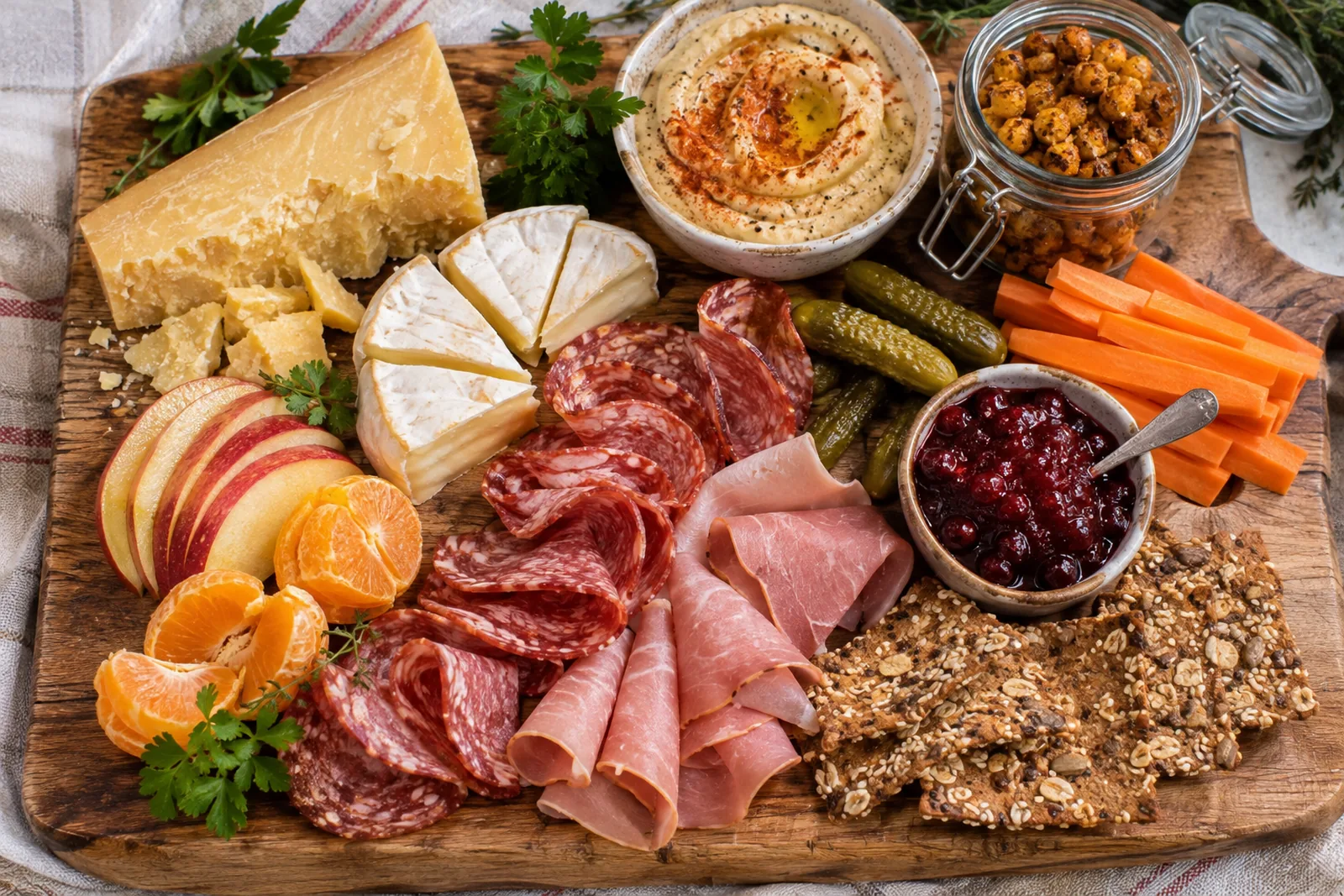
    Large wooden board with slices of brie, chunks of aged cheese and blue cheese, a winding row of folded salami, cured ham, green grapes, walnuts, crackers and a small bowl of honey.

    A cheese and charcuterie board looks like something that requires a chef, but mostly it requires order. No hob is involved, just a couple of knives, a large board and a plan for what goes on first. If you do it in the right order, the board ends up full and generous by itself, and no one needs to see that it took half an hour.

    Amount per person

    The hardest thing about a charcuterie board is knowing how much you need. Work it out according to what the board is for:

    • As a starter before a main course: 40–50 grams of charcuterie and 40–50 grams of cheese per person, plus a handful of fruit and a few crackers.
    • As nibbles with drinks or at a drinks party: 60–75 grams of charcuterie and 60–75 grams of cheese per person. Add more bread and crackers, as people stand and eat for a long time.
    • As a full dinner: 100–125 grams of charcuterie and 100 grams of cheese per person, plus bread, fruit, vegetables and ideally one or two spreads or dips.

    It's better to keep some in the fridge and top up than to put everything out at once. Cheese and charcuterie that has been out for several hours turns sweaty and dry, and what stays in the fridge keeps.

    Which cheeses and which charcuterie?

    The cheeses are chosen so they differ in texture and flavour:

    • A hard, aged cheese: aged Gouda, prästost, Comté or parmesan. It's easy to cut into pieces and holds up well out of the fridge.
    • A creamy cheese: Brie, Camembert or a mild white mould cheese. It's best once it has come to room temperature.
    • A strong cheese: blue cheese, gorgonzola or a goat's cheese. A small piece is enough, so buy the least of this one.

    If you have five cheeses, add a mild semi-hard cheese (such as a young Gouda) and a smoked cheese. More than five makes the board cluttered.

    The charcuterie is chosen so it looks different on the board:

    • Salami in thin round slices – it forms the salami river.
    • Air-dried ham such as serrano or prosciutto – it's folded into soft folds.
    • Something chunkier, such as a spicy chorizo, a smoked sausage or a piece of fennel salami cut into sticks.

    Method

    1. Take out the cheeses. Put the cheeses on the board or a platter 30–60 minutes before the guests arrive. Brie and blue cheese in particular taste of more when they're not fridge-cold. Leave the charcuterie in the fridge for now.
    2. Set out the bowls. Place the bowls of honey, olives and cornichons first, spread across the board, ideally in a triangle. They are the board's anchors and everything else is built around them.
    3. Lay out the cheeses. Place the cheeses far apart from each other, so there's cheese in every part of the board. Cut up part of each cheese and leave the rest whole: the Brie in wedges, the hard cheese in pieces or thin slices and the blue cheese in a chunk guests can crumble themselves.
    4. Make the salami river. Fold each slice of salami in half and then in half again, so it becomes a little quarter. Lay them close together in a row winding in an S-shape between the cheeses, like a river through the board.
    5. Lay the ham in folds. Take one slice of air-dried ham at a time and let it fall into soft folds, or roll it loosely into a rosette. Put it in two or three piles in different places.
    6. Lay out the chunkier charcuterie. Cut the chorizo or sausage into thin slices or sticks and put them in their own group, ideally near the strong cheese.
    7. Fill in with fruit. Lay the grapes in small bunches and the pear or fig wedges in groups. The fruit adds colour and fills the larger gaps.
    8. Lay crackers and bread along the edges. Fan the crackers out in a long line and lay the bread slices in a row along one edge. If there's no room on the board, put the bread in a basket alongside.
    9. Fill the gaps. Scatter the nuts into the small gaps that are left and tuck in herb sprigs here and there. The board should look full, without the base showing.
    10. Serve and top up. Bring out the board just as the guests arrive. Top up charcuterie and cheese from the fridge as it runs out rather than putting everything out at once.

    Have you made this recipe? Rate it

    Be the first to rate this recipe.

    More recipes to try

    All recipes →
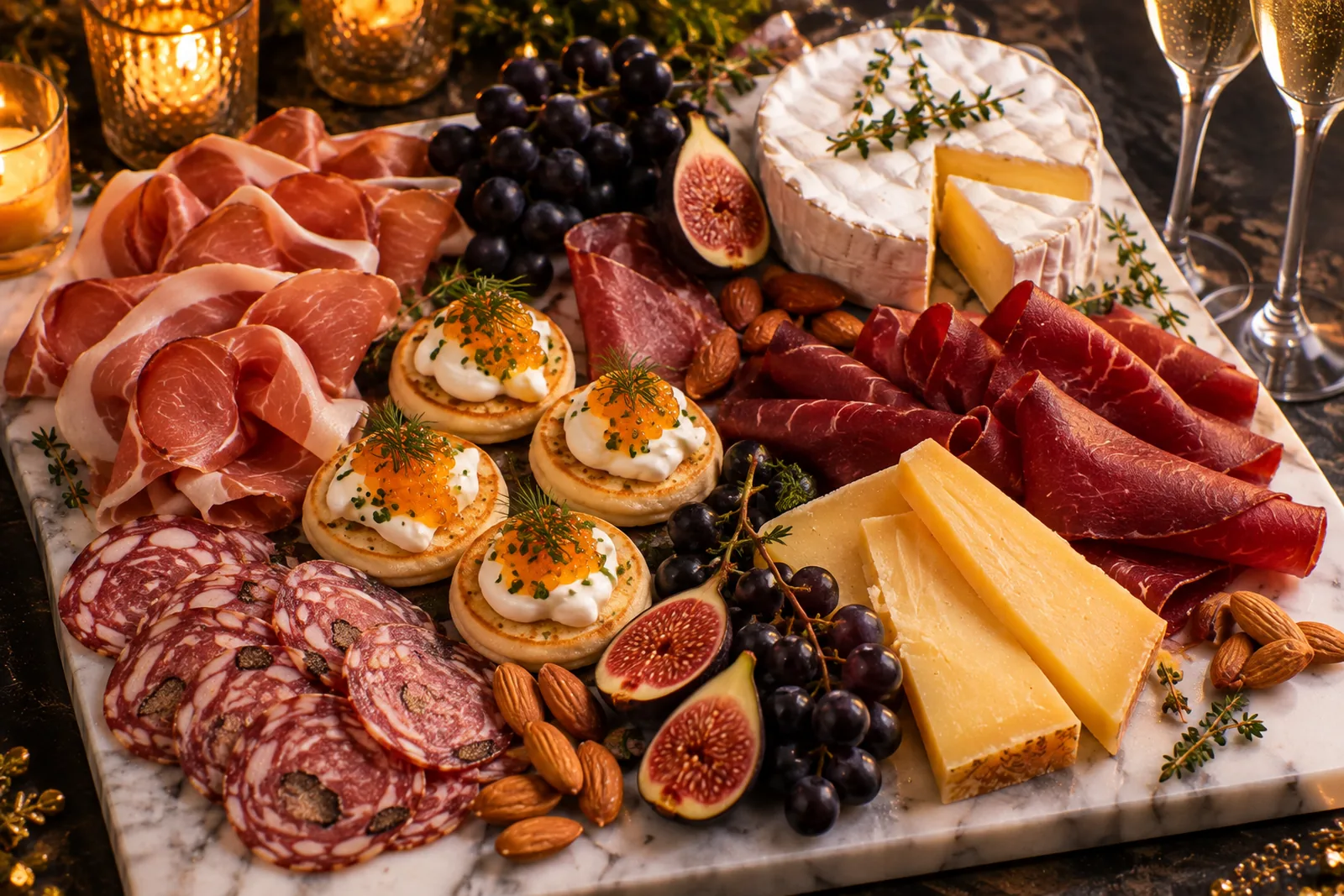
    • A large marble board with folded cured ham, bresaola, truffle salami, a whole brie, chunks of aged cheese, blinis with bleak roe, small dark grapes and champagne glasses beside it.

      Luxury charcuterie board for New Year's Eve – cured ham, truffle salami, comté and bleak roe on blinis

      🍽️ 8 people as a starter 🥕 18 ingredients 👣 8 steps

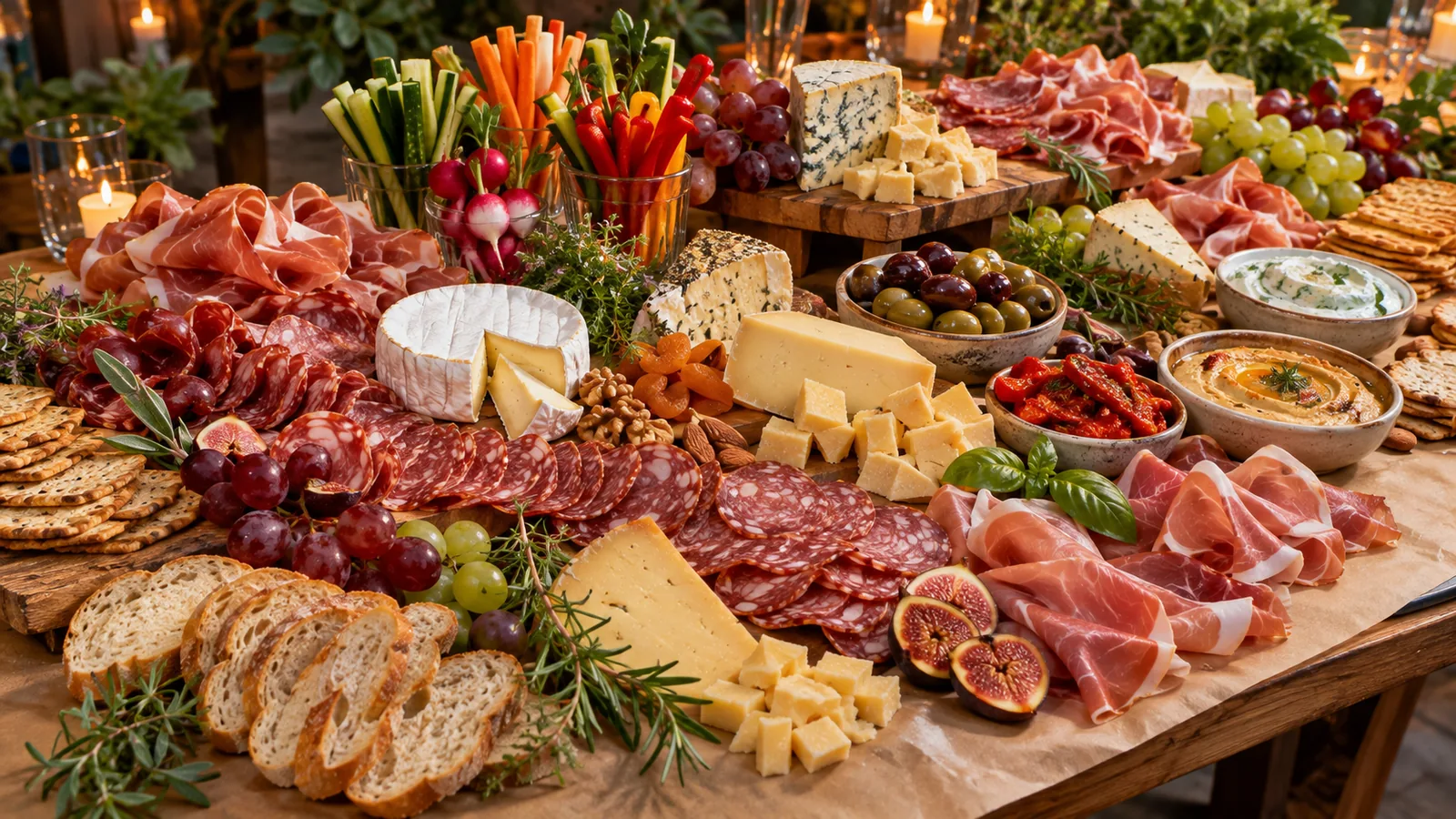
    • Long table covered with baking paper holding several cheeses, winding rows of salami, cured ham, bunches of grapes, figs, vegetable sticks, bowls of dips and olives, bread and crackers along the edges and little labels with the names of the cheeses.

      Grazing table – how to build a big sharing table for 15–30 guests

      🍽️ 20 people as a full dinner 🥕 36 ingredients 👣 11 steps

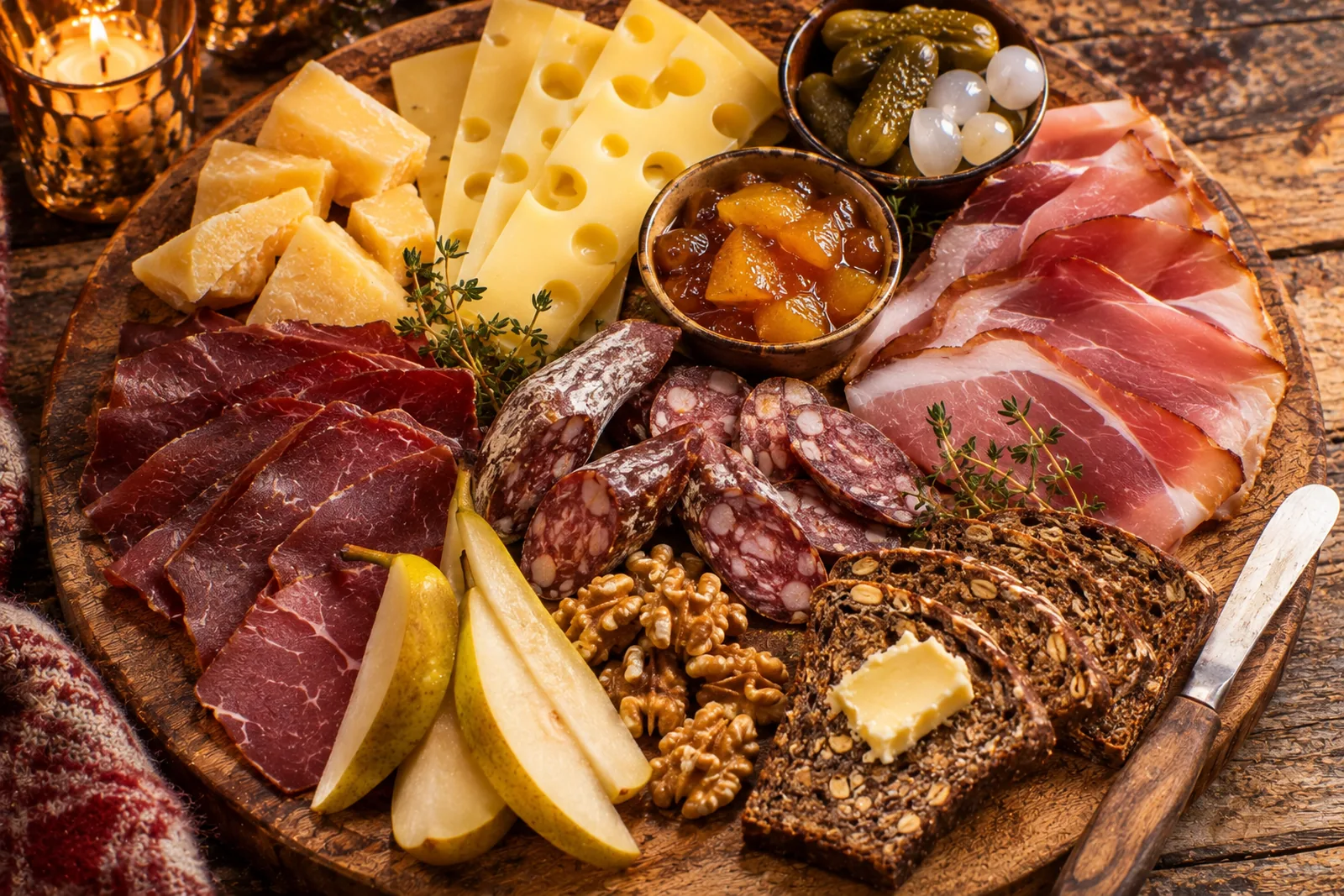
    • Rustic wooden board with large chunks of Gruyère and Emmental, thin slices of dark red air-dried beef, smoked ham, pairs of dried sausages, pear wedges, walnuts and a bowl of mustard fruits beside dark bread.

      Alpine board – mountain cheese, Bündnerfleisch, Tiroler Speck and pears

      🍽️ 6 servings as après-ski or a starter 🥕 17 ingredients 👣 10 steps

    • Twelve small golden tarts with fluted shortcrust edges, some with spinach and crumbled feta and some with ham and cheese, arranged on a rack on a wooden table.

      Mini quiches in a muffin tin – ham and cheese, Västerbotten cheese, and spinach with feta

      🍽️ 12 mini quiches, 6–12 people 🥕 17 ingredients 👣 10 steps

    What you can prepare

    • The day before: cut the hard cheese into pieces and put it in a container with a lid in the fridge. Fold the salami and put it in a container with baking paper between the layers. Toast the nuts.
    • On the day: pour the honey, olives and cornichons into the bowls and put them in the fridge. Rinse and dry the grapes thoroughly, so they don't make the crackers soggy.
    • Just before: cut the Brie and pear, as they discolour and dry out. Add the crackers and bread last, so they stay crisp.

    Tips for a good-looking board

    • Odd numbers. Three cheeses, three kinds of charcuterie and three bowls look more considered than four of everything.
    • The same thing in several places. Put grapes and nuts in two or three groups, so everyone round the table can reach everything.
    • Contrast in colour. Put the red salami next to the white Brie and the green grapes next to the dark chorizo.
    • Honey with the strong cheese. Blue cheese and honey are a classic combination. Put the bowl near the cheese, and guests will find it themselves.
    • Better one board too many than one too few. For more than eight people, two smaller boards are easier than one giant board.

    Safety: how long the board can stay out

    Cheese and charcuterie are chilled foods. Livsmedelsverket (the Swedish Food Agency) advises that chilled foods should not be left out for more than four hours if the room is no warmer than 20°C, three hours if it is up to 25°C and two hours at 26–30°C. A warm room full of guests can get warmer than you think. Whatever has been out all evening shouldn't go back in the fridge and be served again.

    According to Livsmedelsverket (the Swedish Food Agency), pregnant women should avoid mould-ripened and washed-rind cheeses such as Brie, Camembert and blue cheese. Hard cheeses that can be sliced with a cheese slicer are fine. Dried and cold-smoked charcuterie, such as salami and air-dried ham, can contain the toxoplasma parasite and should be frozen for at least three days before eating. Sliced cooked and smoked meats should have been packaged for no more than a week. It's a good idea to make a small separate corner with hard cheese and charcuterie that has been frozen.

    Vary the board

    Common mistakes

    • Too little space – everything ends up in piles and the board looks cluttered. Use a bigger board, or two.
    • Cold cheeses – Brie and blue cheese taste of almost nothing straight from the fridge.
    • One knife for all the cheeses – then everything tastes of the blue cheese.
    • Wet grapes next to the crackers – the crackers go soft.
    • Everything out at once – what's still there after several hours dries out and has to be thrown away.
    • Only salty things – without fruit, honey or jam the board feels heavy after a few bites.

    Frequently asked questions

    How much cheese and charcuterie per person?

    As a starter, 40–50 grams of charcuterie and 40–50 grams of cheese per person is enough. As nibbles with drinks you need 60–75 grams of each, and as a full dinner 100–125 grams of charcuterie and 100 grams of cheese, plus bread, fruit and vegetables.

    Which cheeses should go on a cheese board?

    A hard, aged cheese, a creamy white mould cheese and a strong cheese such as blue cheese or goat's cheese. Three cheeses that differ from each other go a long way. If you want more, add a mild semi-hard cheese and a smoked cheese.

    How do you arrange a charcuterie board?

    Set out the bowls first, then spread out the cheeses, make a winding row of folded salami between them and lay the ham in folds. Then fill in with fruit, lay crackers along the edges and fill the last gaps with nuts and herbs.

    How far in advance can you arrange a charcuterie board?

    Arrange it no more than an hour before and keep it in the fridge under cling film, without crackers and bread. Hard cheese can be cut and the salami folded the day before. Brie, fruit and crackers go on last.

    How long can a charcuterie board be left out?

    No more than four hours in a room no warmer than 20°C, less if it's warmer. It's better to top up from the fridge during the evening than to put everything out at once.

    Can you eat a charcuterie board when pregnant?

    Yes, with a few exceptions. Hard cheeses are fine. Mould-ripened and washed-rind cheeses should be avoided, and dried or cold-smoked charcuterie should be frozen for at least three days before eating. Sliced cooked and smoked meats should have been packaged for no more than a week.

    More guides and recipes to read

    More for the board and the evening

    Roasted chickpeas as a crunchy nibble

    Crispy chickpeas with salt and spices fill the gaps on the board and add something crunchy for those who don't eat charcuterie.

    To the chickpeas

    Snack board for kids

    Mild cheeses, fruit and vegetable sticks on a separate board, so the children can help themselves at the same time as the adults.

    To the kids' board

    Luxury charcuterie board for New Year's Eve

    Bresaola, truffle salami and bleak roe (löjrom) on blinis – the same arrangement, but for the evening as midnight approaches.

    To the New Year's Eve board