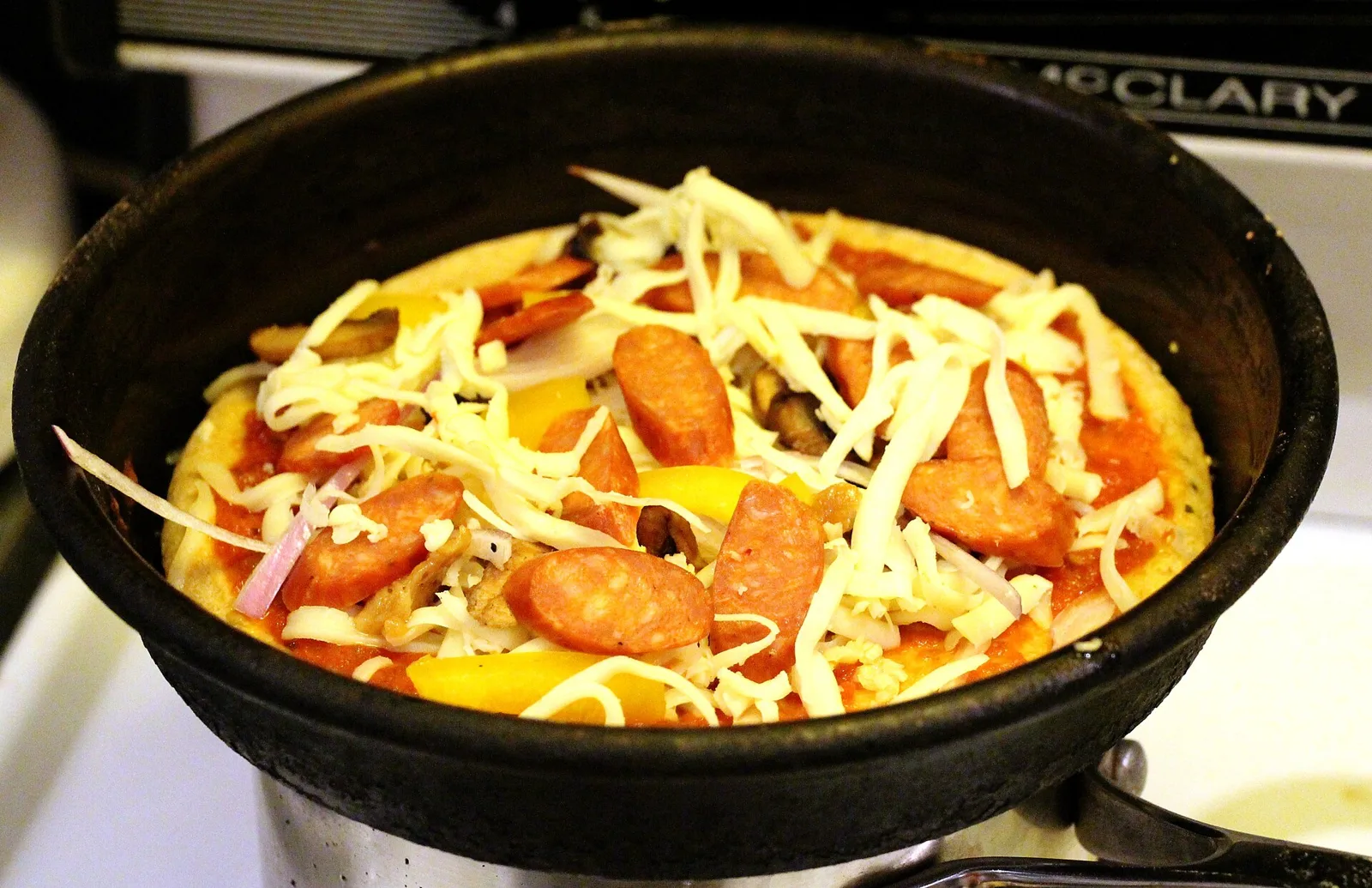
Photo: Karen and Brad Emerson, Wikimedia Commons (CC BY 2.0)
Time: 15 min the night before + 45 min by the fire (about 12 min per calzone)
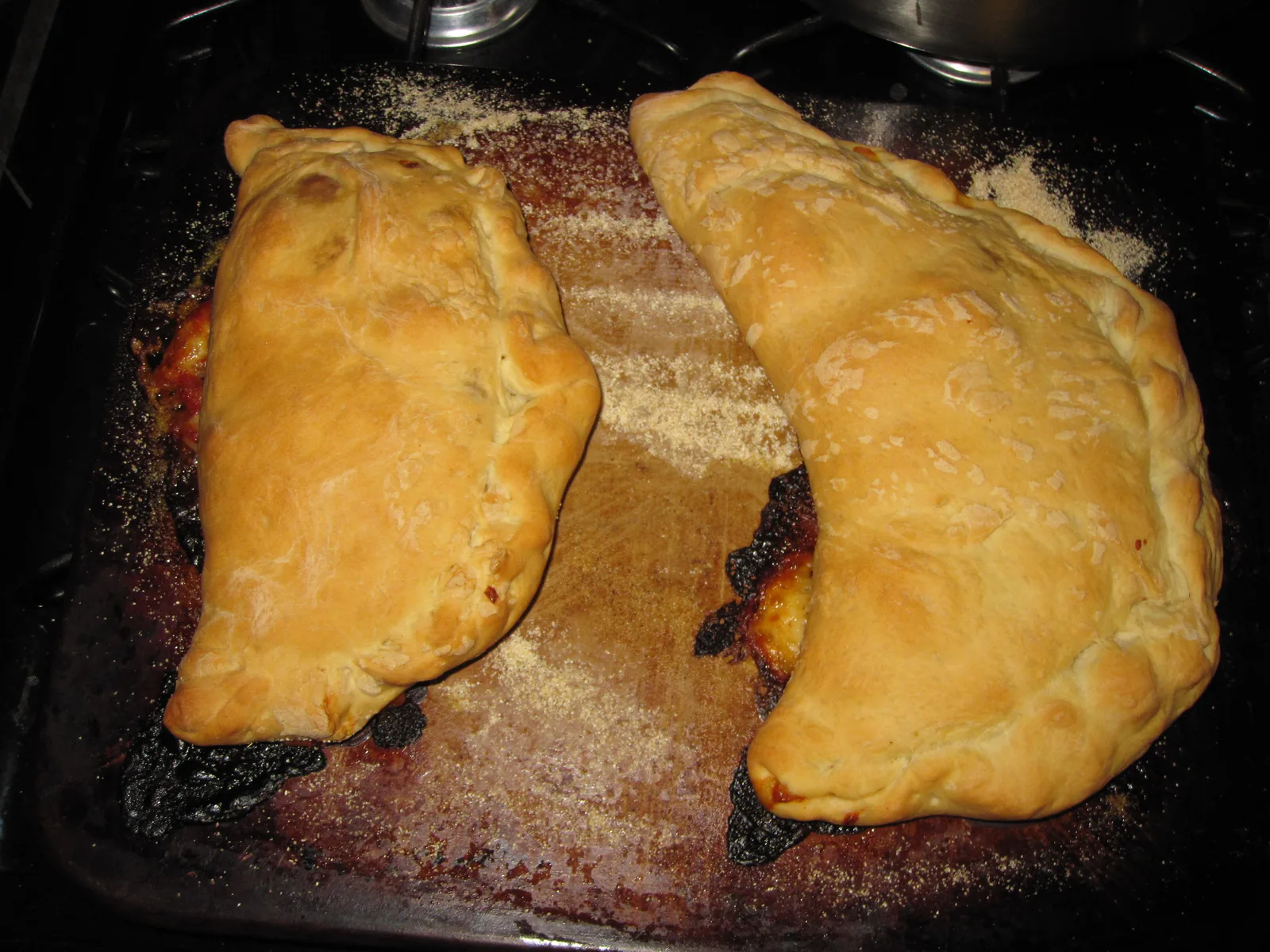
The first calzone in the pan is always the one that gives everything away. The edge comes apart on one side, the tomato sauce runs out and burns on with a sweet, acrid smell, and when the half-moon is finally turned the bottom is almost black while the dough at the seam is still shiny and sticky. The second is better, and the third is just right: golden on both sides, hard when you tap it and full of steam when it's cut open.
The difference isn't in the fire but in three things decided before the calzone even goes into the pan. There should be a little filling, and it should be dry; the edge should be tight and the heat calm, with a lid. Make the dough at home the night before and let it rise slowly in the fridge, so it travels cold in the cool box. If you'd rather have an open pizza with a quick dough, it's in pizza over an open fire in a frying pan – this page is about everything that's different when the pizza is folded over.
Method
1
The night before: dissolve the yeast in the cold water in a bowl. Add the flour, salt and oil and knead the dough for about ten minutes, until it's smooth and comes away from the bowl. It should be soft but not sticky.
2
Divide the dough into four pieces and shape them into balls. Put each ball in its own oiled freezer bag with plenty of room, because the dough grows. Put the bags in the fridge overnight.
3
Make the filling dry the same evening. Fry the mushrooms until the liquid has boiled off completely. Fry the mince until cooked through if you're bringing it, cool it quickly and keep it cold. Mix the tomato sauce so thick that it stands up on a spoon. Put everything in tubs with lids.
4
Pack the dough bags, the filling tubs and the cheese in the cool box with ice packs. Put the flour, oil and baking paper in a separate bag.
5
At the fire: light the fire in good time, so it has time to burn down to an even bed of embers. This takes about 30–45 minutes.
6
Take the dough out of the cool box half an hour to an hour before shaping and leave it in the shade. Cold dough is tough and springs back. On a cool evening it needs the longer time, and it's ready when it can be stretched without shrinking back.
7
Flour your hands and press a dough ball out into a round disc of about 20 centimetres, about half a centimetre thick and ideally a little thinner towards the middle. Do it on a floured chopping board or a piece of baking paper.
8
Put the filling on one half: first a thin streak of tomato sauce, then cheese, ham and vegetables. Leave a two-centimetre border free around the whole half and don't pile it higher than one and a half centimetres.
9
Brush the free border with a little water. Fold over the empty half, gently press the air out towards the edge and pinch together. Then fold the edge up over itself in small pleats, like a rope, and press with a fork.
10
Cut a small slit, about one centimetre, in the middle of the top. That's where the steam escapes instead of bursting the seam.
11
Put the pan on the grill or the stones over the embers and let it heat up for a few minutes. Hold your palm a hand's width above the pan. If you can manage five or six seconds before you have to pull it away, the heat is about right.
12
Brush the pan thinly with oil and lower the calzone in using the baking paper or the spatula. Put the lid on and, ideally, put a few embers on top of the lid with a stick.
13
Bake the first side for about 5–7 minutes. Lift the lid after three minutes and peek under the edge with the spatula. The bottom should be golden brown, not black.
14
Turn the calzone with the spatula, your hand protected by a fire glove. Put the lid back on and bake the second side for about 4–6 minutes. All times are approximate: the embers, the thickness of the pan and the weather matter more than the clock, so let the colour and the sound decide when it's time.
15
Lift the calzone onto the chopping board and let it rest for three to five minutes. Cut it in half and let the steam out before anyone takes a bite. Shape and fill the next calzone while the previous one bakes, so no filled calzone sits waiting and goes soggy. Keep the filling in the cool box in between.
Have you made this recipe? Rate it
0.0 out of 5 · 0 votes
out of 5
vote
votes
Be the first to rate this recipe.
Thanks for your vote!
Your vote could not be saved right now. Please try again later.
Steak straight on the embers – no grill, no pan, just hardwood embers
🍽️ 4 servings🥕 15 ingredients👣 11 steps
🔥 Over fire
Sjömansbiff over an open fire – Swedish "sailor's beef" with meat, onion and potatoes layered in the pot
🍽️ 4 servings🥕 15 ingredients👣 11 steps
🔥 Over fire
Apple cake over an open fire – caramel underneath, embers on top and a flip at the end
🍽️ 6–8 pieces🥕 13 ingredients👣 21 steps
🔥 Over fire
Omelette over an open fire – eggs in a bottle, pan on the embers and a filling that holds
🍽️ 4 servings🥕 14 ingredients👣 9 steps
Little, tight, calm
The rule of thumb is three words, one for each way a calzone over a fire tends to fail.
A little. A calzone is baked from two sides, but the heat has to get through dough, filling and dough again. About one decilitre of filling per calzone is enough. Any more, and the dough closest to the filling won't be done before the bottom is burnt.
Tight. The filling turns to steam as it heats. The steam looks for the weakest point in the edge, and if the seam isn't properly pinched and rolled, it opens. Then cheese and tomato run out into the pan and burn.
Calm. A pizza in the oven can handle very high heat because it bakes in a few minutes. A calzone needs twice as long, so the heat has to be lower and come from both below and above. The lid with embers on top is what turns the pan into a small oven. Why thicker bread needs more heat all round is explained in baking over a fire without an oven.
The filling that mustn't be wet
The most common cause of a doughy calzone is liquid from the filling. It can't boil off inside the dough, so it makes the bread closest to the filling wet and heavy.
Mushrooms, courgette and spinach release a lot of water. Fry them at home until the pan is dry, or leave them out.
Tomato sauce should be thick. Thin passata or chopped tomatoes straight from the pack are too wet, so cook them down at home or use tomato purée.
Fresh mozzarella in brine should be sliced, pressed between kitchen roll and left to drain for a while. Grated cheese is easier.
Ricotta should be put in a sieve overnight so the whey drains off.
Raw mince and raw chicken must never go into a calzone. The dough is done long before raw meat inside is cooked through. Fry the mince at home, cool it quickly and transport it cold. Ham, salami and other ready-to-eat cold cuts are fine as they are.
A good filling should be able to sit on a plate for fifteen minutes without liquid collecting around it.
Calzone on a grill
If you don't have a pan with a lid, you can bake the calzone directly on a grill. It needs more attention, because the heat only comes from below.
Set the grill high above the embers, where you can hold your hand above it for seven to nine seconds. Oil the grill with a piece of kitchen roll held in tongs. Make the calzone a little smaller than in the pan, with a disc of about 15 centimetres, so it's easy to turn. Put it on the grill and leave it undisturbed for about three minutes, until the underside has set and got grill marks. Turn it and repeat. Then keep turning every other minute. Allow 12–16 minutes in total.
An upturned saucepan or a pot lid over the calzone traps the rising heat, so it bakes faster and more evenly. More about the height, the hand test and where the bed of embers is coolest can be found in grills and fish baskets. A large griddle pan with a pot lid over it works well too, and two small calzones fit on it at the same time.
The tomato sauce is acidic. If you want to put the calzone on foil, make sure it's the dough and not the filling that's against the foil. Acidic food cooked in aluminium takes up more of the metal.
Done or not
A calzone is harder to judge than an open pizza, because you can't see the filling. Use four tests:
The colour. Both sides are golden brown, and the edge has coloured too.
The sound. Knock on the underside with a knuckle. It should sound hollow and dry, not dull.
The seam. Lift the edge a little with the spatula. The dough in the fold should be firm and matt. If it's shiny and sticky, the calzone needs a few more minutes. If the bottom is already dark, move the pan out towards the edge of the embers and let the lid and the embers on top do the rest.
The slit. Steam puffs out of the hole on top, and the cheese bubbles.
If the filling has pre-fried mince or chicken, push a thermometer in from the side towards the middle. It should read at least 70 degrees.
At home and by the fire
Most of the work you do at home, where there's a sink, a fridge and plenty of time.
At home: the dough the night before, the dry filling in tubs, the cheese grated, flour and oil in a bag. Cold-proved dough from the fridge is easier to shape and has more flavour than dough that has risen somewhere warm for an hour. It can stay in the cool box for most of the day.
By the fire: the embers, the shaping and the baking. Keep the cheese, ham and mince in the cool box until it's time to fill. Chilled food should be left out for no more than two hours in summer heat, and never in the sun. How to pack the cool box and where to wash your hands when there's no tap is explained in hygiene and washing up outdoors.
Bake an adult's calzone first. The first one is often a trial run while you get to know the embers, and the children's calzones get the calmer minutes afterwards.
🛡️
Safety: the filling is hotter than it looks
The bread on the outside cools quickly, but melted cheese and tomato sauce hold their heat for a long time. That's why a calzone can feel just warm in your hand and still burn your mouth. This applies especially to children, who like to take a big bite right in the middle.
Let the calzone rest for three to five minutes.
Cut it in half and let the steam out before it's eaten.
Give small children pieces from the edge first.
The cast-iron pan and the lid with embers on top stay hot long after the calzone has been lifted out. Put them where nobody walks, and always lift them with fire gloves. If the oil and leaked cheese in the pan catch fire, put the lid on and lift the pan off the embers. Never pour water on burning fat. For a burn: cool with cool water for about fifteen minutes, no longer, and never with ice or snow. More about the fire site, distances and putting the fire out can be found in fire safety in nature, and if there's a fire ban, it's the county administrative board's or the municipality's decision that applies. Check them in lighting fires outdoors.
🧒
Calzone with children
Calzone is one of the best dishes to make together by the fire, because every child can make their own from start to finish, apart from the pan itself.
Their own dough ball. Each child presses out their own disc on the baking paper. It doesn't matter if it turns out oval or a bit uneven.
Filling from the tubs. Set out the tubs with a spoon in each. The children choose for themselves, but the rule is one spoonful of each kind. That keeps the filling to a sensible size.
Folding and pinching. Folding it over and pinching the edge is the most fun part. An adult can show the rope edge on their own calzone first.
Their own mark. Let each child carve their initial into the top with a fork, or add a small piece of dough shaped like a letter. That way everyone knows which calzone is whose.
The adult looks after the pan, the lid and the turning. Flour isn't heat-treated and can in rare cases contain EHEC bacteria, which can cause serious stomach illness. The risk is very small and the bacteria die when the calzone is baked, but don't taste the raw dough, and wash your hands before and after shaping the dough. More ways to let the children help by the fire can be found in cooking with children over a fire.
💡
Tips for a calzone that holds together
Brush the edge with water, not oil. Oil makes the dough slide apart; water makes it stick.
Press out the air. An air bubble at the edge gets blown up by the steam and opens the seam.
Cold filling. Filling that's cold from the cool box doesn't make the dough soft and sticky while you fold.
Thinner towards the middle. The edge becomes double when it's folded, so press the disc thinnest where the filling will go.
The embers decide. If the fire is too hot, move the pan further out towards the edge of the bed of embers instead of waiting for it to cool. How to build a bed of embers with a hot side and a cool side is explained in lighting a fire.
⚠️
Common mistakes
Too much filling – the dough closest to the filling stays raw and the edge splits. Rescue: don't open it – lower the heat, put the lid on and give it a few more minutes on each side.
The edge opens in the pan – pinch it together with a small bit of extra dough, or turn the calzone so the opening faces up and finish baking under the lid. It won't look as nice, but it'll taste just as good.
The bottom turns black after two minutes – the pan is too hot. Move it to one side, scrape off the burnt bits with a knife and carry on further out on the bed of embers with the lid on.
The outside is done but the seam is shiny – the heat has been too high and the time too short. Lower the heat and let it go a few more minutes with the lid on.
No lid – the top stays pale and the dough only cooks from one direction.
Wet filling – mushrooms that haven't been pre-fried and thin tomato sauce make the bread doughy from the inside.
Calzone variations
Classic Italian: ham or salami, mozzarella and ricotta, and ideally a slice of boiled egg. How to boil the eggs over the fire is explained in boiled eggs over a fire.
Vegetarian: pre-fried mushrooms, grilled peppers, feta and a few leaves of fresh basil.
Yesterday's leftovers: chilli or bolognese sauce cooked at home, chilled and thick enough to stand up on a spoon.
Sweet calzone: chopped dark chocolate and thin slices of banana or apple, with a pinch of cinnamon. Eat it warm, but not straight away.
Panzerotti: make smaller half-moons of about twelve centimetres. They're done faster and suit children's hands.
Without dough: when you're in a hurry, campfire quesadillas is the same idea with a tortilla. If you want to bake larger stuffed breads in a tin-can oven or a pot, see stuffed breads over a fire.
Allergens
The dough contains gluten from the wheat flour. Cheese and ricotta contain milk protein, and egg is a common allergen. Salami and other processed meats may contain milk protein or mustard, so read the ingredients list.
Frequently asked questions
How long should a calzone be cooked in a pan over a fire?
About 5–7 minutes on the first side and 4–6 minutes on the second, with a lid and calm embers. The times are approximate. The calzone is done when both sides are golden brown, it sounds hollow when you tap it and the dough in the seam is firm.
Why does the calzone split?
Usually because it's too full, because there's air left at the edge or because the edge isn't moistened and properly pinched. The steam from the filling then forces the seam open. Fill it less, press out the air, roll the edge and cut a small steam hole in the top.
Can you put raw mince in a calzone?
No. The dough is done long before raw mince in the middle has had time to cook through. Fry the mince at home, cool it quickly and transport it cold in the cool box. Ham, salami and other ready-to-eat cold cuts are fine as they are.
Can you make calzone on the grill?
Yes, directly on the grill high above even embers. Turn it after about three minutes and then every other minute, and allow 12–16 minutes. An upturned saucepan over the calzone helps the top.
Can you make the calzone dough the day before?
Yes, and it's better for it. The dough rises slowly in the fridge overnight and travels cold in the cool box. Take it out half an hour to an hour before shaping, and it will stretch.
What's the difference between calzone and panzerotti?
A calzone is a larger folded pizza baked in an oven. Panzerotti are smaller half-moons made from much the same dough, and in Italy they're often deep-fried. Over a fire, both can be baked in a pan with a lid.
We would like to use Google Analytics to see which pages are read, so that we can make the site better. It sets cookies from Google. We do not use any advertising cookies.
Accept and Decline only apply to statistics – the site works just as well whatever you choose. More in our cookie policy.



 🔥 Over fire
 🔥 Over fire
 🔥 Over fire
 🔥 Over fire