
Short answer
Choose by what the child does when nobody's in charge: builds, collects, puzzles things out, runs around, creates or asks how things work. Ask three questions about every idea: can the child manage it alone, will it last the whole Christmas holidays, and will it grow with the child? Two yeses are enough. Let most of the gifts be ordinary good ones, like a marble run, a chapter book series or a folding gym mat, and add one quirky one, like a den-building kit in a box.
The same kind of gift at six and at nine
| The child who | Age 6–7 | Age 8–9 |
|---|---|---|
| Builds | Magnetic building tiles, marble run with big pieces | Snap-together circuit kit, woodworking box with hand drill and clamp |
| Collects | Binder for collector cards, geodes to crack | Coin bag and world map, fossil to dig out |
| Puzzles things out | The first cards of a logic game, magic box | Fingerprint detective kit, fact book about their niche interest |
| Keeps moving | Tin can stilts, gym mat, French skipping elastic | Wooden stilts, balance board, walkie-talkies |
| Creates | French knitting doll, oven-bake clay | Blank comic panels, watercolour pencils, kalimba |
| Wonders | Simple microscope, water rocket with an adult at the pump | Take-it-apart box, crystal growing kit with an adult |
The ages are approximate. A six-year-old who has been building for three years may be ready for circuits, and a nine-year-old can still love magnetic tiles.
It's Boxing Day, ten o'clock in the morning. The seven-year-old has already finished building what she got on Christmas Eve, read the comic from cover to cover and got bored of the thing that blinked. Now she's standing in the kitchen doorway asking what there is to do. Under the tree there's still a present nobody has touched. It turned out to be for a three-year-old.
A lot happens in a short time between six and nine. The child starts school, cracks the reading code, makes friends with their own rules and wants to do things for real – but preferably on their own. That's why gifts often miss in both directions: either they're too babyish or they need an adult at the table the whole Christmas holidays.
This page gives you 32 ideas sorted by what kind of child it is. Most are ordinary good gifts, and a few are quirky on purpose. The bigger picture, and the thinking behind unique Christmas gifts, is in christmas gift guide.
On their own, long-lasting, grows with them – three questions for the in-between years
Ask these three questions about every idea you have. They're made for exactly this age.
- On their own. Can the child manage the gift without an adult, on Christmas Day itself or after being shown once? A seven-year-old wants to be able to do it. A gift that needs an adult to read the instructions every time ends up gathering dust.
- Long-lasting. Will it last the whole Christmas holidays, and not just until Boxing Day? What lasts are projects, collections and things with levels, where there's always a harder step.
- Grows with them. Does it work for both a six-year-old and a nine-year-old? Can the child get better at it, or is it just as fun – and just as finished – after one evening?
Two yeses are enough. Three yeses mean you've found the gift that's still being used in March.
Tip: Let most of the gifts be ordinary good ones. Then add a single quirky one that's a joke, a project or a story. That's the one the child talks about at school after the holidays.
The child who already lives in the woods and the snow has a page of their own – christmas presents for kids who love being outdoors – with a head torch, a first knife, a compass and binoculars. Here you'll find everything else.
The child who builds and tinkers
The child who builds usually already has a box of bricks. What's missing is the next step, and a reason to start again.
A box of mixed building bricks and twelve challenge cards. Buy bricks without instructions and write twelve cards yourself, for example “build a bridge between two chairs”, “a house for a teaspoon” or “something that rolls”. The bricks last for years, and the cards give a starting point when the ideas run out.
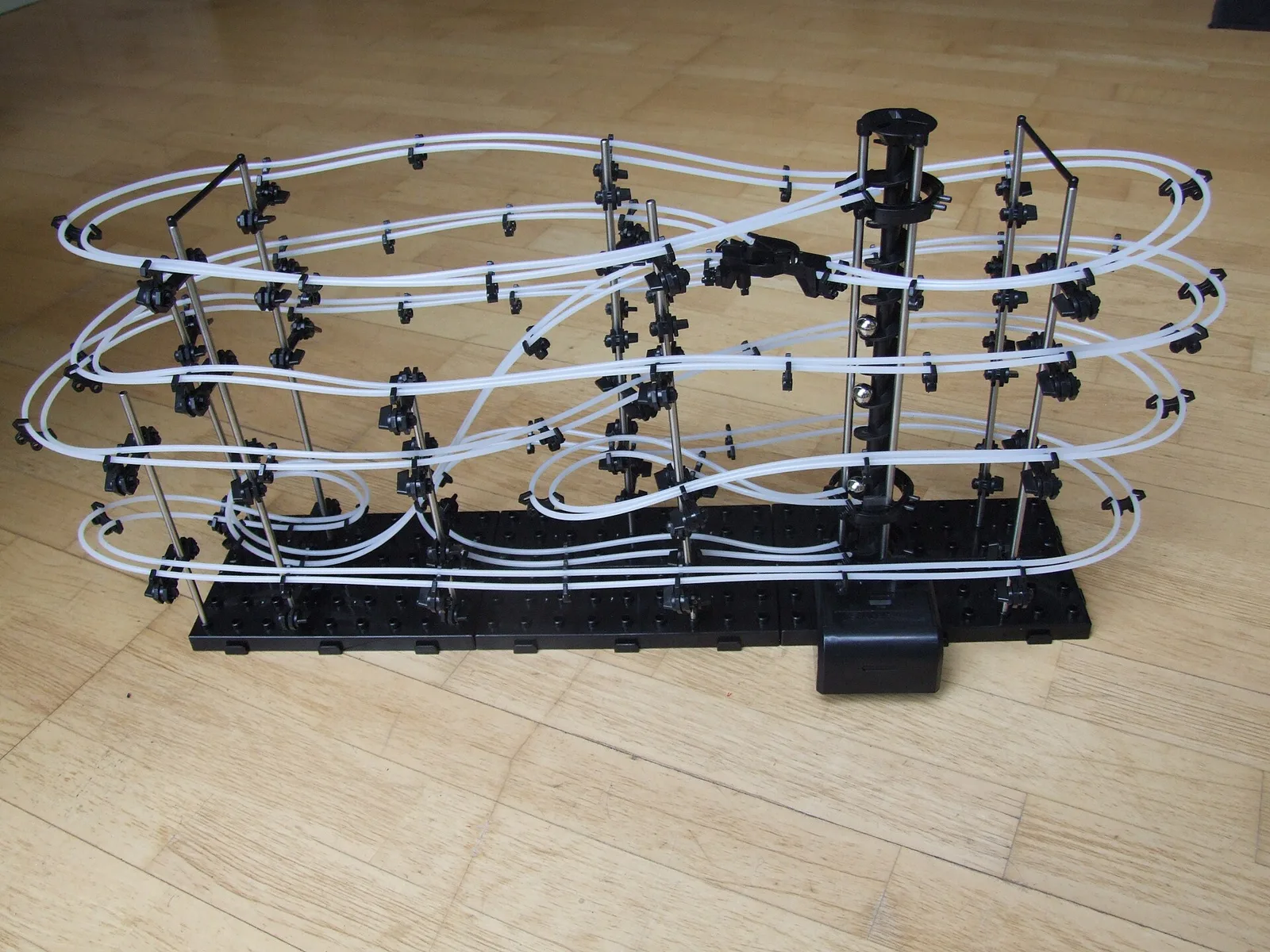
A marble run in pieces that can be rebuilt. Tubes, funnels and spinners that fit together in a new way every time. It grows with every birthday if you buy one from a system where more pieces fit, and it's just as much fun for a six-year-old as for a nine-year-old.
A proper woodworking box in a small size. A short-handled hammer, a small clamp, a hand drill with a crank and nails with big heads. Add a bag of offcuts from a joinery workshop or a timber yard. Between six and nine, children can hammer nails for real with an adult nearby, and the boat made from offcuts becomes their own.
A snap-together circuit kit. Components on plastic tiles that snap onto a base board: battery holder, switch, bulb, fan and buzzer. The child understands how electricity works without soldering and without reading long instructions. Choose a kit that runs on ordinary batteries behind a screw-fastened cover.
Magnetic building tiles. Flat shapes with magnets in the edges that become houses, towers and car ramps in a few minutes. They also work for a younger sibling, as long as the tiles are intact. Check them now and then, and remove any tile that has cracked.
The child who collects
Between six and nine, many children collect everything: stones, bottle caps, cards and shells. Give the collection a home, and it becomes a hobby.
A binder for collector cards and a swap day. A binder with plastic sleeves for nine cards a page, and a checklist where the child ticks off what's missing. Add a card: “Swap day with the cousins between Christmas and New Year.” In the early school years, collector cards are a currency of their own in the playground, and in the binder they don't get crumpled in a pocket.
Geodes to crack yourself. Round, grey stones that are hollow with crystals inside. Put the stone in a cloth bag, put on safety glasses and tap it with a hammer. It's a surprise every time, and the two halves become the finest stones on the shelf.
The coin bag from the family's travels. Ask grandma, uncles and the neighbour whether they have foreign coins left over in a drawer. Give the coins in a cloth bag together with a world map, where the child marks each country. It costs next to nothing, and every coin has a story about who was there.
A fossil to dig out of plaster. A plaster block with a real shell or shark tooth inside, plus a brush and a wooden stick to dig with. It takes an hour or two, and it's patience training that doesn't feel like it. Afterwards, the display cases are more fun when you visit museums with children.
The child who puzzles things out
This is the child who wants to understand the rules – and then find a way around them.
A single-player logic game with challenge cards. A small game board with pieces and a booklet or cards with challenges from easy to very hard. The six-year-old solves the first cards, the nine-year-old chases the last ones. The gift doesn't need an opponent, so it gets used even after friends have gone home.
A fingerprint detective kit. A jar of fine powder, a soft brush, clear tape and cards to keep the prints on. Take fingerprints from everyone in the family and make a register, then let the child solve the case of the gingerbread biscuit that vanished from the tin. It's logic, precision and a bit of theatre all at once.
A magic box and a booked show. A deck of cards, cups and balls and a booklet of tricks. Add a card: “Show for the whole family on New Year's Eve.” With a date, there's a reason to practise, and an audience that claps.
The first three books in a series. Easy-to-read chapter books in a series with the same main character. Give the first three all at once. A child who has just cracked the reading code needs momentum, and when book one ends the next should be ready and waiting, not waiting for the next trip to the library. It's a nice touch to write a christmas gift rhymes on the parcel as a clue to what's in the series.
A fact book about their niche interest. A thick fact book about exactly what the child is obsessed with right now: sharks, volcanoes, knights, space or trains. At this age many children learn facts by heart and quiz the grown-ups at dinner, and a book that goes deep into a single subject gets read over and over again.
The child who never sits still
The Christmas holidays are long and dark, and a child with ants in their pants needs somewhere to put all that energy.
A folding gym mat. A thick mat in sections that folds up and stands behind the sofa when it's not in use. It's where the somersaults, handstands against the wall and wrestling with the grown-ups happen, and a long Christmas holiday indoors gets easier for everyone. An eight-year-old is happy to practise the same thing until it sticks.
French skipping elastic and a long skipping rope. A playground classic. Teach the child the chants and the levels, from ankles to hips. Two chairs can hold the elastic when friends aren't around. It's cheap, takes up no space and is exactly what's popular at break time in the early school years.
A wooden balance board. A curved board the child rocks on, walks across like a bridge or turns upside down and crawls under. It works indoors in the middle of winter, and their balance gets better every week. Put it on a rug, not on a slippery floor.
Stilts. Tin can stilts with strings for the six-year-old, wooden stilts with footrests that can be moved higher for the nine-year-old. It's an afternoon of falling over, and then suddenly it works. It's an old-fashioned gift, and that's why it's one of the quirky ones.
Two walkie-talkies. Two simple radios with big buttons for the children to talk into. They turn hide-and-seek and treasure hunts into missions, and they get used between the den and the kitchen. Children who love missions will find more ideas in our guide to a treasure hunt for kids, and the clues work just as well at Christmas. Choose radios that run on ordinary or rechargeable batteries.
The child who creates
This child needs real materials, and time without anyone saying how it should turn out.
A French knitting doll and three balls of yarn. A wooden spool with four pegs that turns the yarn into a long knitted cord. The cord becomes a pot mat, a scarf for a cuddly toy or a rope for the den. A six-year-old learns in fifteen minutes, and their hands have something to do while you listen to an audiobook.
A pad of blank comic panels. Pages with ready-drawn panels and empty speech bubbles, a fine black pen and a few colouring pencils. The child who can't face writing much can tell a story in pictures, and the nine-year-old fills in the speech bubbles themselves. Bind the pages together into a book in the spring.
Oven-bake clay in lots of colours. Clay that hardens in an ordinary oven, so the figures last. It can become little animals, a whole nativity scene or their own game pieces. Bake on baking paper and follow the temperature on the packaging.
A kalimba. A thumb piano – a wooden box with metal tines you pluck with your thumbs. It's tuned to one key, so it's almost impossible to play it badly, and it sounds lovely from the very first minute. Many come with sheet music in numbers or colours that the child can read on their own.
Watercolour pencils and a proper watercolour pad. Colouring pencils that turn into watercolour when you brush a wet paintbrush over the drawing, and thick paper that doesn't go bumpy. Real materials show that you take the child's drawings seriously.
The child who wonders how everything works
This is the child who asks “why” until the grown-ups no longer know the answer.
The take-it-apart box. An old alarm clock, a corded phone or a keyboard from a flea market, a set of small screwdrivers and a muffin tin to put the screws in. Here the child is allowed to take something apart, and find the motor, the cogs and the springs inside. Remove the battery and cut off the cable before you wrap it. Choose small, simple devices, and never anything big that has been plugged into the wall socket, like a microwave or an old TV.
A crystal growing kit. Powder that dissolves in warm water, and after a few days crystals grow in the jar. The child checks every morning, and it becomes chemistry on the windowsill. The kit contains chemicals, and many are made for slightly older children and must be used with an adult. Read the age and the warnings on the box, keep the jar out of reach of younger siblings and keep the instructions.
A simple microscope and blank slides. A children's microscope with a light and two or three magnifications, and a box of slides the child fills themselves: a hair, a few grains of salt, a piece of onion skin or the wing of a fly from the windowsill. That's where the child discovers that everything looks different up close. Choose a microscope that runs on ordinary batteries.
A water rocket. A rocket made from a plastic bottle and launched with water and air from a bike pump. It's physics in the garden, and it flies higher than anyone expects. It's a spring gift that gets wrapped in December. Point it away from people and houses, and let an adult handle the pump.
Four quirky gifts for the in-between years
These are the gifts that aren't on any wish list, but that the child remembers.
The den-building kit in a box. Ten heavy-duty clamps, a rope, two old sheets and a battery string of lights. All children build dens, and with a box of their own they don't have to borrow the duvet from the bed. Choose a string of lights that runs on ordinary batteries, because many small strings have button cells, and don't leave the rope where a little sibling sleeps.
The office in a box. A date stamp, a receipt book with carbon paper, paper clips, a hole punch and a stapler. Between six and eight, many children play shop, bank and post office, and real office supplies beat pretend ones. There'll be receipts for everything for six months.
A letterbox for the bedroom door. A small metal or wooden letterbox that's screwed onto the child's door, ideally with a flag that goes up when there's post. Put the first letter in it on Christmas Eve. During the Christmas holidays, siblings, parents and grandma write notes, and the child who has just learned to write gets a reason to reply.
A Christmas present of their own for someone else. Give the child a box of materials and the task of making a gift for someone in the family, for example a gingerbread house for the neighbour or a homemade advent calendar for a sibling next year. It's one gift that becomes two, and the child gets to watch someone else open something they made.
Safe under the tree when there are siblings
The gifts on this page are made for children between six and nine. In the same house there's often someone who's three, or one, and then different rules apply.
- Warning or recommendation. The number on the box, like 6+ or 8+, is a recommendation about what the child can handle. A warning that the toy isn't suitable for children under three is about danger, usually small parts that can get stuck in the throat. It applies to the little sibling, even if the gift belongs to their big sister.
- Small parts and marbles. The marbles for the marble run, the geode pieces and the clay should live where the little ones can't reach. Children under three shouldn't play with small parts, small balls or long strings. Anything that fits entirely inside a small parts cylinder counts as a small part, and balls and round objects smaller than 4.5 centimetres can get stuck in the throat.
- Magnets. Small, strong magnets are dangerous for all ages, not just the youngest. Older children sometimes swallow them by accident when they hold them in their mouths while playing. More than one magnet, or a magnet and something metal, can attract each other inside the intestines. If a child has swallowed a magnet, call the health service or 1177 (the Swedish healthcare advice line). If the child has swallowed more than one, go to hospital immediately.
- Button batteries. They're found in strings of lights, musical cards, small torches and small gadgets. A battery that's swallowed and gets stuck can quickly cause very serious chemical burns. If a child has swallowed a button battery (or pushed one into their nose or ear), or you suspect they have, call 112 immediately and ask for Giftinformation (the Swedish Poisons Information Centre). Do not try to make the child vomit. How to store the batteries is in light when the power goes.
- Long strings and ropes from the den kit and the stilts can be a strangulation risk for small children. Don't leave them lying where a little sibling plays or sleeps.
- Chemicals in crystal kits and clay should be kept out of reach of the little ones, and the instructions should be kept.
In less urgent cases, Giftinformationscentralen answers around the clock on 010-456 67 00.
Tip: If you buy second-hand, check that all the parts are intact and nothing is missing. Toys bought before 2013 are often less safe than newer ones, because the EU tightened the rules for toys that year.
When the child turns ten
Somewhere around ten, the child gets the joke of a really quirky gift, and then you can stray further from the wish list. For older children there are separate pages – christmas gifts for son and christmas gifts for daughter – from age ten upwards. And if grandma and grandpa want to give time instead of a thing, we have ideas in christmas gifts for grandparents.
More ideas for a Christmas with more time together and fewer must-dos are collected in christmas with kids.
Check before you wrap
Frequently asked questions
What's a good Christmas gift for a 7-year-old?
A gift the child can manage on their own and that lasts beyond Boxing Day. For seven-year-olds, a marble run to rebuild, the first three books in an easy-to-read series, a single-player logic game with cards from easy to hard, a folding gym mat or a fingerprint detective kit often work well. Start from what the child does when nobody's in charge, not from what it says on the box.
What does the age on the box mean, for example 8+?
A number like 8+ is a recommendation. It says the toy suits the child's skills from about that age. That's not the same as a warning. A warning that the toy isn't suitable for children under three is about danger, usually small parts that can get stuck in the throat. That warning applies to younger siblings in the same house, even if the gift is for an older child.
Are magnetic building tiles and magnetic toys dangerous for a 6–9-year-old?
Under EU rules, strong magnets in toys must be too big to swallow, and magnets that are fixed in place must not come loose. The danger arises when a tile cracks and the magnet comes loose, or when the child plays with loose small magnets. Older children can swallow magnets too, for example when they hold them in their mouths. If a child has swallowed a magnet, call the health service or 1177 (the Swedish healthcare advice line). If the child has swallowed more than one, go to hospital immediately.
Which Christmas gifts suit both a six-year-old and a nine-year-old?
Gifts with levels, where the child can get better: logic games with cards from easy to very hard, building bricks with challenge cards, a kalimba, a French knitting doll and a balance board. Siblings of different ages can share a marble run or a den-building kit, and then the gift becomes something they do together.
What do you give a 6–9-year-old who already has everything?
Something that isn't a new toy. A bag of foreign coins the family has left over from their travels, a box with an old gadget to take apart, or a den-building kit with clamps and sheets. Or an evening when the child gets to perform with their magic box for the whole family.