Short answer
Only grill what will be ready in a quarter of an hour at the fire: sausages, suovas (Sami smoked reindeer meat) in flatbread and quesadillas with the filling made at home. Anything that takes longer, like soup or beans and sausages, is cooked at home and travels hot in a food flask. Bring two flasks, one with food and one with a hot drink, and put an extra layer on the children before you start cooking.
Campfire food for the ski slope and the cross-country tracks
| Dish | By the fire | Done at home | Best for |
|---|---|---|---|
| Sausage on a stick | A few minutes in the embers | Nothing, the sausages go in the rucksack | The slope, the little ones |
| Christmas sausage on skewers | 8–10 minutes over the embers | Sausage simmered, if not pre-cooked | The slope in December |
| Flatbread roll with cheese sausage | Finished off in the pan or on a grate | Sausage wrapped and pre-fried | The slope |
| Suovas (Sami smoked reindeer meat) in flatbread | Fastest of all, half a minute to a minute per side | Suovas thawed, lingonberries and soured cream in tubs | The tracks, easy to carry |
| Quesadillas | 2–3 minutes per side under a lid | Bean mix and filling in tubs, chicken cooked, cheese grated | The slope, with embers on site |
| Beans and sausages | Nothing, eaten from the flask | Everything | The slope and the tracks, backup lunch |
| Potato and leek soup | Nothing, eaten from the flask | Everything, blended smooth | The tracks |
| Blåbärssoppa (warm bilberry soup) | Nothing, or cooked in the pot | Cooked and poured into a flask | The tracks |
| Warm apple juice | Heated without boiling | Spices steeped in the bottle overnight | The slope and the tracks |
| Hot chocolate | Nothing, straight from the flask | Everything | The slope, after the last run |
| Kokkaffe (boiled coffee) | A quarter of an hour to twenty-five minutes | Coffee measured out, water carried hot | The long break on the tracks, for the adults |
Time at the fire is counted from when there are embers. At the fire pits on the slopes the fire is sometimes already going when you arrive; at the lean-to shelters along the tracks you usually have to light it yourselves.
It is half past eleven on a day of the February half-term ski holiday, and the queue for the restaurant already snakes out onto the steps. Over by the children's lift, smoke is rising from the fire pit. Another family has lit it, and the embers are already grey at the edges. The six-year-old wants one more run, and the four-year-old has stopped talking, which means she is cold. Out of the rucksack come a flask, a bag of sausages and a tub of ready-made filling.
Twenty minutes later everyone is full, with warm hands, and on their way up again. What made the difference was not the grill. It was everything that happened in the kitchen the evening before.
This page gathers the campfire food that suits a day on the ski slope or the cross-country tracks, where the break is short and the body cools quickly as soon as you stop. The recipes have their own pages, and here you will find why they work in this situation and what you do differently. How fire works in the cold and more winter recipes are in the hub page winter campfire food.
The rule of thumb: a quarter of an hour, two flasks, one extra layer
Think about three things before you pack:
- A quarter of an hour at the fire. Everything you grill should be ready in about a quarter of an hour once there are embers. Anything that takes longer is cooked at home. On the slope the lift is waiting, on the tracks the rest of the loop is waiting, and the children get cold from standing still.
- Two flasks. One with a hot drink and a food flask with lunch. That way there is something hot to eat straight away, even if the fire pit is full or the fire will not catch.
- One extra layer. Put a jacket or a mid layer on the children as soon as you stop, before anyone starts on the food. 1177 (the Swedish healthcare advice service) writes that damp makes a child colder, and that children who sit still having a snack need warmer clothes than when they are moving. After a morning on the slopes, base layers and mittens are often damp.
If the menu passes those three tests, the break becomes a highlight instead of a race against the clock.
Slope or tracks – two different kinds of break
The fire pit on the ski slope
At many Swedish ski resorts the fire pits are by the children's area, where the little ones ski and the parents are standing around anyway. There is often firewood and kindling on site, and at some resorts the staff light a few of the fire pits in the morning. In Bjursås there are fire pits all around the slopes and by the play area, the children's area and the ice rink, with firewood and fire starters laid out, and the staff light a couple of them every day. In Branäs there is firewood, matches and fire starters at every fire pit around the mountain. Check the resort map before you go, so you know where to meet.
Two things set the slope apart from the tracks. The fire pit is shared with others, so you rarely have the fire to yourselves at twelve o'clock. And you do not want to ride the lift with a heavy rucksack. Leave the food bag in the car, in a locker or on the shelves in the warming hut if there are any, and fetch it when it is time.
Tip: Have lunch at eleven or half past twelve instead of twelve. Then both the fire pit and the restaurant are quieter, and the children do not get that kind of hungry where everything ends in tears.
The lean-to shelter by the cross-country tracks
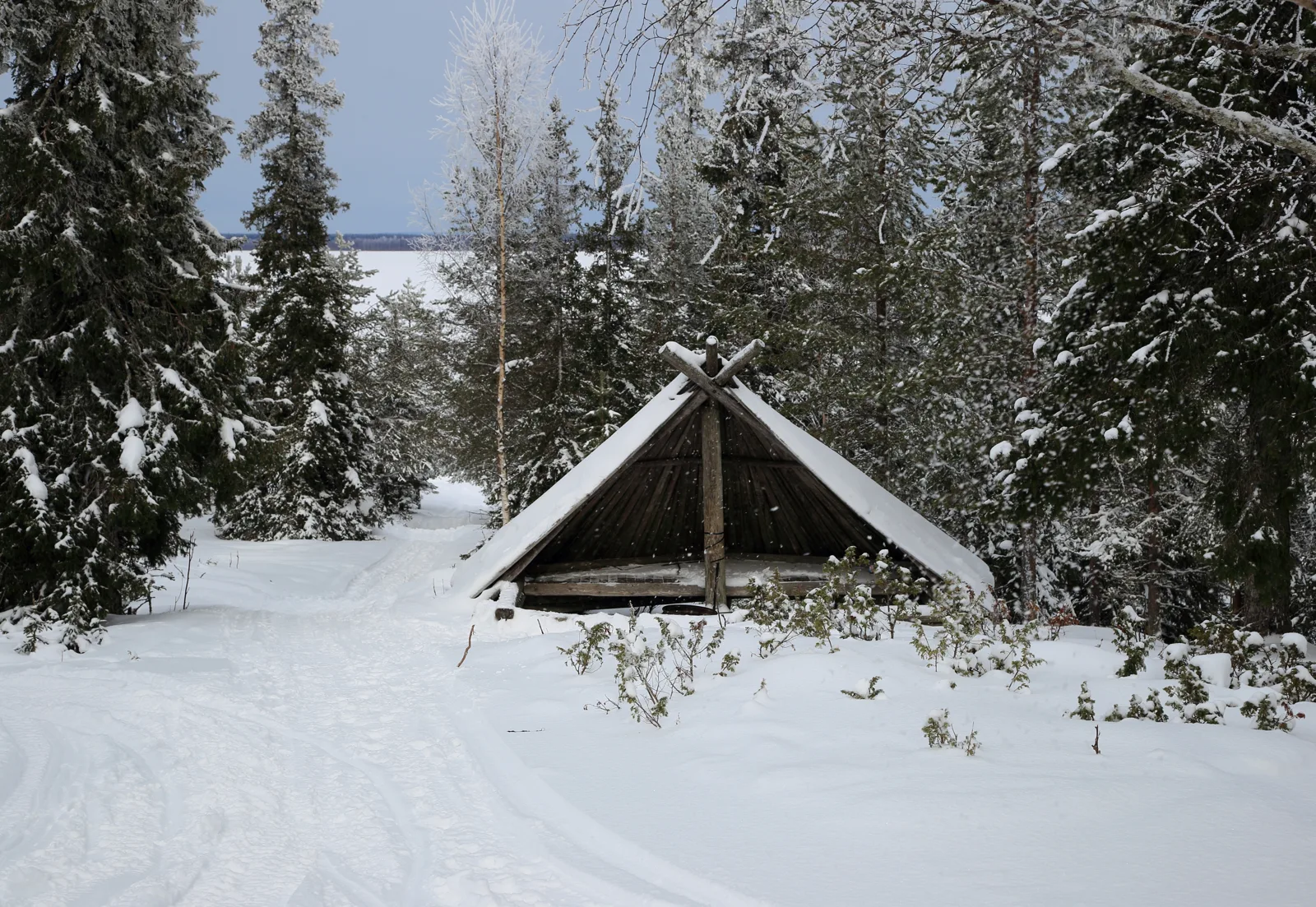
Along cross-country tracks, the rest stops are more often at a turning point or halfway round a loop: a lean-to shelter with a fireplace, and sometimes a grill hut where you can sit inside by the fire. On many family trails it is the goal of the outing itself, and in the guide to cross-country skiing with kids a fire pit or a lean-to shelter is the goal of the five-kilometre yellow loop.
Here you cannot count on firewood. Under the Swedish right of public access you may use branches and cones lying on the ground, but in winter they are under the snow, and you may not take branches from living trees. Bring kindling and a few dry logs in your rucksack or in a pulk sled.
Step right out of the track when you stop, and leave skis, poles and the pulk off to the side. Do not walk in the tracks to get to the shelter, because footprints ruin the surface for the next skier. If you are pulling a child's pulk without its own skis underneath, keep it in the skating lane so the classic tracks stay intact.
The menu: what grills in a quarter of an hour
Sausage on a stick
Sausages are the slope's classic for a reason. They weigh almost nothing, they need no pan and every child can grill their own. If you want to turn the sausage into something more, there is the best falukorv sausage and a flatbread roll with bacon-wrapped cheese sausage. There the sausage is wrapped and pre-fried at home, so it only needs finishing off by the fire, and the mash is made from instant mash powder and hot water from the flask.
Christmas sausage on skewers
In December the sausage becomes a small Christmas dinner. The important thing for the slope is that Swedish Christmas sausage is often sold raw or cold-smoked and must be heated all the way through. Simmer it at home, or buy it pre-cooked, and then the Christmas sausage on skewers only needs cutting, threading onto skewers with apple and red onion and grilling for 8–10 minutes over the embers to get colour and a glaze.
Suovas (Sami smoked reindeer meat) in flatbread
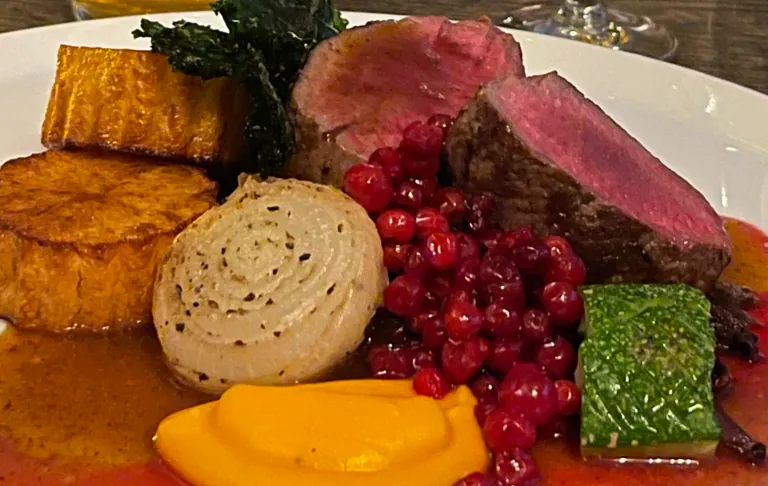
The quickest of all. The thin slices of smoked reindeer meat darken at the edges in half a minute in the pan and should be turned straight away, so the roll is ready before anyone has had time to get cold. Suovas (Sami smoked reindeer meat) in flatbread weighs little and so suits the cross-country tracks especially well, where everything has to be carried. Put the flatbread inside your jacket and the lingonberries and soured cream in small plastic tubs.
Quesadillas
The most lunch-like lunch on the slope, and one the children can help make. The bean mix, the filling and the cheese are made ready at home and travel in tubs, and the chicken is already cooked, because there is nowhere to wash your hands at the fire pit. At the fire, heat the filling in the pan first and soften the tortilla for a few seconds before folding it, so it does not crack in the cold. A lid over the pan gives the cheese time to melt. Quesadillas over an open fire need embers, not flames, so they work best where the fire is already burning when you arrive. On a windy day a pie iron is easier, because the heat comes from both sides.
What travels hot in the flask
Beans and sausages – the backup lunch
Beans and sausages can be thawed and heated in the pot by the fire, but on a day on the slopes it is smarter to heat the dish at home, thin it with a splash of water and pour it piping hot into a preheated food flask. Then you have a lunch that works even if the fire pit is full, the wood is wet or it is too windy to light a fire. Children with cold fingers are happy to eat something hot from a wooden cup while the sausages grill.
Potato and leek soup
By the fire the soup takes about 40 minutes once there are embers, far too long on a day on the tracks, but it is perfect in a flask. Make all of the potato and leek soup at home and blend it smooth before pouring it into the food flask. It is vegetarian at heart, and anyone who wants meat can grill a sausage alongside. It is the flask food for the lean-to shelter at the turning point.
Something hot to drink
Blåbärssoppa (warm bilberry soup)
Blåbärssoppa (warm bilberry soup) (warm bilberry soup) is the cross-country tracks' very own drink. Cook it at home and make it a little thinner than usual, so it pours easily from the flask and does not turn into a custard in the cup as it cools in the cold. Blend it smooth, so no berries are left at the bottom.
Hot apple juice and hot chocolate
Warm apple juice is the change of pace when the children have already had hot chocolate twice that day. It should steam but never boil. Heat it at home and strain off the spices before pouring it into the flask, otherwise it turns bitter. Or heat it in the pot over the embers and move the pot out to the edge when it starts to steam. Hot chocolate after the slopes is worth saving for the last break, as a reward for the last run.
Do not give the little ones a drink straight from the flask. 1177 reminds us that small children should not be given drinks that are too hot, so dilute it with a little cold drink or let it cool to lukewarm first.
Kokkaffe for the adults
If you have a long break at the lean-to shelter on the tracks and the fire is already going, kokkaffe (boiled coffee) is worth the minutes. Carry the water hot in a flask, so the fire only needs to bring it to the boil. Heat the children's drink first in the same pan, then the coffee. On the slopes you rarely have time to wait for the grounds to settle, so flask coffee will do there.
What can wait for another day
Baked apples, rotmos (mashed swede and potato) and kalops (Swedish beef stew) take too long for a lunch break between two runs. They suit a day better when the fire is the whole point, like a weekend of winter camping. stick bread also works best on a calm day, because it takes a while to cook all the way through and the children stand still in the meantime.
The evening before: what is done at home
Most of the work is done at the cooker. A simple order:
- The flask food is heated piping hot in the morning, not the evening before. Preheat the food flask with boiling water while the food heats up.
- Fillings for the quesadillas and flatbread rolls are made the evening before and put in plastic tubs. Glass can crack in the cold.
- The sausages are simmered at home if it is raw Christmas sausage, so they are cooked through before being cut and threaded onto skewers by the fire. Bacon-wrapped cheese sausages are wrapped and pre-fried at home.
- Kindling and firewood are packed in a bag of their own, so they do not get damp from the snow on the skis.
- Spare clothes for each child go on top in the rucksack, so they are the first thing to come out.
More basic ideas on splitting the work between the kitchen and the outdoor kitchen are in cooking outdoors in winter.
The fire by the slope and the tracks
Cook over embers, not flames. At the fire pit on the slopes the fire is often already going, so add wood in good time so there are embers by the time the food comes out. If you are first, light the fire while someone else puts the children's extra layer on.
The fire pit is shared. Ask before you put your sausages on someone else's embers, add some wood when you leave so the next family has something to grill on, and take rubbish and leftover food home. Naturvårdsverket, the Swedish Environmental Protection Agency, reminds us that leftover food containing meat left in nature can spread African swine fever. If you are the last ones at the lean-to shelter on the tracks, put the fire out completely and rake through the ash so no embers are left.
How to get the fire going in the cold is in the hub page on winter campfire food, and what applies to lighting fires is in rules for lighting fires outdoors.
Timetable for the day
A day on the ski slope
- Nine o'clock: first run. The food bag stays in the car or in the warming hut.
- Eleven o'clock: one adult goes ahead and adds wood or lights the fire. The others take two more runs.
- Quarter past eleven: everyone at the fire pit. Extra layers on, a hot drink from the flask and the food flask opened.
- Half past eleven: sausages, suovas or quesadillas on the embers. Ready in a quarter of an hour.
- Quarter to twelve: rubbish in the bag, the food bag put back and out on the slope again while the restaurant queue is still long.
- The afternoon: the last flask of hot chocolate after the last run.
A day on the cross-country tracks
- Start: a short loop to a lean-to shelter, no longer than the little ones can manage to get back from.
- At the turning point: extra layers on first, then the fire. Soup from the food flask while the fire gets going.
- Once there are embers: suovas or sausages, and blåbärssoppa for dessert.
- Before you leave: put the fire out and take off the extra layer just before you set off, so you do not get sweaty straight away.
The children's role
Children with a job to do forget more often that they are cold.
- Three to five years: fill their own tortillas from the tubs, pour blåbärssoppa with some help and collect rubbish in the bag.
- Six to nine years: grill their own sausage on a long stick, stand behind a line you draw in the snow around the fire, and keep an eye on the time for the quesadilla.
- Ten years and older: handle the pan with a spatula and barbecue gloves, and can light the fire with an adult beside them.
More jobs by age are in cooking with children over a fire. Take your skis off by the fire, and keep ski boots and snow trousers away from the flames. Sparks easily burn holes in thin shell jackets and mittens.
Keep an eye on the cold
Children who have skied all morning are often sweaty, and when they stop by the fire they cool down quickly. Swap damp mittens and socks for dry ones before eating. A child who shivers, turns pale or would rather stand still is cold, and white patches on the cheeks and nose are the first sign of frostbite. What to do then is in hypothermia and frostbite.
When it is too cold for the grill
The barbecue break is for days when it is nice to be outside. On a windy day with severe cold, even a short break by the fire is too long for the little ones. Where to draw the line is in how cold is too cold on the slopes. On days like that, eat the flask food inside the warming hut, where some resorts have a microwave, and save the grill for a sunny day. Dinners in the cabin after a day on the slopes are in food on a ski trip.
Packing for the barbecue break on the slope or the tracks
Frequently asked questions
Are you allowed to barbecue on the ski slope?
Yes, at the fire pits the resort has set up. Many Swedish ski resorts have fire pits by the children's area and along the runs, and at several of them firewood and kindling are laid out. Do not light your own fire on the piste or by the lifts, and follow the signs at the fire pit.
Do you need to bring your own firewood to the fire pit?
On the ski slope there is often firewood on site, but not always. At lean-to shelters and fire pits along cross-country tracks it is less certain, and in winter branches and cones are under the snow. Bring a bag of kindling and a few dry logs in your rucksack or pulk, so lunch does not depend on what is left in the woodshed.
What can you grill on the ski slope apart from sausages?
Suovas in flatbread, quesadillas in a frying pan or pie iron, Christmas sausage on skewers and flatbread rolls with sausage. Everything is quick if the filling is made at home. Soups and stews take too long to cook by the fire on a day on the slopes, so bring them hot in a food flask.
How long should the lunch break be with children in the cold?
Short enough that nobody has time to get stiff. Aim for a quarter of an hour at the fire for the cooking itself, and put an extra layer on the children as soon as you stop, because the body cools quickly once you stop skiing. If a child starts to shiver, turns pale or wants to stand still, it is time to go inside or keep skiing.
How do you keep food warm on the cross-country tracks?
Cook it at home and pour it piping hot into a preheated food flask. Fill the flask right to the top and do not open it until you eat. At the lean-to shelter you then only need a hot drink and perhaps something quick to grill, like sausages or suovas.
Are you allowed to make a fire by the cross-country tracks?
Use the lean-to shelters and fire pits along the tracks. Under the right of public access you may only make a fire where it can be done safely, and a permanent fire pit is the safest choice. Do not walk in the tracks to get there, put the fire out completely if you are the last ones and take leftover food home.