Short answer
In Sweden, All Saints' Day 2026 falls on Saturday 31 October, the same day as Halloween. It is the day when people go to the cemetery and light candles for those who have died. Take the children along at dusk, let them choose a candle and light it with an adult, and talk simply and honestly about the person you are remembering. Grave candles should stand in a lantern or candle holder, and memorial groves often have their own rules.
All Saints' weekend 2026
| Day | Date | What happens |
|---|---|---|
| All Saints' Eve | Friday 30 October | Not a public holiday. Quieter at the cemeteries than on the Saturday. |
| All Saints' Day | Saturday 31 October | The main day. Candles on the graves, open chapels and the most people at dusk. The same day as Halloween. |
| All Souls' Day | Sunday 1 November | A day for remembering your own loved ones who have died. Many churches hold a memorial service. |
All Saints' Day always falls on the Saturday between 31 October and 6 November. Times and programmes vary between cemeteries.
All Saints' Day is the quietest weekend of the autumn. As darkness falls on Saturday afternoon, the cemeteries fill with thousands of small flames, and most children who get to come along remember it for a long time. It is a good opportunity to talk about people who are no longer here – without it having to feel heavy.
In 2026, All Saints' Day falls on Saturday 31 October, the day after the autumn break ends and the same day as Halloween.
What is All Saints' Day?
Originally it was a church day for honouring the saints. Today, for most people, it is about remembering their own dead: you go to the grave, clear away the leaves, lay down some spruce sprigs or heather and light a candle. The custom of lighting candles on graves only became a widespread Swedish tradition in the 1950s.
The weekend has three parts. All Saints' Eve is the Friday, All Saints' Day is the Saturday and All Souls' Day is the Sunday, when many parishes hold a memorial service.
Halloween on the same weekend – how to keep them apart
Children rarely find it hard to keep two things apart if they are given a simple explanation. Halloween is dressing up, pumpkin lanterns and trick or treat. All Saints' Day is a day of remembrance, and the cemetery is a place where you are quiet and kind.
A plan that works for many families: the cemetery at dusk on Saturday, and the cosy Halloween fun afterwards or on the Friday evening. Let the costumes wait until you are back home. A ghost sheet among the graves can feel wrong to someone who is grieving.
Lighting candles with the children
Let the child choose the candle and hold it. An adult lights it with a long lighter, and the child puts the lid on and places the lantern on the grave. For the youngest, that very moment is the whole point.
Things that tend to work at the grave:
- Share a memory. “Grandma always baked cinnamon buns when we came.” A single concrete memory is enough.
- Leave something the child has made. A drawing in a plastic sleeve, a pine cone or a pretty leaf from the walk.
- Count the candles. For three-year-olds, the sea of lights is a voyage of discovery in itself.
- Light a candle for someone buried far away. Almost every cemetery has a memorial grove or a shared spot where you can light a candle for someone buried elsewhere.
If you have no grave to visit, it is just as fine to simply walk around and look. Lots of people do, and nobody thinks it is strange.
Talking about death – gently and honestly
The Church of Sweden's advice is clear: don't lie to protect the child, and start from the child's own questions. Answer what the child asks, no more.
- Ages 2–4: The child does not yet understand that death is for ever. Use plain words: “Grandad is dead. His body has stopped working. He isn't in pain and he isn't cold.” Avoid “fallen asleep” and “passed away” – they can make the child afraid of going to sleep, or make them wonder when Grandad is coming back.
- Ages 5–7: Now come the questions about why, and whether you are going to die too. An honest answer might be: “Most people live until they are really, really old. I plan to be with you for a very long time.”
- Ages 8–10: The child understands that death is final and may want to talk about what people believe happens afterwards. It is fine to say “nobody knows for sure, but this is what I think”.
Expect the same question to come up again, perhaps in the car on the way home or at bedtime. Children's grief is often described as puddle-jumping: sad one moment, playing the next. That doesn't mean they don't care.
In Gothenburg, Sankt Lukas chapel at Västra kyrkogården has a short programme for children on All Saints' Day 2026, “Can you play with death?”, at 13:30, 14:30, 15:30 and 16:30.
Safe candles and lanterns
- Grave candles in a lantern or candle holder. A pillar candle placed straight on the ground melts and runs.
- Keep a distance from spruce sprigs and wreaths. Dry twigs and fabric ribbons catch fire easily.
- Not too close together in the memorial grove. Candles packed tightly in a shared candle stand can heat each other up and catch fire. It has happened in cemeteries over All Saints' weekend.
- Check the rules on LED and battery candles. In Gothenburg, the cemetery administration advises against LED candles, and in several memorial groves both battery candles and outdoor torches are banned.
- The child carries a battery lantern. For walking in the dark, a battery lantern or head torch is better in a child's hands than a lit candle. Add a high-vis vest, because it is dark in the car park and along the road. There is more about reflectors and walks in the dark in advent outings.
At home, you can light a memorial candle in the window if you can't get out. The same safety rule as for Lucia (the Swedish candlelit festival on 13 December) applies: never leave a lit candle unattended.
Skogskyrkogården and other places to see the candles
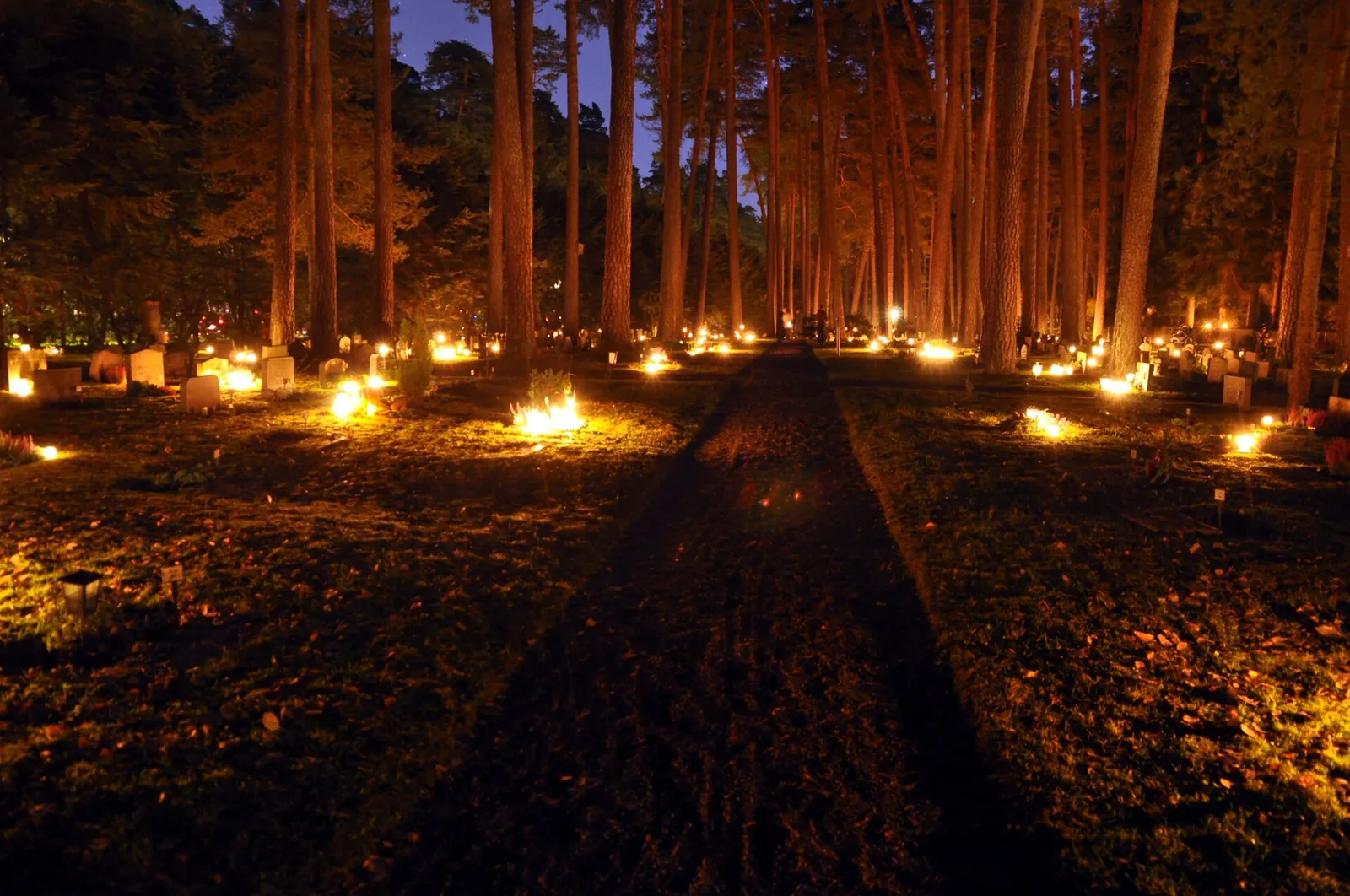
Skogskyrkogården in Stockholm is the best known. It was designed by Gunnar Asplund and Sigurd Lewerentz and is one of Sweden's World Heritage Sites. Over All Saints' weekend, 30 October–1 November 2026, the candles glow between the pine trees along the long paths, and the hill Almhöjden can be seen from far away. It is busiest on Saturday afternoon and evening. Take the underground to Skogskyrkogården station instead of driving. The Tallum visitor centre serves fika (coffee and cake), and the chapels of Faith, Hope and the Holy Cross are closed for renovation until the second half of 2027.
Gothenburg: Östra kyrkogården and Örgryte nya kyrkogård are completely car-free on 31 October from 11:00 to 18:00. The staff offer coffee, squash and biscuits, and the chapels are open.
Lund: Norra kyrkogården is usually lit up with outdoor torches along the paths and stays open late on All Saints' Day.
Go early in the evening, around four to half past four, rather than late. That way the children get to see the candles being lit and you are home in time for dinner. Take a flask of hot chocolate and make a calm walk of it, as one of the autumn's kid-friendly activities.
What to bring to the cemetery at All Saints'
Frequently asked questions
When is All Saints' Day 2026?
All Saints' Day is Saturday 31 October 2026. It always falls on the Saturday between 31 October and 6 November. All Saints' Eve is Friday 30 October and All Souls' Day is Sunday 1 November.
Can you take small children to the cemetery at All Saints'?
Yes. Many children find the sea of lights beautiful and exciting. Go at dusk, put a reflector on your child and let them hold an adult's hand where it gets crowded. It is fine to run a little on the gravel paths, but not on the graves.
How do you explain death to a three- or four-year-old?
With short, concrete words: the body has stopped working, the person who has died doesn't breathe and can't feel cold or pain, and they won't come back. Avoid saying that someone is sleeping or has fallen asleep – it can make small children afraid of going to sleep.
Are LED candles allowed on graves?
It depends on the cemetery. In Gothenburg, the cemetery administration advises against LED candles, and several administrations allow neither battery candles nor outdoor torches in memorial groves. Read the sign at the entrance or the cemetery's website before you buy candles.
Are All Saints' Day and Halloween the same thing?
No. All Saints' Day is a quiet Christian day of remembrance with candles on the graves. Halloween comes from Celtic tradition and is celebrated with dressing up and trick or treat. In 2026 they fall on the same Saturday.
Where are the candles most beautiful at All Saints'?
Skogskyrkogården in Stockholm is the best known, with candles between the pine trees and on Almhöjden. In Gothenburg, many people gather at Östra and Västra kyrkogården. But the small cemetery where the family is buried is often the one that means most to the children.