Short answer
Halloween is celebrated on 31 October, and in 2026 it falls on a Saturday – the same day as All Saints' Day. Many families go door to door for sweets on the Friday evening or early on the Saturday. Only knock where a pumpkin is lit or decorations are up, give everyone reflectors and let an adult go with the little ones. You can also celebrate the spooky night at home with jack-o'-lanterns, fancy dress and food by the fire.
Halloween week 2026 in the calendar
| Day | Date | What happens |
|---|---|---|
| Autumn Break | 26–30 October (week 44) | Off school in most municipalities – a good time to carve pumpkins and decorate |
| All Saints' Eve | Friday 30 October | Many go door to door for sweets already this evening |
| Halloween | Saturday 31 October | Halloween itself – the same day as All Saints' Day |
| All Saints' Day | Saturday 31 October | Candles are lit on graves – cemeteries are no place for pranks |
| All Souls' Day | Sunday 1 November | Memorial services in many churches |
The autumn break week can differ between municipalities – check the school calendar.
In thirty years, Halloween has gone from an odd imported holiday to one of the biggest autumn evenings for families with children in Sweden. For the kids, it is about dressing up, walking in the dark with a flashlight and coming home with a bucket full of sweets. For the adults, it is mostly about everything going smoothly: that the children are visible, that nobody gets truly frightened and that neighbours who do not want to take part are left in peace.
This guide covers everything from when it is and how trick-or-treating (going door to door for sweets) works in Sweden to how to adapt the evening to your children's age. If you want to carve a jack-o'-lantern, there is a separate step-by-step guide: pumpkin carving with kids.
When is Halloween 2026?
Halloween always falls on 31 October. In 2026 it is a little special: 31 October is a Saturday, and it is the same day as All Saints' Day. Since the early 1950s, All Saints' Day in Sweden has been celebrated on the Saturday that falls between 31 October and 6 November, so this year it lands exactly on Halloween.
This means that two very different traditions collide. On the evening of 31 October, many children dress up and go from house to house, while at the same time many people light candles on the graves of their loved ones. Some families therefore choose to go door to door for sweets already on Friday evening, All Saints' Eve. Others stick to the Saturday as usual. No day is wrong, but it is good to know what applies in your particular area. The neighbourhood Facebook group or the parents' group at preschool is usually the quickest way to find out.
The autumn break also falls in week 44 in most municipalities, that is 26–30 October. That gives plenty of time to decorate, carve and plan costumes before the weekend. If you are looking for more to do during the break, you will find tips in our autumn break guide for the West Coast.
Why do we celebrate Halloween in Sweden?
Halloween comes from the Celtic festival of Samhain, which was celebrated in Ireland and Scotland on the last day of October. It was the first day of winter, and people believed that the boundary between the living and the dead was thinner that night. Children went from farm to farm with lanterns made from hollowed-out turnips and sang for the dead, and were often given a cake as thanks. The tradition travelled with Irish emigrants to the USA, where the turnip was swapped for the bigger and easier pumpkin.
Halloween only really arrived in Sweden in 1990, when a restaurant in Stockholm and a chain of fancy-dress shops organised a Halloween week together. During the 1990s the celebration grew quickly, largely driven by retailers, and today it is hard to find a residential area without pumpkins in the windows at the end of October.
Halloween is not the same thing as All Saints. All Saints' Day is a Christian holiday when people remember the dead, visit the cemetery and light candles. Both have their origins in remembering those who have passed away, but the mood is completely different. It is nice to talk to the children about the difference – and about why you do not play pranks in the cemetery.
Trick or treat – how it works
Going door to door for sweets – trick or treat – is the big highlight of Halloween for most children. The children knock on the door, call out “trick or treat!” and get a sweet or two. In practice there are almost never any pranks – and there should not be. A few unwritten rules have developed in Sweden:
- Only knock where it is decorated. A lit pumpkin by the door, a cobweb in the window or a sign means “welcome”. A dark, undecorated house means “not this year”.
- Respect notes. If the note says that they do not want any visits from children asking for sweets, move on without knocking.
- Once per house. Do not go back in a new costume for more sweets.
- Say thank you. It sounds obvious, but children who are excited in the dark easily forget.
- Go between roughly 5 and 8 pm. The little ones go early, just after dark, and the older ones a little later. After 8 pm, people stop knocking.
- No real pranks. No eggs, no toilet roll in the trees and no firecrackers. It frightens animals and older people, and it can get expensive.
If you want to welcome visitors yourselves: put out a lit jack-o'-lantern by the door, have a bowl of sweets ready and expect a stream of little ghosts between half past five and seven. If there are people with allergies in your family or neighbourhood, it is kind to also have something without nuts, such as lollipops or small boxes of raisins.

Be seen in the dark – reflectors and lights
The most important thing about the whole evening is that the children are visible. Most Halloween costumes are black, dark purple or dark grey, and the evening is often both wet and dark. With a reflector, a child can be seen from about 125 metres away when a car is driving with low beams. Without a reflector and in dark clothes, the child is only seen at 20–30 metres – too short a distance for a driver to have time to brake.
- Put reflectors on both sides of the body, ideally one dangling at knee height. A reflective vest over the costume also works, and the children can draw ghosts on it.
- Give the children a flashlight or headlamp. It quickly becomes a fun part of the costume and makes them easier to see.
- Choose masks with large eye holes, or paint their faces instead. A mask that blocks their view makes it hard to see kerbs and cars.
- Avoid long capes and trains that children can trip over.
Real candles in pumpkins and lanterns are cosy, but a fire risk when children in flimsy costumes run past steps and gates. Use LED candles in jack-o'-lanterns instead, and in lanterns that the children carry. If you have real candles indoors: place them steadily on something that does not burn and blow them out when you leave the room.
Just scary enough – adapt to their age
Halloween should be exciting, not truly frightening. Where the line goes differs a lot between a three-year-old and an eleven-year-old.
- Ages 2–5: The youngest usually like dressing up and getting sweets the most. Choose friendly costumes – pumpkins, cats, bats, little ghosts – and visit a few houses where you know the neighbours. Avoid houses with scary sounds and figures that jump out. Go home when your child says they have had enough, even if it was only four doors.
- Ages 6–9: This is where things speed up. Children like to be witches, skeletons and monsters, and think it is exciting to get a little scared. An adult goes along, but can stay a little way behind on the pavement. Agree on a route in advance.
- Ages 10–12: Many want to go with friends instead of with their parents. Agree on the area, a finishing time and that someone in the group has a charged mobile phone. Reflectors easily get forgotten at that age – make them part of the costume.
Talk before the evening about there being people behind the masks, and that it is always fine to turn back. Children who know what to expect are less frightened.
The sweets afterwards
When you get home, it is time for what everyone has been waiting for: tipping the sweets out on the table. Take the opportunity to sort them before anything is eaten:
- Throw away sweets that have been opened or are not in their original wrapping.
- Remove anything containing nuts if someone in the family is allergic – and remember that loose sweets from the same bowl can sometimes contain traces of nuts.
- Small children under three should not have hard sweets, lollipops with loose parts or peanuts, as they can easily choke on them.
Many families have a rule that some sweets are eaten straight away and the rest are saved in a jar for the weekends ahead.
A spooky night at home – or in the forest
Going door to door for sweets is not the only way to celebrate. Many families make Halloween night their own tradition at home or outdoors:
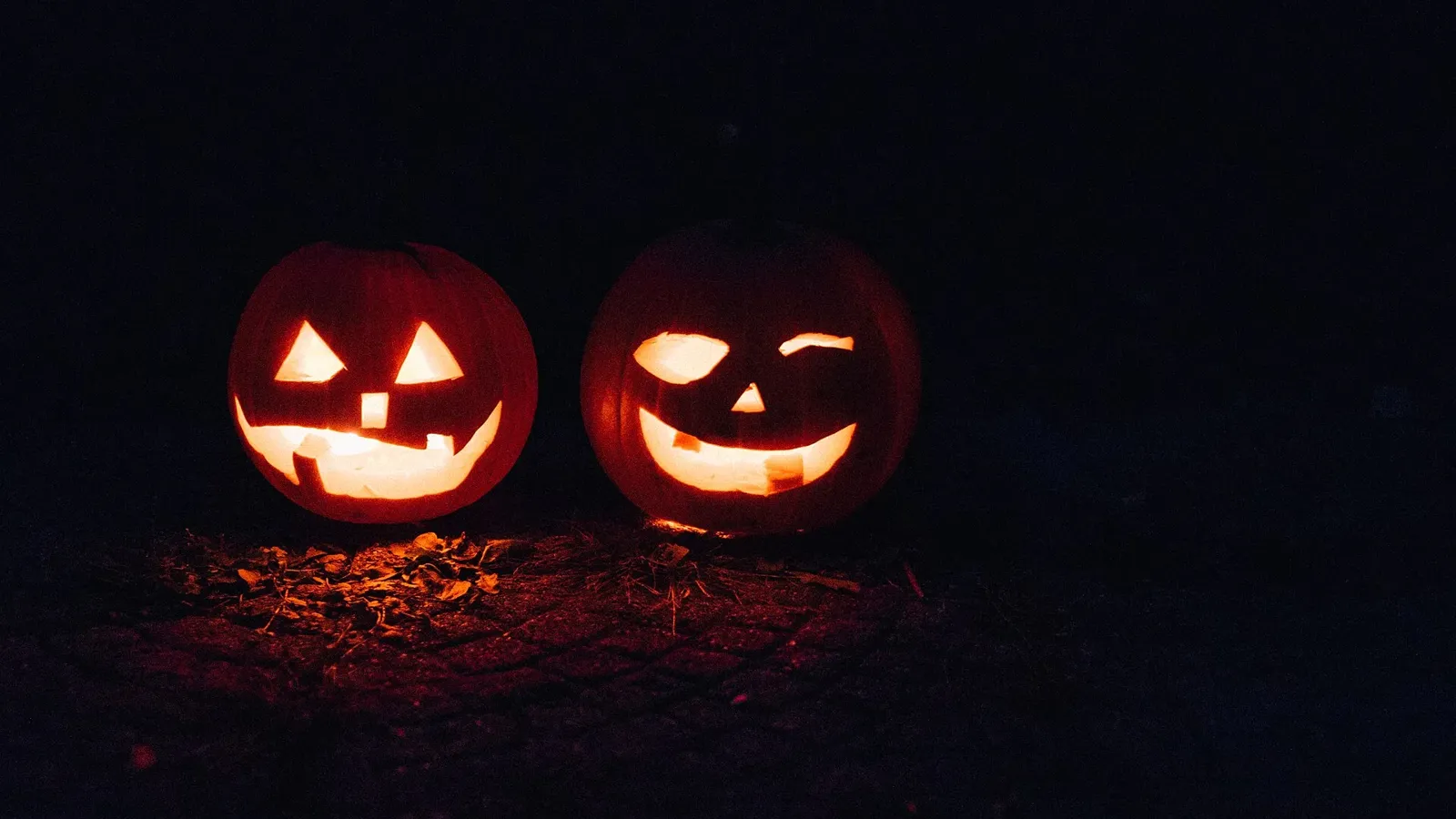
- Carve pumpkins. The children draw the face, the adults do the cutting. The pumpkin seeds are roasted and become a snack for the film. It is all in the guide to carving a pumpkin with kids.
- A ghost walk with flashlights. Walk a short loop in the forest or park after dark, with headlamps, and tell a gentle ghost story during a break. You can read about what the atmosphere can be like in a dark mountain landscape in our night hiking in Funäsdalen.
- Treasure hunt. A ready-made Halloween treasure hunt with eight rhyming clues to print – perfect for the youngest.
- Crafts. Pine cone ghosts from the forest walk and paper plate masks for dressing up.
- Halloween food. Mummy sausages, ghost bananas and witches' brew – the ideas are in Halloween food for kids.
- Food by the fire. A fire in the garden or at a barbecue spot is perfect for Halloween. Make s'mores or a chocolate fondue over an open fire, and warm your hands with hot chocolate from the flask.
- Halloween dinner. A big autumn stew is easy to make “scary” – call the beef stew over an open fire witches' brew and serve it in a pumpkin bowl.
- Decorating. Cobwebs, a string of pumpkin lights and ghost lanterns made from glass jars in the window and a bat garland in the doorway transform the hallway in fifteen minutes. It is also the easiest way to show the neighbourhood children that they are welcome.
Halloween away from home
If you want to make a bigger outing around Halloween, several amusement parks and zoos have Halloween opening during October and the autumn break. The biggest is Halloween at Liseberg in Gothenburg, with thousands of pumpkins, haunted houses and its own Rabbit Land for the youngest. The park usually has Halloween opening from the beginning of October to the beginning of November. You will find more parks around the country in our guide to amusement parks in Sweden – always check the current opening hours before you go.
Many museums also have Halloween programmes during the autumn break with ghost walks and crafts. Tips on museums that work well with children can be found in museums with children.
Packing for trick or treat
Frequently asked questions
When is Halloween 2026?
Halloween is always on 31 October. In 2026 it falls on a Saturday, the same day as All Saints' Day. All Saints' Eve is Friday 30 October, and the autumn break falls in week 44 (26–30 October) in most municipalities.
Which day do you go trick-or-treating in 2026?
There is no fixed rule. Many go on Halloween itself, Saturday 31 October, but since it is also All Saints' Day, some families choose the Friday evening. Check in your neighbourhood group what applies where you live.
How do you know who wants trick-or-treaters?
In Sweden it has become the custom to only knock where a pumpkin is lit, decorations are up or a sign says you are welcome. If it is dark and undecorated, you move on. A note saying that the household does not want any visits should always be respected.
What time should children go trick-or-treating?
Between about 5 and 8 pm is most common. Small children go early, just after dark, and most families expect it to be over by around 8 pm.
From what age can children go trick-or-treating on their own?
It depends on the child and the area. Many let children from ten or eleven go in a group with friends on familiar streets, with a mobile phone, reflectors and a set time to be home. Younger children go with an adult.
What is the difference between Halloween and All Saints?
Halloween comes from the Celtic festival of Samhain in Ireland and Scotland and arrived in Sweden in the 1990s. All Saints' Day is a Christian holiday when people remember the dead and light candles on graves. Both are originally about remembering the dead, but the mood is very different.