Short answer
First write in the times that are already fixed. Then choose two or three fixed points for the week, for example an outdoor day, a home project and a booked outing. Decide on food and a smaller backup for each fixed point, and leave other days free to move around.
A winter sports break at home doesn't need to be filled with a big new activity every day. Choose a few things you want to get done, leave room for the weather and let some days be ordinary days with a small outing in the middle.
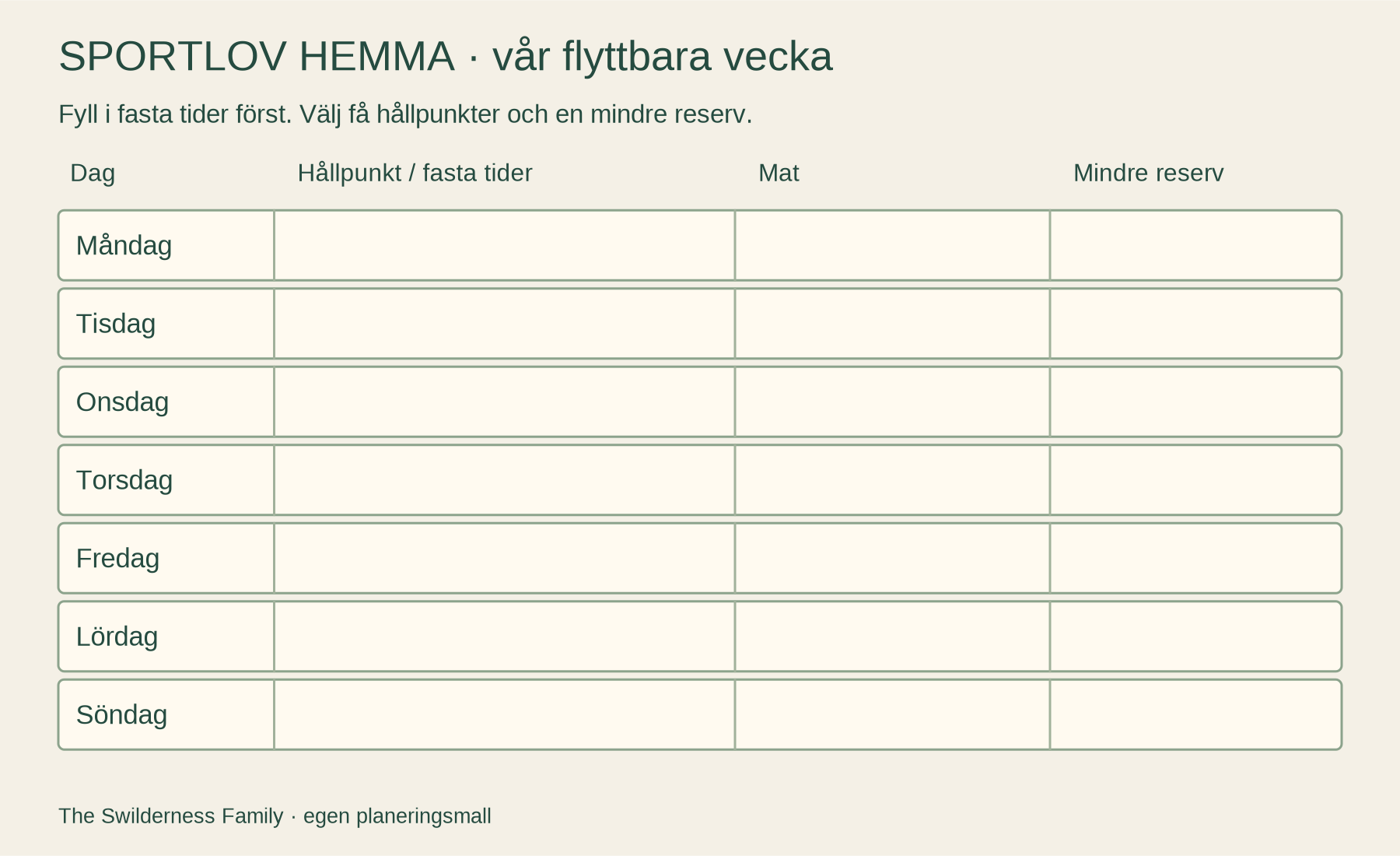
First plan when the family actually has time together. Then fill in two or three fixed points and keep the rest flexible. Here's a weekly plan to fill in. You can see which week your municipality has the break in sportlov 2027 (Swedish February ski break).
Start with the times that are already fixed
Write in work, regular training sessions, booked appointments and anything else that already shapes the week. Also mark when different adults are available. That makes it easier to see which activities can be shared and which need to be small and close by.
Ask each child about one thing they most want to do. Keep wishes and bookings apart: first you gather ideas, then you choose what fits. A longer outing may mean keeping another day quiet.
Open the blank weekly plan and print it if you want to fill it in on paper. The template has room for the day's fixed point, food and a simpler alternative. Use pencil so the plan can be changed.
Choose three fixed points for the whole week
Try setting one outdoor day, one home project and one outing to an attraction or place. That gives different kinds of days without needing seven bookings. Choose fixed points that work with the family's budget, transport and energy.
The outdoor day can be a familiar loop with a packed lunch. The home project can be baking, building or crafting in two short rounds. The third fixed point can be the library, a museum or the swimming pool once you've found a time that suits and the booking is sorted where needed.
If you're looking for places to go where you live, there's sportlov (February half-term) in Stockholm and the winter sports break in Gothenburg and on the West Coast. Choose the place with the local guide and spread out the days with this plan.
A week you can move around
| Day | Fixed point | Food that makes the day easier | Backup |
|---|---|---|---|
| Monday | A short walk and choose the week's project | A familiar lunch at home | Read and plan at the kitchen table |
| Tuesday | The first part of the home project | Prepared lunch | Just one small step |
| Wednesday | Outdoor day with a packed lunch | Ready-made packed lunch and a hot drink | The same food at a spot close to home |
| Thursday | Free day or finish the project | Yesterday's leftovers | Rest with no new item on the programme |
| Friday | The booked outing | Food before or after the visit | Your own activity if the booking falls through |
| Saturday | A shared favourite close to home | Something you cook together | A shorter version of the same idea |
| Sunday | Pack the week away | Simple dinner | Let the day be calm |
Move the days around to suit your schedule and the weather forecast. It's the mix of different kinds of moments that helps, not that Wednesday always has to be an outdoor day.
Make the outdoor day small enough to actually happen
Choose a place with an easy way home and a clear first goal. Bring just one main activity. Winter bingo works on a short walk even when there's no snow, while the snowman suits days when the snow can be shaped.
Decide on food and seating before you set off. For a a winter picnic without a fire the food can be ready before you go. Then the adult keeping the activity together doesn't also have to sort out a stove on the spot.
Have the right clothes, dry spares and an adult responsible for choosing the route. Finish when someone needs to get indoors into the warmth. In bad weather, the walk can be shortened to the nearest stop or moved to another day.
Give the home project two sessions
Choose something that can be put away. The first session can be preparing materials and trying a part; the second painting, cutting or putting it together. That makes it easier for children who want to join in for different lengths of time.
Paper snowflakes can start with a single fold and a simple snowflake. A kitchen project can be measuring out the ingredients before lunch and doing the rest later. Have a place where the work can be left out without blocking the whole dining table for the rest of the day.
Choose tasks according to the tools. Anyone not using scissors or a hot pan can measure, decide the order, draw or set the table. The activity feels more shared when everyone has a real task than when everyone waits for the same step.
Make the backup plan smaller than the original
A backup plan should reduce the work. If it requires another long car journey and a new booking, it won't help when the weather or energy changes. Instead, write the shortest version: a walk around the block, a snack in the garden or carrying on at home.
It's a good idea to keep a good-weather day empty until you know what you want to use it for. Then a snow day can be made the most of without anything booked having to be cancelled. For more small choices, see child-friendly nature activities.
Let the food be part of the preparation
Decide on lunch for the three fixed-point days and have a simple stock of basics for the rest. Children who want to help can choose fruit for the packed lunch or count how many portions to bring.
Choose from the picnic food if one day is going to be spent outdoors. At home, a single dish made together can be enough of an activity. Don't let every holiday lunch become a new recipe project if the week already has plenty going on.
Finish without counting completed activities
On Sunday you can choose one thing that was fun and one that should be made simpler next time. Keep the filled-in plan as a memory of what actually happened, crossings-out and all.
Put gear away, find the school things and keep the evening calm. A holiday can have been good even if a planned outing was swapped for two small walks and a project only got finished later.
Frequently asked questions
How many activities should you book for the winter sports break?
Start with two or three fixed points for the whole week and keep other days flexible. Adapt to your fixed commitments, transport and energy.
What should the backup plan include?
A smaller version that takes less work: a shorter walk, an activity at home or a packed lunch at a closer spot. Avoid a backup that needs a big new booking.
Does the plan work when adults are working part of the week?
Write in the fixed times first and choose shared activities in the gaps that actually exist. Not every day needs a shared outing.