Short answer
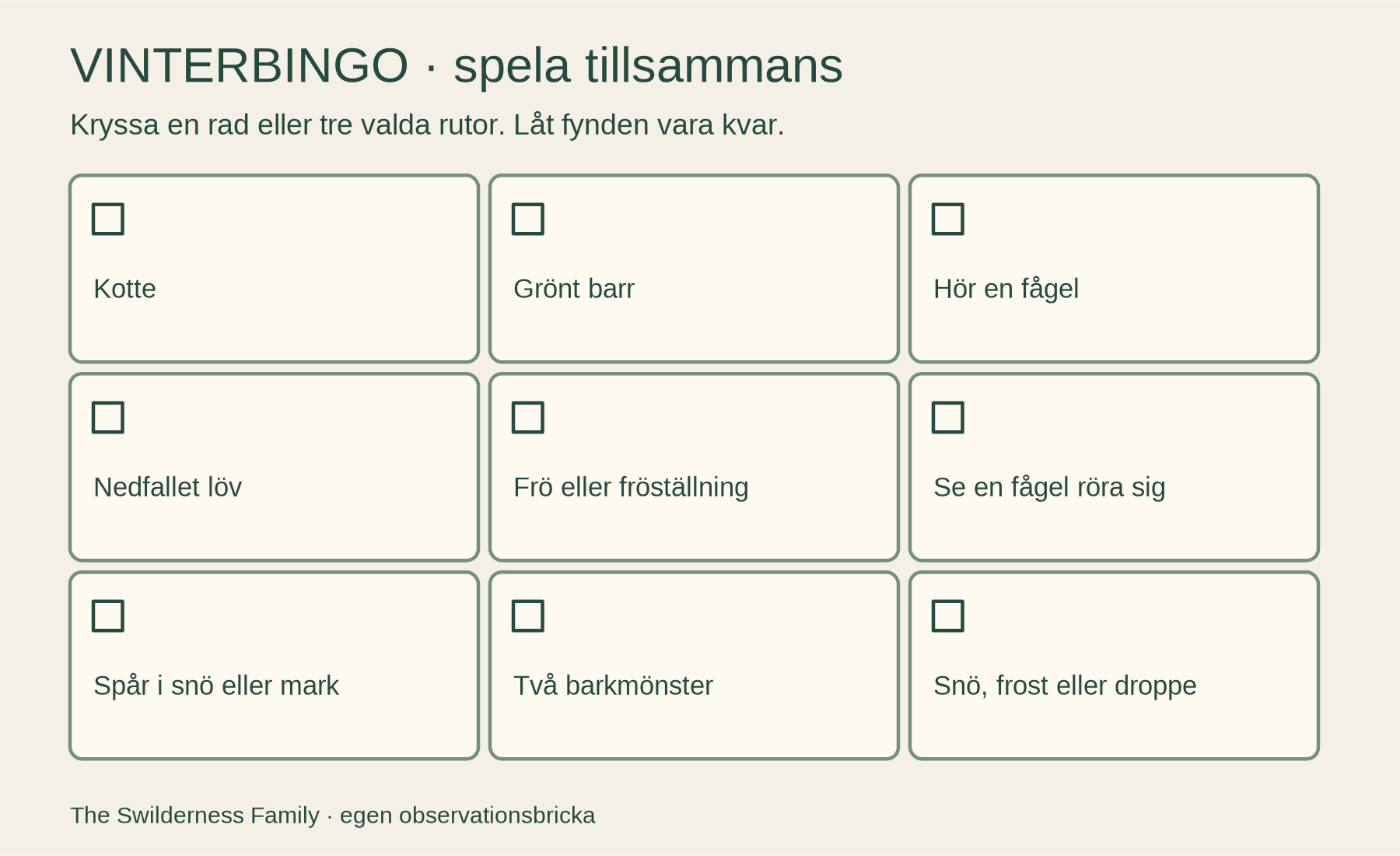
Take a short walk with nine spotting squares: cone, needle, birdsong, leaf, seed, bird movement, track, bark and winter weather. Play as a team and let one row be enough. Choose three squares for a short outing and swap the snow tasks to suit the day's weather.
Winter bingo turns an ordinary walk into a little search. A track in the snow, a cone by the path and the sound of a bird are enough to make you start looking at the place in a new way. Nobody needs to know the names of everything you find.
Play together and choose the squares to suit the weather. Nine small tasks work even on a winter day without snow, and you can stop after one row. Here's a card of its own to bring along; for more kinds of outings there's child-friendly activities in nature.
Bring the card or read three squares at a time
Open the winter bingo for printing and print it on slightly thicker paper if you can. If it's wet out, the sheet can go in a plastic sleeve. A pen and something to lean on are all you need besides ordinary outdoor clothes.
You can also read out three squares before you go and let the children remember them. Then you don't have to take off your mittens every time someone finds something. The adult ticks them off when you stop.
Start by choosing a place where you can walk a short loop or there and back. The park, the garden or a familiar forest path all work. Don't let any find tempt you further than you planned to go.
Nine squares to discover in winter
| Look close to the ground | Look at the plants | Use your ears and eyes |
|---|---|---|
| A loose cone | A green needle | Hear a bird |
| A fallen leaf | A seed or a dry seed head | See a bird move |
| A track in snow or soft ground | Two different bark patterns | Snowflake, frost or raindrop |
The squares are written so they can be explored on the spot. You don't need to take the objects home. Point, take a photo with your own phone or describe what you see, and leave the find where it is.
The bark square means comparing the surfaces of two trees, not peeling off bark. For needles, it's enough to see them on a branch. If you're also going to collect materials for crafts, the rules are in allemansrätten (the right to roam).
Make it easier without turning it into a test
Choose three squares for a short first round. One child can listen for birds, another look for cones and an adult help with the bark patterns. Play as a group and let the finds count for everyone.
Anyone who wants more to do can describe each find in two words: pointy cone, stripy bark or shiny drop. Another version is to draw one of the finds on the back once you're indoors.
If your children want different amounts, let one row be enough for one while the others keep spotting on the way home. The bingo should help the walk along, not become a list that has to be finished before anyone can go inside.
Adapt the snow square to the day
With snow you can compare different prints from the path. Look at the shape, size and direction. You don't need to identify the track's species to tick the square. A shoe print can be the first find, and then you can look for something different.
Without snow, the same task can be done in soft ground from the path. If the ground is hard and dry, skip that square and choose another row. The bingo should follow the day – nobody needs to look for frost when it's above zero.
When the snow packs well, you can finish by going to build a snowman or making a snow lantern at home – as a moment of its own after the walk.
Stop when you hear a bird
Listen first from a place where everyone is standing comfortably. Then try to see where the sound came from. Just hearing a bird is enough for the sound square; spotting the movement can be the next task.
At an existing feeder you can stand still for a while and look at the size, colours and how the bird moves. The guide to birds at the winter feeder helps you compare a few common species. Don't go closer to get a tick if the birds are being disturbed.
Decide the way home before the search starts
Choose a familiar place where you're allowed to be and keep the group together. An adult is responsible for the route. Leave plants and animals where they are, don't taste your finds and don't go out on ice or near traffic for the sake of a square. Change anything that's got wet and end the search if someone needs to get indoors into the warmth.
If you go late in the day, light and route need to be planned from the start. Read about a winter walk in the dark instead of letting the bingo lead you ever deeper into a dark forest.
Keep one thing from the walk
Let each person choose the find of the day: a drop hanging at the very tip of a twig, a sound you couldn't place or two trunks with completely different bark. Write or draw it on the back of the card.
Use the same place another day and see what has changed. The track may be gone and the bird silent, while a seed head is still standing. For more short outings in December, see advent outings.
Frequently asked questions
Does winter bingo work without snow?
Yes. Most of the squares are about things you can find on bare ground too. Choose raindrop in the weather square and a track in soft ground if there's no snow.
Do the children need to know the names of the species?
No. The squares are based on looking and listening. It's enough to describe, for example, a bird moving or two different bark patterns.
Does the whole card need to be filled?
Let one row or three chosen squares be enough. Finish when the walk is done and come back with the same card another day.