Kolbulle is one of Sweden's most classic outdoor dishes – but its history begins long before it became a natural part of outings and markets. Originally, kolbulle was a simple working meal for charcoal burners and forestry workers during the 1700s and 1800s. It developed at a time when Sweden's iron industry demanded enormous amounts of charcoal and thousands of people worked deep in the forests in regions like Dalarna, Hälsingland and parts of Norrland.
Today kolbulle is a symbol of Swedish outdoor culture. For a comprehensive overview of the dish and how to cook it in nature, read more in our Kolbulle – the complete guide.
What is kolbulle and where did it originate?
Kolbulle is a pancake-like dish consisting of flour, water and salt fried together with salted pork in a cast iron pan over an open fire. It contains neither eggs nor milk, which sets it apart from traditional pancakes. The simplicity isn't a coincidence – it's a result of the conditions in which the dish arose.
Kolbulle is particularly associated with forest regions in Dalarna, but also with Hälsingland and other parts of central and northern Sweden where charcoal burning was a key industry. During the expansion of the iron industry, enormous amounts of charcoal were needed to run the blast furnaces. To produce this charcoal, charcoal burners lived in the forest for long stretches, often isolated from villages and farms.
It was in this environment that kolbulle emerged – as a practical solution to a concrete need.

The life of charcoal burners in the forest during the 1700s–1800s
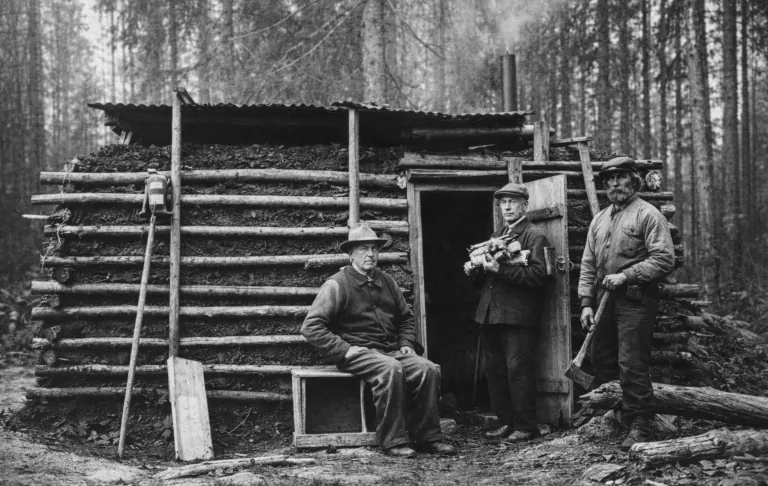
To understand kolbulle, you have to understand the living conditions of the charcoal burners. During the 1700s and 1800s, iron was one of Sweden's most important export goods. Blast furnaces and ironworks required huge amounts of charcoal, which was produced in charcoal kilns out in the forests.
Charcoal burners often lived in simple huts near their kilns. The work was physically demanding and went on around the clock for periods at a time. Leaving the kiln unattended could mean the entire batch was ruined. That's why the food had to be:
- Easy to make
- Quick to cook
- Energy-rich
- Easy to transport
- Long-lasting without refrigeration
Flour and salt could be stored for a long time. Water was available in the forest. Salted pork kept for weeks. The combination of these ingredients became a dish that could be cooked directly over the embers in a cast iron pan – a tool that could withstand high heat and an uneven fire.
So kolbulle wasn't primarily a culinary innovation, but a functional solution to a hard working life.
Why flour, water and pork specifically?
The choice of ingredients was crucial. In a time without refrigerators and modern transport solutions, ingredients with a long shelf life were required.
Flour was cheap, easy to transport and energy-rich. Water was naturally available in the forest and by streams. Salt preserved and improved the flavour. Salted pork provided both fat and protein, and served as the main flavour carrier.
The pork's fat was particularly important. It worked both as frying fat and as an energy source. The result was a dish that provided lasting fullness through working days that could stretch from dawn to dusk.
This simple ingredient logic is one of the reasons kolbulle is still practical to cook over an open fire today. For a practical walkthrough of how it's cooked in nature, see Kolbulle Over an Open Fire – recipe.

Kolbulle in different parts of Sweden
Although Dalarna is often mentioned as kolbulle's core region, the dish has spread across large parts of Sweden. In Hälsingland and parts of Värmland there are similar traditions linked to forestry and charcoal burning.
Today kolbulle is served at local heritage days, markets and outdoor events around the country. In some regions the dish has developed small variations, for instance by adjusting the ratio of batter to pork or serving it with different accompaniments.
Lingonberries have become the most established accompaniment, likely because the berry was available across large parts of Sweden and its tartness balances the fatty pork.
Kolbulle has thus gone from being local work food to becoming a nationally recognised feature of Swedish food culture.

From work food to outdoor classic
During the 1900s, Sweden's working life changed. Industrialisation and urbanisation reduced the need for traditional charcoal burning. At the same time, the outdoor movement grew, and interest in nature experiences increased.
In this new context, kolbulle took on a second meaning. It was no longer just work food but a symbol of tradition and closeness to nature. The simple cooking over an open fire fit well with the ideals of outdoor life.
Today kolbulle is a natural part of many outdoor activities. It's cooked on schools' Outdoor Days, at scout camps and during various outdoor festivals. The dish represents continuity – a direct link between historical forest work and today's interest in nature.

Kolbulle today – cultural heritage and identity
Kolbulle today is more than just a dish. It's a story about Sweden's industrial history, about the charcoal burners' toil in the forest, and about how simple ingredients could become essential for survival.
Cooking kolbulle over an open fire means recreating a historical practice in modern times. It's a tangible, physical connection to the past. At the same time, the dish is accessible and easy to adapt for today's outdoor life.
By understanding kolbulle's origins, the experience of cooking it becomes richer. It's not just food – it's culture, tradition and identity.
For a complete picture of how kolbulle fits into Swedish outdoor food, you can return to Kolbulle – the complete guide.

Summary
Kolbulle arose as a practical solution for charcoal burners and forestry workers in 1700s and 1800s Sweden. The combination of flour, water and salted pork was suited to a life in the forest where durability and energy were crucial.
Today the dish has become a symbol of Swedish outdoor culture and a living piece of cultural heritage. By understanding its history, we gain a deeper appreciation for both the food and the society that shaped it.

Read more about kolbulle
Want to see how kolbulle is cooked in practice, and how to avoid common mistakes outdoors? Explore our guides: