
Popular searches

    Chocolate fondant with a molten centre – fill the moulds in advance and bake after the main course

    Firm edge, molten middle and just twelve minutes in the oven
    • 6 servings
    • Time: 20 min + 10–16 min in the oven
    • Difficulty: Medium
    • 11 ingredients
    • 10 steps
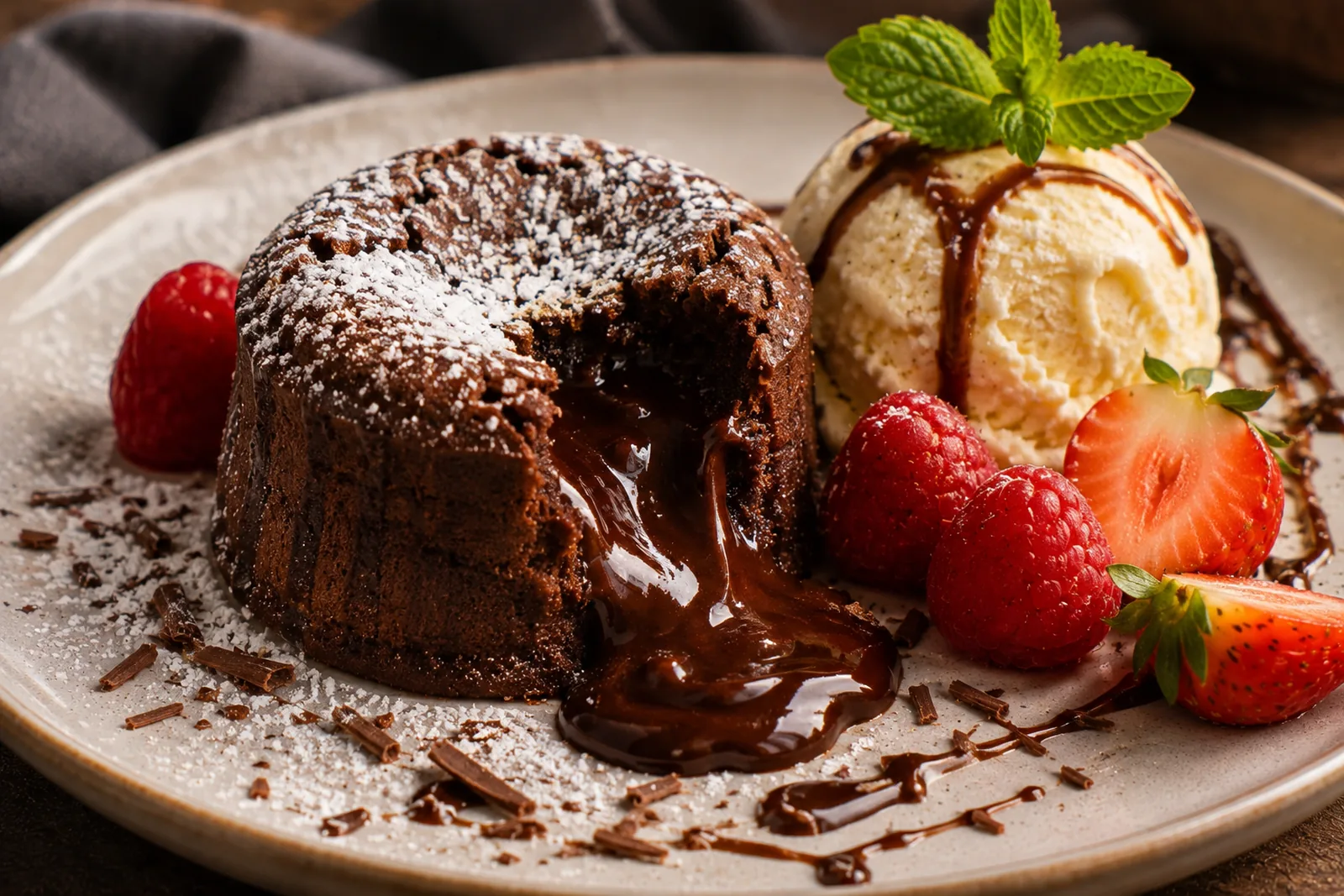
    Turned-out chocolate fondant on a white plate, broken open with a spoon so the dark, molten chocolate centre flows out, served with raspberries and a dollop of whipped cream.

    The secret is a short time in a hot oven. The edge has time to set while the middle is still creamy, and only a couple of minutes separate a molten centre from an ordinary, tasty chocolate cake. That is why two things need to be taken seriously: greasing the moulds properly so the cake comes out, and baking a test fondant before your guests arrive. No two ovens are alike, and the only baking time you can trust is the one you have seen for yourself.

    Method

    1. Grease the moulds. Brush the moulds with soft butter, base and sides, in strokes from the bottom upwards. Sprinkle in cocoa, turn the mould so everything is coated and tap out the excess. Put the moulds in the fridge while you make the batter. A second layer of butter gives extra insurance that the cake will come out.
    2. Melt the chocolate and butter. Break the chocolate into pieces and put it in a bowl with the butter, cut into pieces. Melt over a bain-marie on a low heat, or in the microwave in short bursts, stirring in between. Stir until smooth and let it cool a little, to roughly finger-warm.
    3. Whisk the eggs and sugar. Whisk the eggs, egg yolks, sugar and salt with an electric whisk for 4–5 minutes, until the mixture is pale, airy and thick.
    4. Fold together. Pour the chocolate into the egg mixture and gently fold together with a spatula. Sift in the flour and fold it in until it has only just disappeared. Don't stir more than necessary, or the air will be lost.
    5. Fill the moulds. Divide the batter between the moulds. They should be filled to about three quarters.
    6. Rest, chill or freeze. If the fondants are to be baked within an hour, they can stay out. Otherwise, cover them with cling film and put them in the fridge for up to 24 hours, or in the freezer for up to a month.
    7. Set the oven to 200°C, conventional heat, and let it get properly hot. Put the moulds on a baking tray.
    8. Bake. Put the tray in the middle of the oven. Allow 9–10 minutes for batter at room temperature, 11–13 minutes for batter straight from the fridge and 14–17 minutes for batter straight from the freezer. The fondant is ready when the edge is firm and has pulled away slightly from the mould, but the middle still wobbles when you gently nudge the tray.
    9. Rest and turn out. Leave the moulds to stand for a minute. Run a thin knife around the edge, place a plate on top and flip. Lift the mould straight up.
    10. Serve straight away with raspberries, cream or ice cream and a little flaky salt. The centre sets if the fondant is left to stand.

    Have you made this recipe? Rate it

    Be the first to rate this recipe.

    More recipes to try

    All recipes →
    • Chocolate fudge cake with vanilla ice cream, raspberries, blueberries, powdered sugar and chocolate sauce on a plate.

      Kladdkaka – classic recipe with a perfectly gooey center

      🍽️ about 8–10 pieces 🥕 9 ingredients 👣 10 steps

    • Bowl with three scoops of vanilla ice cream topped with orange sauce and bits of fruit.

      Vanilla Ice Cream with Warm Cloudberries – a Nordic dessert classic

      🍽️ 4 servings 🥕 3 ingredients 👣 5 steps

    • Golden French toast roll-ups coated in cinnamon sugar, one of them cut open to show the melted chocolate spread, arranged on a plate with strawberries.

      French toast roll-ups with Nutella – sandwich bread filled with chocolate spread, fried and rolled in cinnamon sugar

      🍽️ 4 servings, 12 rolls 🥕 12 ingredients 👣 11 steps

    • Round wooden board with sliced Christmas ham, smoked sausage, chunks of Prästost and Västerbotten cheese, gingerbread with blue cheese and fig jam, clementines, wholegrain mustard and sprigs of spruce.

      Christmas board with charcuterie and cheese – Christmas ham, Västerbotten cheese and gingerbread with blue cheese

      🍽️ 6 servings as a starter 🥕 17 ingredients 👣 9 steps

    Bake a test fondant

    This is the most important step, and it is done the day before or on the afternoon of New Year's Eve.

    • Make one extra mould, or take one of six and serve five large ones and a smaller one later.
    • Bake it the same way the others will be baked: from the fridge if they will be chilled, from the freezer if they will be frozen.
    • Check after 10 minutes (fridge) or 13 minutes (freezer) and then every minute.
    • Write down the time when the edge is firm and the middle wobbles. Turn it out and cut it open. If it runs too much, add a minute. If it is firm all the way through, take off a minute.

    That time applies to your particular oven and your moulds. Foil moulds heat up faster than thick porcelain ramekins, and a fondant in a small mould is ready sooner than one in a large mould.

    Timeline for New Year's Eve

    With the freezer, the week before:

    • Sunday 27 or Monday 28 December: make the batter, fill the moulds, cover with cling film and freeze. Make one extra mould and bake it as a test straight from the freezer the next day.
    • New Year's Eve: the moulds stay in the freezer. They should not be thawed.

    With the fridge, the day before:

    • Wednesday 30 December: make the batter, fill the moulds, cover and put in the fridge. Bake a test fondant.
    • New Year's Eve: the moulds stay in the fridge until they go into the oven.

    In the evening, whichever you chose:

    • When the main course is served: get out the plates, whip the cream and put the raspberries in a bowl.
    • When the main course has been eaten: set the oven to 200°C. It needs 10–15 minutes to heat up. If you use the oven for the main course, set it to 200°C when the main dish comes out.
    • When the oven is hot: in go the fondants, and set a timer. Clear the table while they bake.
    • When the timer goes off: rest for a minute, turn out and serve.

    Safety: eggs in a molten centre

    A molten centre means the middle of the fondant has not been fully heated through, and it contains egg. Salmonella in eggs dies almost instantly at around 70°C and more slowly at 65°C. The edge reaches that, but not always the middle.

    • Use Swedish eggs, or eggs from Norway, Finland or Denmark. Eggs from those countries are rarely infected with salmonella. Livsmedelsverket (the Swedish Food Agency) advises against using raw eggs from other countries.
    • Freezing does not kill salmonella. Frozen batter is just as raw as fresh.
    • Pregnant women, young children, older people and people with weakened immune systems can have a fondant baked 3–4 minutes longer, until the middle has set. It becomes a moist chocolate cake instead, and it is delicious with the same cream and raspberries. Another option is pasteurised eggs, which some shops stock.
    • Storage: batter in the fridge should be baked within 24 hours. Leftover baked fondants can be kept in the fridge and eaten the next day. The centre no longer runs, but it becomes like a kladdkaka (Swedish sticky chocolate cake).

    Allergens: the fondant contains egg, milk and gluten. Dark chocolate may contain traces of nuts and milk. For a gluten-free fondant, the flour can be swapped for the same amount of ground almonds or cornflour, but the baking time may change, so do a test bake.

    Tips for a fondant that comes out and runs

    • Good chocolate. The fondant is almost nothing but chocolate, butter and eggs, so it's the chocolate you taste. 55–70 per cent gives a dark but not bitter centre.
    • A hot oven. The oven should be fully preheated. In a lukewarm oven, the heat reaches the middle before the edge sets.
    • Cold batter gives you a margin. Batter from the fridge or freezer copes with an extra minute much better than batter at room temperature.
    • Better a minute too little. A slightly too runny fondant is still a dessert. One baked too long is a cake.
    • Turn them out quickly. If they stay in the mould for more than a couple of minutes, they keep baking.
    • Moulds that won't release: serve the fondant in the mould with a dollop of cream on top. It tastes just as good and looks intentional.

    Chocolate fondant with children

    Children usually love both making and eating chocolate fondant. They can brush butter into the moulds, sprinkle in cocoa and tap it out, weigh the sugar and spoon the batter into the moulds. An adult melts the chocolate, does the whisking and handles the oven, as the moulds get very hot.

    Fondant variations

    • With a surprise: press a piece of white chocolate, a teaspoon of peanut butter or a raspberry into the middle of each mould before chilling.
    • Orange: grate the zest of an orange into the batter. Goes nicely after duck breast.
    • Espresso: stir a teaspoon of instant coffee into the melted chocolate. You can barely taste the coffee, but the chocolate becomes deeper.
    • Chilli and flaky salt: a pinch of chilli flakes in the batter and flaky salt on top, for those who like some heat.
    • Cherry and cream: serve with cherry jam or cherry compote and cream.

    Common mistakes

    • Moulds not greased properly – the cake sticks and breaks when turned out.
    • Oven too cold – the heat reaches the middle before the edge is firm, and the centre sets.
    • No test bake – the baking time in recipes is a guide, not the truth for your oven.
    • Too much stirring when folding in the flour – the batter turns stodgy and doesn't rise.
    • Thawing frozen batter before baking – the edge and middle get equally hot and the centre doesn't run. Bake straight from the freezer.
    • Letting the fondant stand – the centre keeps setting in the mould.

    Frequently asked questions

    How long should chocolate fondant be in the oven?

    At 200°C, a fondant at room temperature takes 9–10 minutes, one straight from the fridge 11–13 minutes and a frozen one 14–17 minutes. Bake a test fondant first, as ovens and moulds vary.

    Can you freeze chocolate fondant?

    Yes. Fill the moulds, cover them with cling film and freeze them. They keep for about a month and should be baked straight from the freezer, without thawing, for 14–17 minutes.

    Can you make chocolate fondant the day before?

    Yes. Fill the moulds, cover them and put them in the fridge. Bake them within 24 hours, straight from the fridge, for 11–13 minutes.

    Why doesn't the centre run?

    Usually the fondant has been baked too long or at too low a temperature. The oven should be fully preheated to 200°C. Take off a minute next time, or bake the batter straight from the fridge.

    Why does my chocolate fondant break when I turn it out?

    The moulds haven't been greased properly or the fondant is underbaked. Brush on two layers of butter and dust with cocoa, and wait until the edge is firm and has pulled away slightly from the mould.

    Is it dangerous to eat chocolate fondant with a molten centre?

    The middle contains egg that hasn't been fully heated through. Use Swedish eggs, or eggs from Norway, Finland or Denmark. Pregnant women, young children and older people can have a fondant baked until the middle has set.

    More guides and recipes to read

    More for the New Year's Eve dinner

    The whole New Year's Eve menu

    Starters, mains and desserts you can prepare ahead – and a timeline for the whole of New Year's Eve.

    To the New Year's Eve menu

    Duck breast with cherry sauce first

    Pink duck breast with a glossy cherry and red wine sauce – and cherries go just as well with the chocolate afterwards.

    For the duck breast

    Homemade vanilla ice cream for the fondant

    Creamy vanilla ice cream made in advance and kept in the freezer – cold ice cream against warm chocolate is hard to beat.

    For the vanilla ice cream