Short answer
For the family's nights in a tent from summer to early autumn we recommend the Stormberg Padjelanta 3P tunnel tent, the Urberg G5 sleeping bag for adults and G6 for children, the Stormberg Regular sleeping pad, a tarp as a roof over camp and the Mardingtop 75L backpack. It is good down to a few degrees above zero. You don't need a stove or a winter sleeping bag until it starts to freeze.
The summer package
| Section | We recommend | Why |
|---|---|---|
| Tent | Stormberg Padjelanta 3P | 3.42 kg, two doors, vestibule for gear. Two adults and one or two small children |
| Adult sleeping bag | Urberg 3-season G5 | Comfort −2.3 °C, draught collar, three lengths |
| Child's sleeping bag | Urberg Kids G6 | Children up to 150 cm, 930 g. Summer and mild nights |
| Sleeping mats | Stormberg Regular | R about 2, foot pump, 580 g. Goes well with the G5 |
| Roof | Toprunyi tarp | About 3 × 3 m over the kitchen and seating area |
| Backpack | Mardingtop 75L | Everything fits, MOLLE for what hangs on the outside |
| Stove | Trangia 25-3 UL | Cooks for 3–4, works in wind |
The best thing about summer camping is that you don't need much. A good tent, warm sleeping bags, something to lie on and a roof over the eating area go a long way. Here is the gear we recommend for the family's nights in a tent from Midsummer to September. Everything comes from our gear, and each part has its own page with all the details.
How the parts fit together
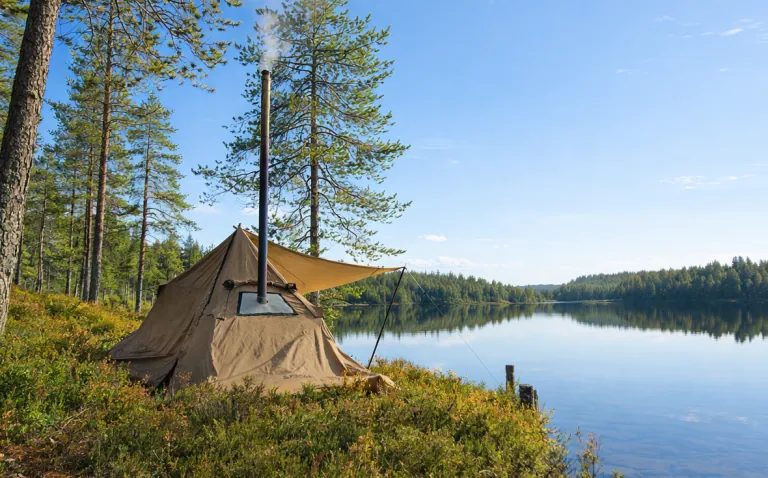
The tent. Stormberg Padjelanta 3P is a light tunnel tent with two doors and a vestibule where backpacks and shoes go. It is perfect for two adults and one or two small children.
The sleeping bags. Urberg G5 has a comfort rating down to −2.3 °C and is enough for most nights from May to September. The children sleep in Urberg G6, a child-size sleeping bag that a child warms up faster than a big adult bag.
The pad. A sleeping bag only warms from above. Stormberg Regular has an R-value of around 2 and goes with the G5 on a cool autumn night. On a warm July night the wider Hex is enough. We explain the difference in which sleeping pad.
The roof. The Toprunyi tarp stretched between two trees makes rain a minor matter. The kitchen and seating area end up under cover, and nobody has to squeeze into the tent.
The kitchen and the backpack. Trangia 25-3 UL cooks for the whole family, and everything is carried in Mardingtop 75L, where everything fits.
How cold can it handle?
With the G5 on the Regular pad you sleep well down to a few degrees above zero. Put a thin foam pad underneath and sleep in dry base layers and a hat, and you will manage a frosty night in September. Below zero you need a warmer sleeping bag and pad, and then it is the cold-night package that applies.
The child's bag G6 has no standardised temperature test. Think of it as a summer bag. Feel the child's neck, not their hands, to know whether it is warm enough.
This can stay at home
- Stove and hot tent. Not until it really freezes.
- Winter sleeping bag. Too heavy and warm for a summer night.
- The big power bank. If nobody is charging a computer on the trip, a small one is enough.
Pack the rest
The gear is the foundation. Clothes, food and small items are in the packing list for tent camping, and if the children are coming along there is a separate packing list for camping with children.
Frequently asked questions
What does a family need to camp in summer?
A tent with room for everyone, a sleeping bag and sleeping pad per person, a stove, something to carry it in and preferably a tarp as a roof. The rest is clothes, food and the things on the packing list.
How cold can the package handle?
The Urberg G5 sleeping bag has a comfort rating of −2.3 °C and the Regular pad an R-value of around 2. That is enough for most summer and September nights. When it starts to freeze you need a warmer pad and sleeping bag, and then it is the cold-night package that applies.
Why Regular and not Hex?
The Regular has an R-value of around 2 and goes with the G5 on a cool autumn night. The Hex is wider and comfortable on a warm July night, but insulates less when the ground is cold.
Do you need a tarp?
You don't need one, but it makes camp much better when it rains. With a tarp stretched between two trees you can cook and sit outside even in the rain, instead of squeezing into the tent.