
Short answer
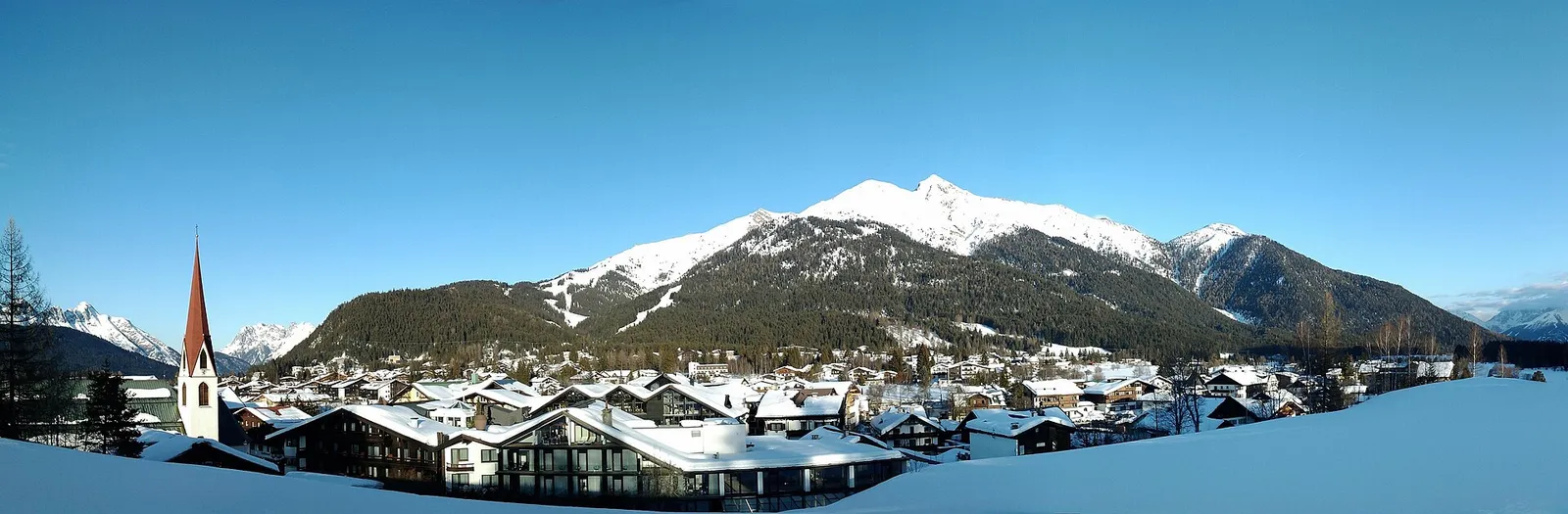
Seefeld sits on a sunny high plateau at 1,200 metres, half an hour by train from Innsbruck. The downhill skiing is small but friendly – around 31 kilometres of pistes in five areas, mostly blue – and the cross-country network is one of the largest in the Alps, at 245 kilometres. Children use the cross-country trails free of charge up to age 15, and the centre is a pedestrian street a few minutes from the station.
Quick facts
- Country / region
- Austria, Tyrol (Olympiaregion Seefeld)
- Ski area
- Happy Ski Card – Rosshütte, Gschwandtkopf, Geigenbühel, Birkenlift and Katzenkopf
- Altitude (village – top)
- 1,180 – 2,064 m above sea level
- Pistes
- 31 km
- Lifts
- 33
- Season
- early December – mid-March (Gschwandtkopf and Katzenkopf longer)
- Nearest airports
- Innsbruck (approx. 30 min)
- Train
- Karwendelbahn from Innsbruck Hbf to Seefeld, about 36 minutes
- Price level
- ●●●●● (1 = cheap, 5 = expensive)
Family rating
4 / 5
- Beginner slopes Almost all blue, a fenced children's area at Rosshütte and magic carpets at Gschwandtkopf, Geigenbühel and Birkenlift.
- Children's lift passes A separate, cheaper category for children up to age five, but no free lift passes. The cross-country trails are free up to age 15.
- Without a car Trains from Innsbruck, a pedestrian street in the centre and a free ski bus with the guest card.
- More than skiing 245 km of cross-country trails, a floodlit evening trail, evening sledging in Leutasch and evening skiing at Rosshütte on Fridays.
- A challenge for older children Only a few kilometres of red and black. Teenagers who want to ski a lot will soon have done it all.
The rating is our overall assessment for families with children based on the criteria above – not a paid placement.
Seefeld is not the resort you choose for the piste kilometres. It is the resort you choose when the children are small, when someone in the family would rather ski cross-country than downhill, and when you want to do without the car all week. The village sits on a sunny high plateau above Innsbruck, with five small ski areas around it and one of the largest networks of cross-country trails in the Alps right outside the door.
Here we sort out which area suits which age, how lift passes work for children and why the train is the smartest way to get here. If you want to compare with other resorts in the country, see skiing holidays in Austria.
Five small areas instead of one big one
Region Seefeld has around 31 kilometres of pistes and 33 lifts spread across five areas. All of them are included in the Happy Ski Card. It doesn't sound like much, but for a family with children between three and ten it is plenty – almost everything is blue.
| Area | Best for | Good to know |
|---|---|---|
| Rosshütte | The whole family | The largest area, up to 2,064 metres, with a children's area and evening skiing |
| Gschwandtkopf | Beginners and small children | All blue, close to the centre, ski bus with the guest card |
| Geigenbühel | The very youngest | A few minutes' walk from the centre, magic carpets and ski school |
| Birkenlift | The first days on skis | Magic carpets and the Birky’s Magical Land children's area |
| Katzenkopf (Leutasch) | Sledging and easy runs | Floodlit sledging hill three evenings a week |
Rosshütte is the main area. A funicular runs up from Seefeld, and from there the lifts continue towards Seefelder Joch and Härmelekopf. The area stretches from 1,230 to 2,064 metres and has just under 18 kilometres of pistes, most of them blue and only a kilometre or so black.
Gschwandtkopf is the small rounded hill opposite, between 1,160 and 1,470 metres. Here there is a four-seater chairlift, a row of drag lifts and the child-friendly Happy Schleppi lift and a magic carpet at Pfarrhügel. The family run is 1.7 kilometres long – a perfect first proper run for a child who has just learnt the snowplough turn.
Children's areas and ski school
Sportis Kinderland at Rosshütte is a fenced practice area of 20,000 square metres, separate from the main slope. It has three fully covered magic carpets and a platter lift, plus a slalom course with easy obstacles. Only skiers are let in – no walkers, sledges or pushchairs – which keeps the area calm for the youngest. There is a separate, cheaper lift pass for the children's area alone, if a full-day pass feels unnecessary.
At Geigenbühel, the ski school Snowsport Seefeld has four magic carpets with different gradients and a practice lift. The youngest pupils are taken from age three, and there is a lunch club where the children eat and warm up in the middle of the day. Other ski schools have meeting points at Gschwandtkopf and Rosshütte, and several of them have groups for the youngest from age three and regular children's groups from about age five. Check the age limit with the school you book.
For older children who want a bit of speed, there is the Crazy Hole snow park at Rosshütte, with jumps and big airbags to land in. Read our guide to ski trips with children, too, for how to plan the days.
Children's lift passes 2026/27
Seefeld has no free lift passes for the youngest, which is worth knowing before you compare it with resorts where children under six ski free. The Happy Ski Card has four age groups:
- The youngest (up to age five): a separate category that costs less than the children's pass.
- Children: 6–15 years.
- Youth: 16–18 years.
- Adults: from age 19.
The age limits vary slightly between the areas, so bring passports or ID cards. During two periods in the 2026/27 season, 8–24 January and 1–14 March 2027, the Happy Ski Card is cheaper if you buy in advance – by 15 December and 15 February respectively. Current prices are shown when you book.
Cross-country skiing – Seefeld's great strength
Seefeld has hosted the Nordic World Ski Championships twice, in 1985 and 2019. The trail network on the plateau covers 245 kilometres, both classic and skate, and stretches between Seefeld, Leutasch, Mösern, Reith and Scharnitz.
For families there are several short, almost flat loops:
- A1 Seekirchl – 3.1 kilometres around the little baroque chapel, floodlit Monday to Friday, 17–20:30.
- A3 Torfstich – 1.8 kilometres with hardly any climbing.
- A10 Weidach – 1.7 kilometres, a good first outing.
- A11 Bodenalm – 10.7 kilometres for anyone who wants to make a full day of it with a packed lunch.
There are five practice areas: two at Seekirchl, two at Arena 365 and one at the Alpenbad in Leutasch. Adults need a trail pass – it is cheaper with the guest card – but children ski free until their 15th birthday. In Leutasch you can hire a pulk to tow behind you if your children are too small for skis of their own. If you are considering a pure cross-country week, compare it with the mountain set-up in Sjusjøen.
The pedestrian street and the evenings
Seefeld has one of Tyrol's first pedestrian streets, with over 60 shops, cafés and restaurants around the late Gothic church of St. Oswald. So the heart of the village is car-free, and from there it is only a few minutes' walk to the children's slopes at Geigenbühel.
There is more to the evenings than dinner. Rosshütte has evening skiing on Fridays on floodlit slopes, with its own evening pass or as an add-on to the day pass. At Katzenkopf in Leutasch, the sledging hill is floodlit on Tuesday, Thursday and Saturday evenings, 18–20, and the hut at the top stays open afterwards.
Getting there
- By train: Seefeld is on the Karwendelbahn (Mittenwaldbahn), Austria's first fully electrified railway, dating from 1912. From Innsbruck Hbf the journey takes around 36 minutes, and the line climbs 650 vertical metres along the Martinswand rock face. The same line continues towards Mittenwald and Garmisch-Partenkirchen. How night trains and changes work from Sweden is explained in train to the Alps – how it works.
- By air: Innsbruck is the closest. Munich has more departures from Sweden and onward trains via Garmisch or Innsbruck.
- By car: not needed once you are there. Read more about the options in car, train or plane to the ski resort.
The guest card is valid on the regional buses and on the train between Seefeld and Scharnitz, and the Yellow and Blue ski buses to Gschwandtkopf and Rosshütte are free with a guest card, a lift pass or ski gear.
Good to know
- The season 2026/27: Rosshütte 4 December–14 March, Gschwandtkopf 11 December–21 March, Geigenbühel 12 December–14 March, Birkenlift 18 December–14 March and Katzenkopf 19 December–31 March.
- The high plateau is at around 1,200 metres and gets plenty of sun. That means bright days, but late in March the lowest slopes can turn slushy in the afternoon.
- Older children who already ski reds all day will soon have done it all here. Then Stubaital with its glacier or Oberstdorf is a better fit.
Don't forget the ski trip packing list, and plan your meals with the recipes for a whole ski week if you are staying in an apartment.
Packing for Seefeld – the things that are easy to forget
Frequently asked questions
Is Seefeld good for families with small children?
Yes, especially for beginners and families who want to combine downhill with cross-country skiing. Almost all the pistes are blue, Gschwandtkopf and Geigenbühel are close to the centre, and Rosshütte has a large fenced children's area. Anyone who already skis red pistes all day, on the other hand, will have done the whole area in a couple of days.
Do small children ski free in Seefeld?
Not on the lifts. The Happy Ski Card has a separate, cheaper category for the youngest up to age five, then a children's pass for 6–15 and a youth pass for 16–18. The cross-country trails, however, are free for children until their 15th birthday.
Where do children learn to ski in Seefeld?
Sportis Kinderland at Rosshütte is a fenced area of 20,000 square metres with three covered magic carpets and a platter lift. At Geigenbühel, a few minutes from the centre, the Snowsport Seefeld ski school takes children from age three and has a lunch club for them.
How long is the 2026/27 ski season in Seefeld?
Rosshütte opens on 4 December 2026 and stays open until 14 March 2027. Gschwandtkopf's season runs 11 December–21 March, Geigenbühel's 12 December–14 March and Katzenkopf's in Leutasch 19 December–31 March.
Do you need a car in Seefeld?
No. The train from Innsbruck takes around half an hour, the centre is a pedestrian street and the ski buses to Gschwandtkopf and Rosshütte are free with a guest card, a lift pass or ski gear. The guest card is also valid on the regional buses and the train between Seefeld and Scharnitz.
Does cross-country skiing cost anything in Seefeld?
Adults need a trail pass, which is cheaper with the guest card. Children ski free until their 15th birthday. There are day passes, multi-day passes and season passes – the season pass includes, among other things, the train journey from Innsbruck.


